Department of Neurology, University of Erlangen-Nuremberg, Schlossplatz 4, 91054, Erlangen, Germany.
Icahn School of Medicine at Mount Sinai, New York, NY, USA.
Neurol Sci. 2022 Jan;43(1):365-371. doi: 10.1007/s10072-021-05764-4. Epub 2021 Nov 25.
The Composite Autonomic Symptom Score 31 (COMPASS 31) is a validated, 31-item self-assessment questionnaire assessing autonomic symptoms in six domains, orthostatic intolerance, vasomotor, secretomotor, gastrointestinal, bladder, and pupillomotor function. So far, there is no validated German COMPASS 31 version. This study aimed at developing and validating a German COMPASS 31.
Two autonomic experts with command of German and English independently translated the English COMPASS 31 into German. One agreed-upon German version was translated back into English to assure conformity with the original version. Twenty patients with possible autonomic symptoms and 20 age- and gender-matched healthy persons completed the English and German COMPASS 31 in a randomized order with a 4-week interval. To evaluate reliability of the German COMPASS 31, total scores and sub-scores of the domains assessed with the German version were correlated with corresponding scores of the English version using Pearson's or Spearman's test. The Cronbach alpha-coefficient evaluated the internal consistency of the questions. Total- and sub-scores of both COMPASS 31 versions were compared between patients and controls by analysis of variance with post-hoc analysis (significance: p < 0.05).
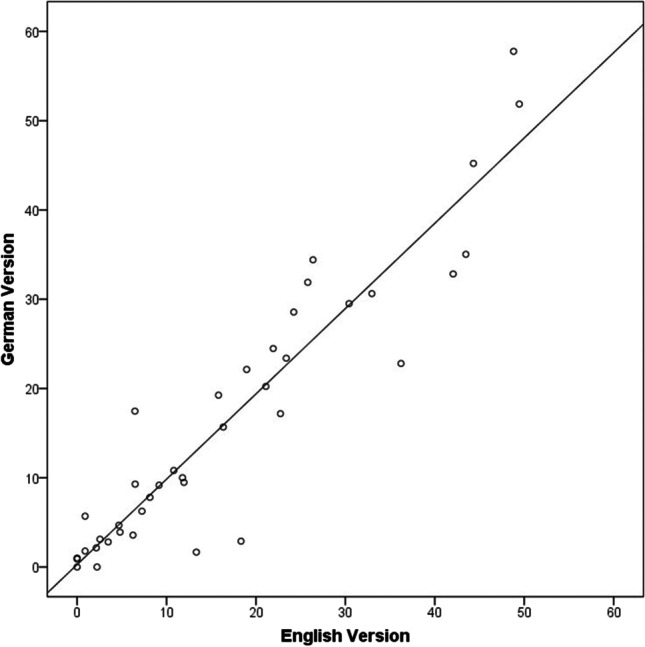
Total scores and sub-scores of the German and English COMPASS 31 correlated significantly (p < 0.001) and closely (correlation coefficients: 0.757-0.934). Cronbach alpha-coefficients were above 0.7 in all domains except for the secretomotor domain. In the German and English COMPASS 31, total scores were significantly higher in patients than controls.
The German COMPASS 31 is reliable, internally consistent, and valid to detect and quantify autonomic symptoms in patients with neurological disorders.
复合自主症状评分 31 项(COMPASS 31)是一种经过验证的 31 项自我评估问卷,用于评估六个领域的自主症状,包括体位不耐受、血管运动、分泌运动、胃肠道、膀胱和瞳孔运动功能。到目前为止,还没有经过验证的德语 COMPASS 31 版本。本研究旨在开发和验证德语 COMPASS 31。
两位精通德语和英语的自主专家分别将英语 COMPASS 31 翻译成德语。一份经双方同意的德语版本被回译成英语,以确保与原文一致。20 名可能有自主症状的患者和 20 名年龄和性别匹配的健康人以随机顺序在 4 周间隔内完成了英语和德语 COMPASS 31。为了评估德语 COMPASS 31 的可靠性,使用 Pearson 或 Spearman 检验将用德语版本评估的各域的总分和子评分与英语版本的相应评分相关联。问题的克朗巴赫 alpha 系数评估了内部一致性。通过方差分析和事后分析比较两种 COMPASS 31 版本的患者和对照组的总分和子评分(显著性:p < 0.05)。
德语和英语 COMPASS 31 的总分和子评分显著相关(p < 0.001)且相关性高(相关系数:0.757-0.934)。除了分泌运动域之外,所有域的克朗巴赫 alpha 系数均高于 0.7。在德语和英语 COMPASS 31 中,患者的总分明显高于对照组。
德语 COMPASS 31 可靠、内部一致且有效,可用于检测和量化神经系统疾病患者的自主症状。