U.O.C. Neurologia - Ospedale S. Maria delle Croci, AUSL Romagna - ambito di Ravenna, Ravenna, Italy.
Dipartimento di Scienze Biomediche e Neuromotorie, Università di Bologna, Bologna, Italy.
Neurol Sci. 2021 Apr;42(4):1395-1403. doi: 10.1007/s10072-020-04620-1. Epub 2020 Aug 10.
Dysautonomic symptoms (DS) are frequent but often underrecognized in multiple sclerosis (MS) patients, despite the relevant impact on quality of life and physical performance.
To assess frequency and characteristics of DS in our MS population compared with healthy controls (HC). To investigate the relationship between DS and disease characteristics (MS subtype, disease duration, Expanded Disability Status Scale (EDSS), clinical and/or radiological activity, disability progression).
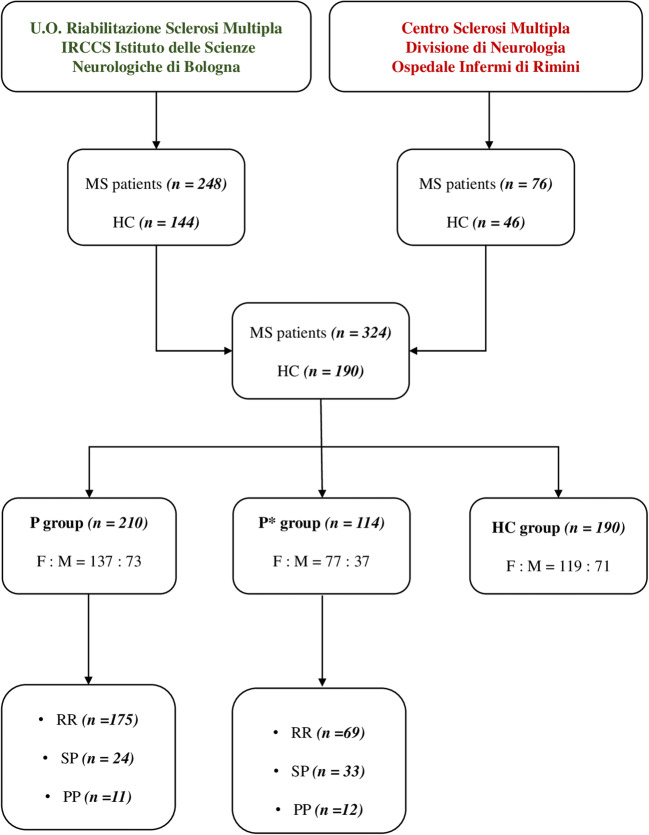
Cross-sectional study includes 324 MS patients (mean age 44.9 ± 10.7 years; 66% female) and 190 HC (mean age 40.60 ± 12.83 years; 63% female). DS were assessed using the Italian validated version of the Composite Autonomic Symptom Score-31 (COMPASS-31). Possible confounding factors were considered.
More than 94% of enrolled MS patients reported alterations in ≥ 2 domains of the COMPASS-31 scale (score > 0) and significantly higher COMPASS-31 total and single domain median scores compared with HC, independently from possible confounding factors (orthostatic intolerance: p = 0.001; vasomotor: p = 0.017; secretomotor: p = 0.040; gastrointestinal: p = 0.047; bladder: p < 0.001; pupillomotor: p < 0.001; COMPASS-31 total score: p < 0.001). COMPASS-31 total, secretomotor, gastrointestinal, and bladder domain scores showed weak to moderate correlation with disease duration (Rho = 0.19, p < 0.001; Rho = 0.18, p = 0.01; Rho = 0.25, p = 0.030; Rho = 0.28, p < 0.001, respectively). A moderate correlation between EDSS score, COMPASS-31 total, and bladder domain scores (Rho = 0.32, p < 0.001 and Rho = 0.48, p < 0.001, respectively) was observed. Progressive subtypes showed higher COMPASS-31 total (p = 0.025), gastrointestinal (p = 0.07), and bladder (p < 0.001) domain scores vs relapsing-remitting patients.
Our findings confirm that MS-related DS are frequent and tend to increase paralleling disease duration and clinical worsening, reaching the highest clinical impact in progressive subtypes.
自主神经症状(DS)在多发性硬化症(MS)患者中很常见,但往往未被识别,尽管这对生活质量和身体机能有相关影响。
评估我们的 MS 患者群体中 DS 的频率和特征,并与健康对照组(HC)进行比较。探讨 DS 与疾病特征(MS 亚型、疾病持续时间、扩展残疾状态量表(EDSS)、临床和/或影像学活动、残疾进展)之间的关系。
这是一项横断面研究,纳入了 324 名 MS 患者(平均年龄 44.9±10.7 岁;66%为女性)和 190 名 HC(平均年龄 40.60±12.83 岁;63%为女性)。使用意大利验证的复合自主症状评分-31 版(COMPASS-31)评估 DS。考虑了可能的混杂因素。
超过 94%的入组 MS 患者报告在 COMPASS-31 量表的≥2 个领域存在改变(评分>0),且与 HC 相比,COMPASS-31 总分和单个领域的中位数评分显著更高,这与可能的混杂因素无关(直立不耐受:p=0.001;血管运动:p=0.017;分泌运动:p=0.040;胃肠道:p=0.047;膀胱:p<0.001;瞳孔运动:p<0.001;COMPASS-31 总分:p<0.001)。COMPASS-31 总分、分泌运动、胃肠道和膀胱领域评分与疾病持续时间呈弱至中度相关(Rho=0.19,p<0.001;Rho=0.18,p=0.01;Rho=0.25,p=0.030;Rho=0.28,p<0.001,分别)。EDSS 评分、COMPASS-31 总分和膀胱领域评分之间存在中度相关性(Rho=0.32,p<0.001 和 Rho=0.48,p<0.001,分别)。与复发缓解型患者相比,进展型患者的 COMPASS-31 总分(p=0.025)、胃肠道(p=0.07)和膀胱(p<0.001)领域评分更高。
我们的研究结果证实,MS 相关的 DS 很常见,且随着疾病持续时间和临床恶化而趋于增加,在进展型亚型中达到最高的临床影响。