School of Physical Education, Chongqing University, Chongqing, China.
School of Physical Education, Huaibei Normal University, Huaibei, China.
BMC Psychol. 2024 Feb 26;12(1):99. doi: 10.1186/s40359-024-01558-3.
This study explores the relationship between physical health beliefs and physical exercise behavior intention of college students and constructs a mediation model through the mediation role of exercise imagery.
Using the stratified cluster sampling method, 1356 college students were measured in group psychology by using the Physical Health Beliefs Scale, Exercise Imagery Inventory, and Physical Exercise Behavior Intention Scale. The statistical software Mplus 8.1, SPSS 22.0 and SPSS PROCESS 3.3 were used for statistical processing. The common method deviation test was carried out by Harman single-factor control method. Finally, the bootstrap sampling test method and process plug-in were used to test the significance of intermediary effect.
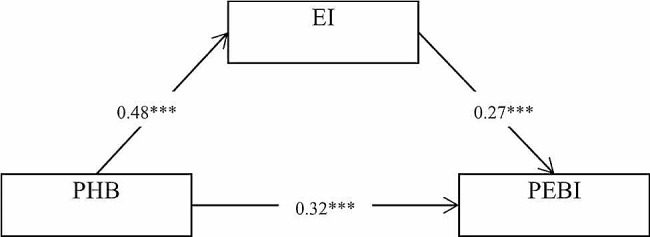
(1) physical health beliefs have a significant predictive effect on physical exercise behavior intention (β = 0.32, p < 0.001); (2) exercise imagery (β = 0.13, p < 0.001) mediate the relationship between physical health beliefs and physical exercise behavior intention (physical health beliefs → exercise imagery → physical exercise behavior intention (95% Cl: 0.14, 0.32)).
physical health beliefs can directly improve the physical exercise behavior intention of college students, which can also affect college students' physical exercise behavior intention indirectly through exercise imagery. The findings suggest that exercise imagery are important variables that mediate the effect of the college students' physical health beliefs on their physical exercise behavior intention.
本研究探讨了大学生身体健康信念与身体锻炼行为意向之间的关系,并通过锻炼意象的中介作用构建了一个中介模型。
采用分层整群抽样方法,对 1356 名大学生进行团体心理测试,采用身体健康信念量表、锻炼意象量表和身体锻炼行为意向量表进行测试。采用 Mplus 8.1、SPSS 22.0 和 SPSS PROCESS 3.3 统计软件进行统计处理。采用 Harman 单因素控制法进行共同方法偏差检验。最后,采用 bootstrap 抽样检验方法和过程插件检验中介效应的显著性。
(1)身体健康信念对身体锻炼行为意向有显著的预测作用(β=0.32,p<0.001);(2)锻炼意象(β=0.13,p<0.001)中介了身体健康信念与身体锻炼行为意向之间的关系(身体健康信念→锻炼意象→身体锻炼行为意向(95% Cl:0.14,0.32))。
身体健康信念可以直接提高大学生的身体锻炼行为意向,也可以通过锻炼意象间接影响大学生的身体锻炼行为意向。研究结果表明,锻炼意象是中介大学生身体健康信念对身体锻炼行为意向影响的重要变量。