Beijing Friendship Hospital, Capital Medical University, Beijing, China
Inquiry. 2024 Jan-Dec;61:469580241235755. doi: 10.1177/00469580241235755.
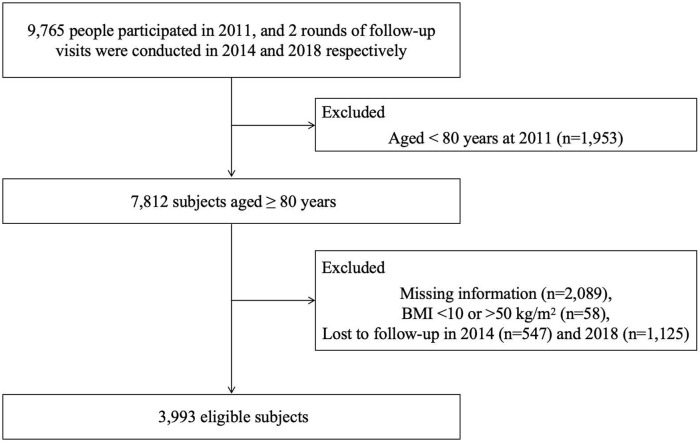
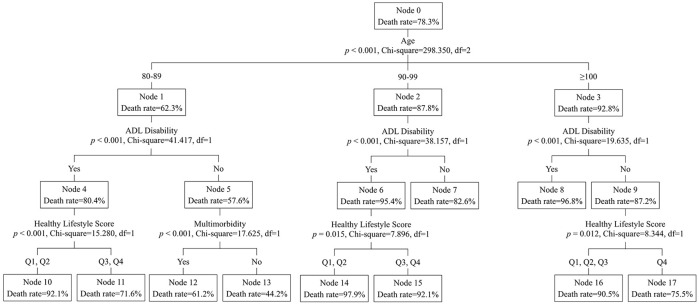
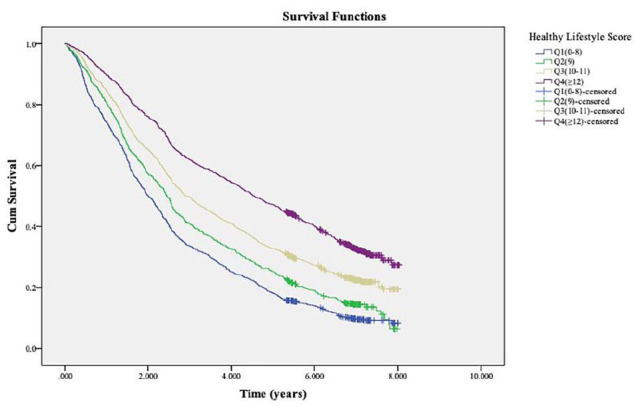
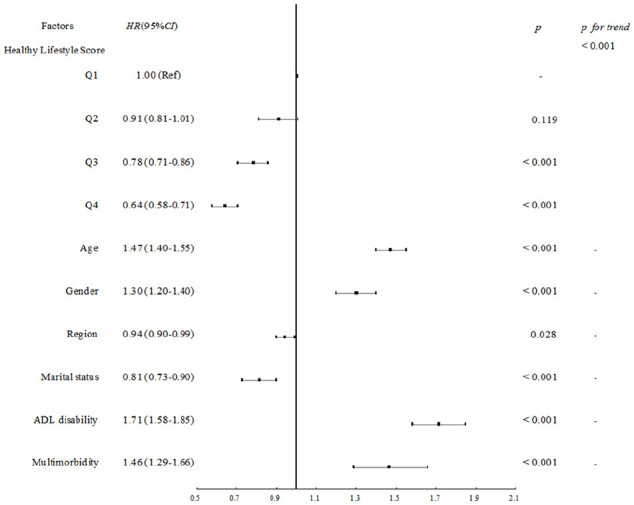
To identify key factors affecting all-cause mortality in the elderly aged 80 years and above. Data from Chinese Longitudinal Healthy Longevity Survey (2011-2018) were utilized ( = 3993). A healthy lifestyle score was obtained by assigning 8 factors: smoking, drinking, exercise, sleep duration, social activity, waist circumference, BMI, and healthful plant-based diet index. Cox regression and decision tree model were used to identify factors influencing the mortality risk. Lifestyle and activities of daily living (ADL) were 2 of the most important modifiable factors influencing the mortality risk of the oldest seniors. A higher healthy lifestyle score was associated with lower mortality risk. The (95% ) of death risk in Q2, Q3, and Q4 groups were 0.91 (0.81-1.01), 0.78 (0.71-0.86), and 0.64 (0.58-0.71), respectively, when compared with the Q1 group of healthy lifestyle score. Elderly with ADL disability had a higher mortality rate than those without ADL disability. When the elderly already have ADL disability, the healthier the lifestyle, the lower the mortality rate. Among individuals aged 80 to 89 years with ADL disability, the mortality rate was higher in the healthy lifestyle score Q1-Q2 groups (92.1%) than that in the Q3-Q4 groups (71.6%). Similar results were observed among subjects aged 90 to 99 years with ADL disability (Q1-Q2: 97.9%, Q3-Q4: 92.1%). For centenarians without ADL disability, maintaining a healthy lifestyle significantly reduced mortality (Q1-Q3: 90.5%, Q4: 75.5%). Caregivers should prioritize the consideration of lifestyle and ADL in their healthcare practices of the oldest old.
为了确定影响 80 岁及以上老年人全因死亡率的关键因素。利用中国长寿纵向研究(2011-2018 年)的数据(n=3993)。通过分配 8 个因素来获得健康生活方式评分:吸烟、饮酒、运动、睡眠时间、社交活动、腰围、BMI 和健康植物性饮食指数。使用 Cox 回归和决策树模型确定影响死亡率风险的因素。生活方式和日常生活活动(ADL)是影响最年长老年人死亡率风险的两个最重要的可改变因素。更高的健康生活方式评分与更低的死亡率风险相关。与健康生活方式评分 Q1 组相比,Q2、Q3 和 Q4 组的死亡风险(95%)分别为 0.91(0.81-1.01)、0.78(0.71-0.86)和 0.64(0.58-0.71)。有 ADL 残疾的老年人死亡率高于没有 ADL 残疾的老年人。当老年人已经有 ADL 残疾时,生活方式越健康,死亡率越低。在有 ADL 残疾的 80-89 岁人群中,健康生活方式评分 Q1-Q2 组(92.1%)的死亡率高于 Q3-Q4 组(71.6%)。在有 ADL 残疾的 90-99 岁人群中也观察到类似的结果(Q1-Q2:97.9%,Q3-Q4:92.1%)。对于没有 ADL 残疾的百岁老人,保持健康的生活方式可以显著降低死亡率(Q1-Q3:90.5%,Q4:75.5%)。护理人员在为最年长老年人提供医疗保健时,应优先考虑生活方式和 ADL。