The Wellcome Centre for Cell Biology, Institute of Cell Biology, University of Edinburgh, Edinburgh, EH9 3BF, UK.
Centre for Gene Regulation and Expression, School of Life Sciences, University of Dundee, Dundee, DD1 5EH, UK.
EMBO J. 2024 Apr;43(7):1351-1383. doi: 10.1038/s44318-024-00059-8. Epub 2024 Feb 27.
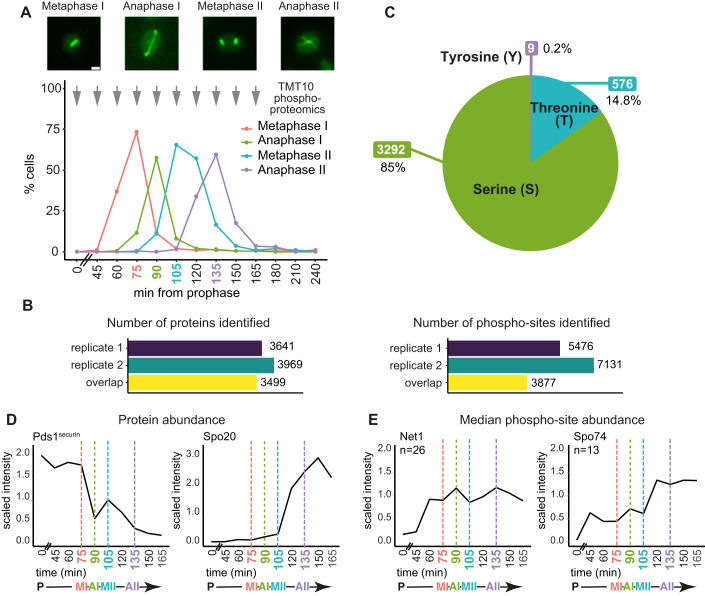
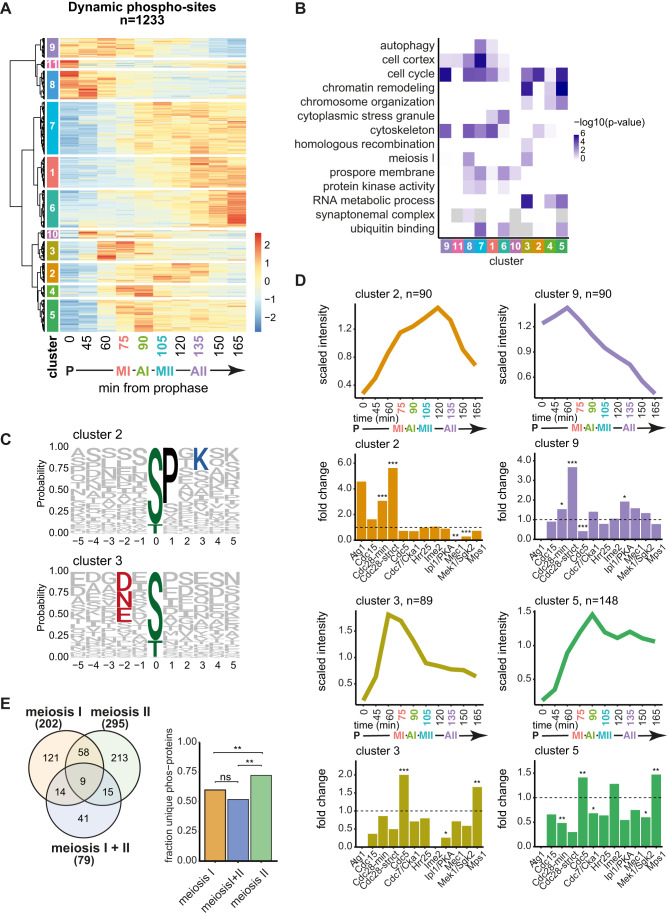
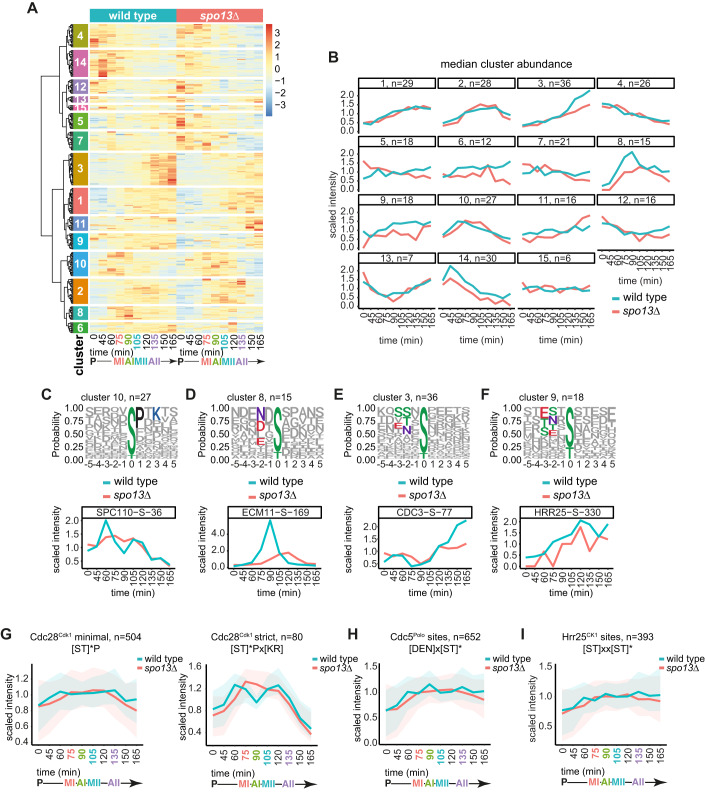
The cell cycle is ordered by a controlled network of kinases and phosphatases. To generate gametes via meiosis, two distinct and sequential chromosome segregation events occur without an intervening S phase. How canonical cell cycle controls are modified for meiosis is not well understood. Here, using highly synchronous budding yeast populations, we reveal how the global proteome and phosphoproteome change during the meiotic divisions. While protein abundance changes are limited to key cell cycle regulators, dynamic phosphorylation changes are pervasive. Our data indicate that two waves of cyclin-dependent kinase (Cdc28) and Polo (Cdc5) kinase activity drive successive meiotic divisions. These two distinct phases of phosphorylation are ensured by the meiosis-specific Spo13 protein, which rewires the phosphoproteome. Spo13 binds to Cdc5 to promote phosphorylation in meiosis I, particularly of substrates containing a variant of the canonical Cdc5 motif. Overall, our findings reveal that a master regulator of meiosis directs the activity of a kinase to change the phosphorylation landscape and elicit a developmental cascade.
细胞周期由一系列受调控的蛋白激酶和磷酸酶来控制。为了通过减数分裂产生配子,会发生两次不同的、连续的染色体分离事件,其间没有 S 期。对于减数分裂来说,经典的细胞周期调控是如何被修饰的,目前还不是很清楚。在这里,我们使用高度同步的出芽酵母群体,揭示了在减数分裂过程中全局蛋白质组和磷酸化蛋白质组的变化。虽然蛋白质丰度的变化仅限于关键的细胞周期调控因子,但动态磷酸化变化是普遍存在的。我们的数据表明,两个波的细胞周期蛋白依赖性激酶(Cdc28)和 Polo(Cdc5)激酶活性驱动连续的减数分裂。这两个不同的磷酸化阶段由减数分裂特异性的 Spo13 蛋白来保证,该蛋白重新构建了磷酸化蛋白质组。Spo13 与 Cdc5 结合,促进减数分裂 I 中的磷酸化,特别是那些含有经典 Cdc5 基序变体的底物。总的来说,我们的研究结果揭示了减数分裂的主要调控因子指导激酶的活性改变磷酸化图谱,并引发发育级联反应。