Taylor Matthew K, Burns Jeffrey M, Choi In-Young, Herda Trent J, Lee Phil, Smith Aaron N, Sullivan Debra K, Swerdlow Russell H, Wilkins Heather M
Department of Dietetics and Nutrition, University of Kansas Medical Center, Kansas City, KS, 66160, USA.
Alzheimer's Disease Research Center, University of Kansas, Fairway, KS, 66205, USA.
Pilot Feasibility Stud. 2024 Feb 27;10(1):42. doi: 10.1186/s40814-024-01469-5.
Impaired brain bioenergetics is a pathological hallmark of Alzheimer's disease (AD) and is a compelling target for AD treatment. Patients with AD exhibit dysfunction in the brain creatine (Cr) system, which is integral in maintaining bioenergetic flux. Recent studies in AD mouse models suggest Cr supplementation improves brain mitochondrial function and may be protective of AD peptide pathology and cognition.
The Creatine to Augment Bioenergetics in Alzheimer's disease (CABA) study is designed to primarily assess the feasibility of supplementation with 20 g/day of creatine monohydrate (CrM) in patients with cognitive impairment due to AD. Secondary aims are designed to generate preliminary data investigating changes in brain Cr levels, cognition, peripheral and brain mitochondrial function, and muscle strength and size.
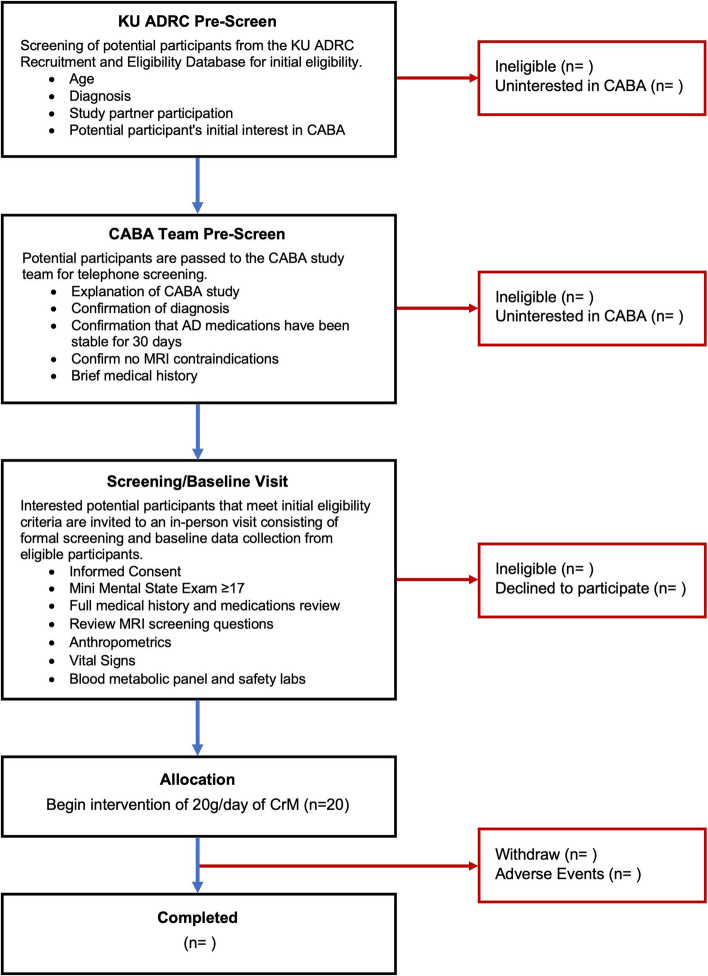
CABA is an 8-week, single-arm pilot study that will recruit 20 patients with cognitive impairment due to AD. Participants attend five in-person study visits: two visits at baseline to conduct screening and baseline assessments, a 4-week visit, and two 8-week visits. Outcomes assessment includes recruitment, retention, and compliance, cognitive testing, magnetic resonance spectroscopy of brain metabolites, platelet and lymphocyte mitochondrial function, and muscle strength and morphology at baseline and 8 weeks.
CABA is the first study to investigate CrM as a potential treatment in patients with AD. The pilot data generated by this study are pertinent to inform the design of future large-scale efficacy trials.
ClinicalTrials.gov, NCT05383833 , registered on 20 May 2022.
脑生物能量代谢受损是阿尔茨海默病(AD)的病理标志,也是AD治疗的一个极具吸引力的靶点。AD患者的脑肌酸(Cr)系统功能失调,而该系统在维持生物能量通量中不可或缺。最近对AD小鼠模型的研究表明,补充Cr可改善脑线粒体功能,并可能对AD肽病理和认知具有保护作用。
阿尔茨海默病中补充肌酸增强生物能量代谢(CABA)研究旨在主要评估每日补充20克一水肌酸(CrM)对AD所致认知障碍患者的可行性。次要目的是生成初步数据,研究脑Cr水平、认知、外周和脑线粒体功能以及肌肉力量和大小的变化。
CABA是一项为期8周的单臂试点研究,将招募20名AD所致认知障碍患者。参与者需参加五次现场研究访视:两次基线访视以进行筛查和基线评估、一次4周访视以及两次8周访视。结果评估包括招募、保留率和依从性、认知测试、脑代谢物的磁共振波谱分析、血小板和淋巴细胞线粒体功能,以及基线和8周时的肌肉力量和形态。
CABA是第一项研究CrM作为AD患者潜在治疗方法的研究。本研究产生的试点数据有助于为未来大规模疗效试验的设计提供参考。
ClinicalTrials.gov,NCT05383833,于2022年5月20日注册。