Bouabida Khayreddine, Lebouché Bertrand, Pomey Marie-Pascale
Centre de Recherche, Centre de Recherche du Centre Hospitalier de l'Université de Montréal (CRCHUM), Montreal, QC, Canada.
École de Santé Publique, Département de Gestion, D'évaluation et de Politique de Santé, Université de Montréal, Montreal, QC, Canada.
Front Digit Health. 2024 Feb 13;6:1346039. doi: 10.3389/fdgth.2024.1346039. eCollection 2024.
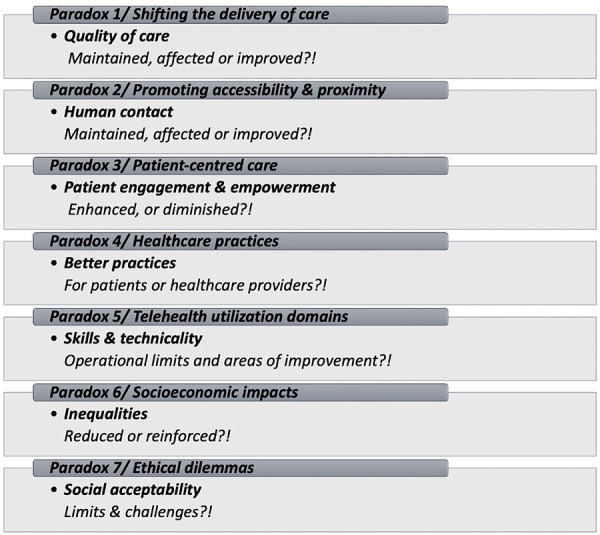
This article is an overview and reflection of the findings of an evaluative study conducted on a program called "Techno-Covid Partnership" (TCP) implemented in April 2020 at the Centre Hospitalier de l'Université de Montréal (CHUM) in Montreal, Canada. In the context of the COVID-19 pandemic, the CHUM decided in April 2020 to implement telehealth, virtual care, and telemonitoring platforms and technologies to maintain access to care and reduce the risks of contamination and spread of COVID-19 as well as to protect users of health services and health professionals. Three technological platforms for telehealth and remote care and monitoring have been developed, implemented, and evaluated in real-time within the framework of the TCP program. A cross-sectional study was carried out in which a questionnaire was used and administered to users of telehealth platforms including patients and healthcare professionals. The methods and results of the study have been published previously published. In the completion of the two articles published in this context, in this paper, we briefly recall the context of the study and the method performed. The main focus of the paper is on presenting a critical overview and reflection on the major findings of our evaluation of the use of telehealth platforms from the point of view of patients and health professionals and discuss certain paradoxes i.e., the advantages, challenges, recommendations, and other perspectives that emerged in this study.
本文是对一项评估研究结果的概述与反思,该研究针对2020年4月在加拿大蒙特利尔的蒙特利尔大学中心医院(CHUM)实施的一个名为“技术与新冠合作项目”(TCP)的项目。在新冠疫情背景下,CHUM于2020年4月决定实施远程医疗、虚拟护理以及远程监测平台与技术,以维持医疗服务的可及性,降低新冠病毒传播和扩散的风险,同时保护医疗服务使用者和医护人员。在TCP项目框架内,实时开发、实施并评估了三个远程医疗及远程护理与监测技术平台。开展了一项横断面研究,其中使用了问卷并对远程医疗平台的使用者(包括患者和医护人员)进行了问卷调查。该研究的方法和结果此前已发表。在完成在此背景下发表的两篇文章后,在本文中,我们简要回顾研究背景和所采用的方法。本文的主要重点在于从患者和医护人员的角度,对我们评估远程医疗平台使用情况的主要发现进行批判性概述与反思,并讨论本研究中出现的某些矛盾之处,即优势、挑战、建议以及其他观点。