Dujak Christian, Coleto-Alcudia Veredas, Aranzana Maria José
Centre for Research in Agricultural Genomics (CRAG) CSIC-IRTA-UABUB, Plant and Animal Genomics, Campus UAB, 08193 Bellaterra, Barcelona, Spain.
IRTA (Institut de Recerca i Tecnologia Agroalimentàries), Genomics and Biotechnology, 08140 Caldes de Montbui, Barcelona, Spain.
Hortic Res. 2023 Dec 19;11(2):uhad270. doi: 10.1093/hr/uhad270. eCollection 2024 Feb.
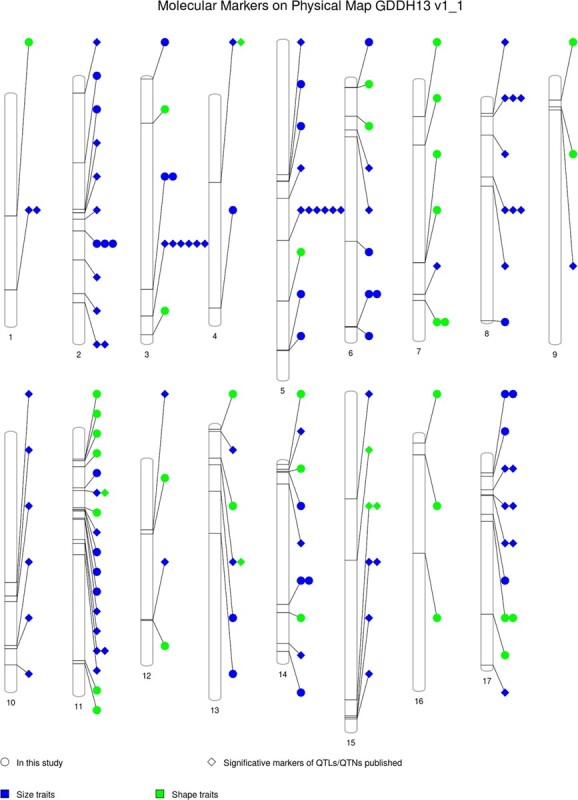
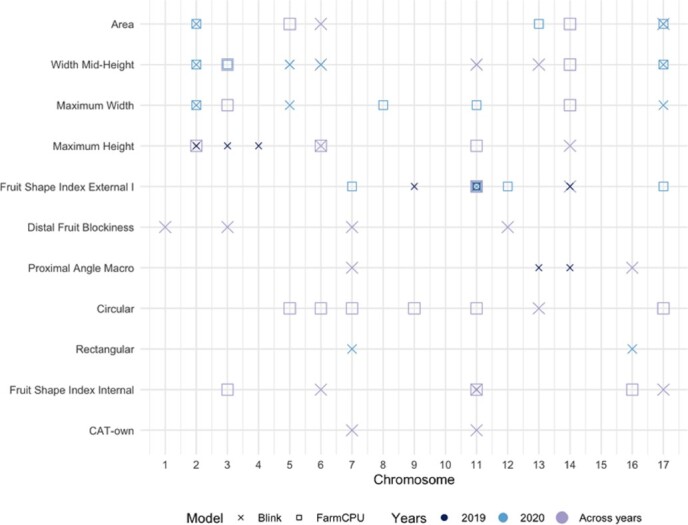
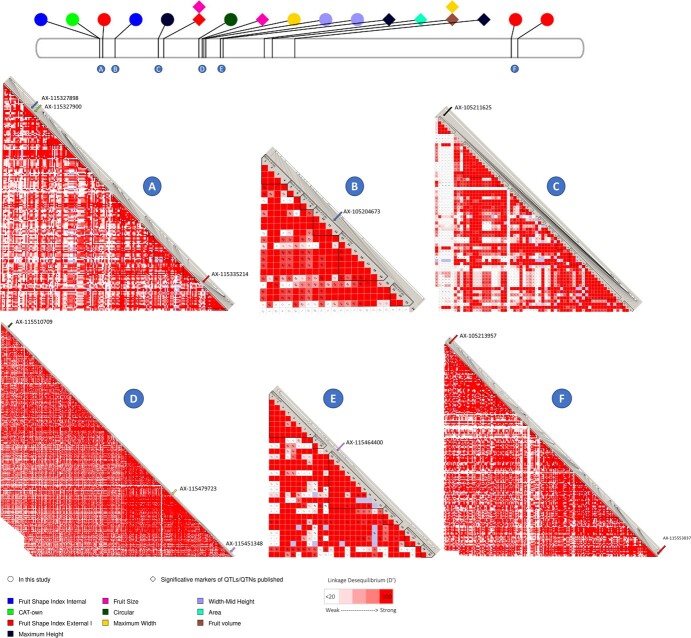
Genomic tools facilitate the efficient selection of improved genetic materials within a breeding program. Here, we focus on two apple fruit quality traits: shape and size. We utilized data from 11 fruit morphology parameters gathered across three years of harvest from 355 genotypes of the apple REFPOP collection, which serves as a representative sample of the genetic variability present in European-cultivated apples. The data were then employed for genome-wide association studies (GWAS) using the FarmCPU and the BLINK models. The analysis identified 59 SNPs associated with fruit size and shape traits (35 with FarmCPU and 45 with BLINK) responsible for 71 QTNs. These QTNs were distributed across all chromosomes except for chromosomes 10 and 15. Thirty-four QTNs, identified by 27 SNPs, were related for size traits, and 37 QTNs, identified by 26 SNPs, were related to shape attributes. The definition of the haploblocks containing the most relevant SNPs served to propose candidate genes, among them the genes of the ovate family protein MdOFP17 and MdOFP4 that were in a 9.7kb haploblock on Chromosome 11. RNA-seq data revealed low or null expression of these genes in the oblong cultivar "Skovfoged" and higher expression in the flat "Grand'mere." The Gene Ontology enrichment analysis support a role of OFPs and hormones in shape regulation. In conclusion, this comprehensive GWAS analysis of the apple REFPOP collection has revealed promising genetic markers and candidate genes associated with apple fruit shape and size attributes, providing valuable insights that could enhance the efficiency of future breeding programs.
基因组工具有助于在育种计划中高效选择改良的遗传材料。在此,我们聚焦于苹果的两个果实品质性状:形状和大小。我们利用了来自苹果REFPOP群体355个基因型连续三年收获期收集的11个果实形态参数的数据,该群体是欧洲栽培苹果遗传变异的代表性样本。然后,这些数据被用于使用FarmCPU和BLINK模型进行全基因组关联研究(GWAS)。分析确定了59个与果实大小和形状性状相关的单核苷酸多态性(SNP)(FarmCPU鉴定出35个,BLINK鉴定出45个),这些SNP对应71个数量性状核苷酸(QTN)。除了10号和15号染色体外,这些QTN分布在所有染色体上。由27个SNP鉴定出的34个QTN与大小性状相关,由26个SNP鉴定出的37个QTN与形状属性相关。包含最相关SNP的单倍型块的定义有助于提出候选基因,其中卵形家族蛋白MdOFP17和MdOFP4的基因位于11号染色体上一个9.7kb的单倍型块中。RNA测序数据显示,这些基因在长圆形品种“Skovfoged”中表达低或不表达,而在扁平形品种“Grand'mere”中表达较高。基因本体富集分析支持了卵形家族蛋白(OFP)和激素在形状调控中的作用。总之,对苹果REFPOP群体进行的这项全面GWAS分析揭示了与苹果果实形状和大小属性相关的有前景的遗传标记和候选基因,为提高未来育种计划的效率提供了有价值的见解。