Qin Han, Zhang Liping, Li Xiaodan, Xu Zhifei, Zhang Jie, Wang Shengcai, Zheng Li, Ji Tingting, Mei Lin, Kong Yaru, Jia Xinbei, Lei Yi, Qi Yuwei, Ji Jie, Ni Xin, Wang Qing, Tai Jun
Department of Child Health Care, Children's Hospital Capital Institute of Pediatrics, Chinese Academy of Medical Sciences & Peking Union Medical College, Capital Institute of Pediatrics, Beijing, China.
Pharmacovigilance Research Center for Information Technology and Data Science, Cross-strait Tsinghua Research Institute, Xiamen, China.
Front Pediatr. 2024 Feb 14;12:1328209. doi: 10.3389/fped.2024.1328209. eCollection 2024.
The objective of this study was to investigate the effectiveness of a machine learning algorithm in diagnosing OSA in children based on clinical features that can be obtained in nonnocturnal and nonmedical environments.
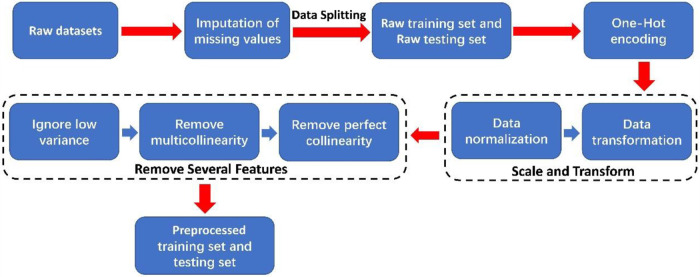
This study was conducted at Beijing Children's Hospital from April 2018 to October 2019. The participants in this study were 2464 children aged 3-18 suspected of having OSA who underwent clinical data collection and polysomnography(PSG). Participants' data were randomly divided into a training set and a testing set at a ratio of 8:2. The elastic net algorithm was used for feature selection to simplify the model. Stratified 10-fold cross-validation was repeated five times to ensure the robustness of the results.
Feature selection using Elastic Net resulted in 47 features for AHI ≥5 and 31 features for AHI ≥10 being retained. The machine learning model using these selected features achieved an average AUC of 0.73 for AHI ≥5 and 0.78 for AHI ≥10 when tested externally, outperforming models based on PSG questionnaire features. Linear Discriminant Analysis using the selected features identified OSA with a sensitivity of 44% and specificity of 90%, providing a feasible clinical alternative to PSG for stratifying OSA severity.
This study shows that a machine learning model based on children's clinical features effectively identifies OSA in children. Establishing a machine learning screening model based on the clinical features of the target population may be a feasible clinical alternative to nocturnal OSA sleep diagnosis.
本研究的目的是基于可在非夜间和非医疗环境中获得的临床特征,探讨一种机器学习算法在诊断儿童阻塞性睡眠呼吸暂停(OSA)中的有效性。
本研究于2018年4月至2019年10月在北京儿童医院进行。本研究的参与者为2464名3至18岁疑似患有OSA的儿童,他们接受了临床数据收集和多导睡眠图(PSG)检查。参与者的数据以8:2的比例随机分为训练集和测试集。采用弹性网络算法进行特征选择以简化模型。重复进行5次分层10折交叉验证以确保结果的稳健性。
使用弹性网络进行特征选择后,保留了47个用于呼吸暂停低通气指数(AHI)≥5的特征和31个用于AHI≥10的特征。使用这些选定特征的机器学习模型在外部测试时,对于AHI≥5的平均曲线下面积(AUC)为0.73,对于AHI≥10的平均AUC为0.78,优于基于PSG问卷特征的模型。使用选定特征的线性判别分析识别OSA的灵敏度为44%,特异度为90%,为OSA严重程度分层提供了一种可行的临床替代PSG的方法。
本研究表明,基于儿童临床特征的机器学习模型能有效识别儿童OSA。基于目标人群临床特征建立机器学习筛查模型可能是夜间OSA睡眠诊断的一种可行的临床替代方法。