Alizadeh Madeline, Wong Uni, Siaton Bernadette C, Patil Seema A, George Lauren, Raufman Jean-Pierre, Scott William H, von Rosenvinge Erik C, Ravel Jacques, Cross Raymond K
Institute for Genome Sciences, University of Maryland School of Medicine, Baltimore, MD, USA.
Division of Gastroenterology and Hepatology, Department of Medicine, University of Maryland School of Medicine, Baltimore, MD, USA.
Heliyon. 2024 Feb 18;10(4):e26571. doi: 10.1016/j.heliyon.2024.e26571. eCollection 2024 Feb 29.
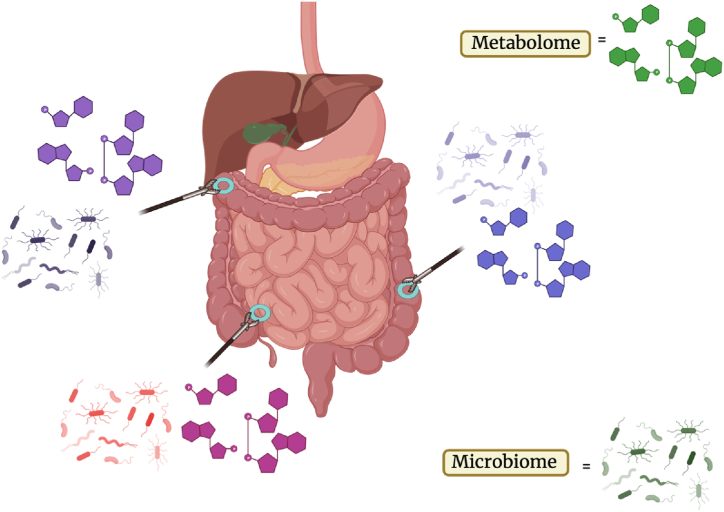
Inflammatory Bowel Disease (IBD)-associated arthritis is a frequent and potentially debilitating complication of IBD, that can affect those with or without active intestinal disease, and is often difficult to treat. The microbiome is known to play a role in IBD development and has been shown to be associated with inflammatory arthritis without concomitant IBD, but its role in IBD-associated arthritis is still unexplored. Further, disease localization is associated with development of IBD-associated arthritis, and stool compositional profiles are predictive of disease localization, yet mucosal location-specific microbiomes have not been well characterized. To address this gap in understanding, we designed a study (LOCATION-IBD) to characterize the mucosa-associated intestinal microbiome and metabolome in IBD-associated arthritis.
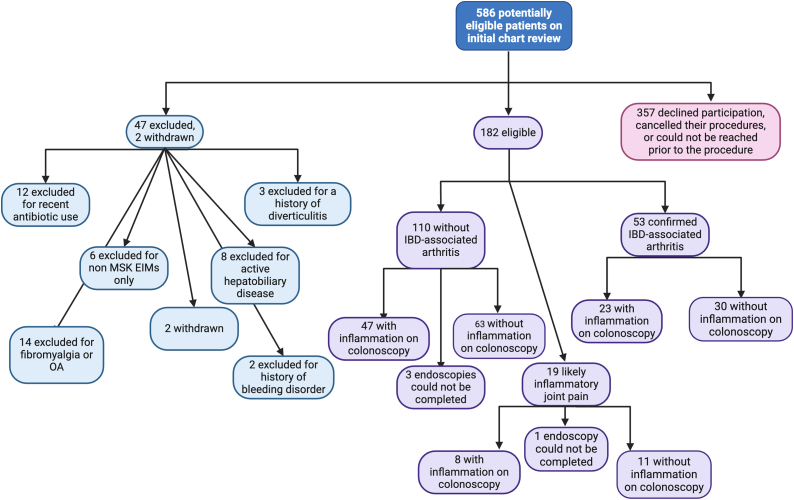
Adults with an established diagnosis of IBD undergoing clinical colonoscopy between May of 2021 and February of 2023 were invited to participate in this study; those interested in participation who met inclusion criteria were enrolled. Prior to enrollment, participants were stratified into those with or without IBD-associated arthritis. All participants were interviewed and had clinical and demographic data collected, and 97.8% completed clinical colonoscopy with biopsy collection.
A total of 182 participants, 53 with confirmed IBD-associated arthritis, were enrolled in this study, resulting in 1151 biopsies obtained for microbiome and metabolome analysis (median 6, mean 6.3 per participant). Clinical and demographic data obtained from the study population will be analyzed with microbiome and metabolome data obtained from biopsies, with the goal of better understanding the mechanisms underpinning the host-microbiome relationship associated the development of IBD-associated arthritis.
炎症性肠病(IBD)相关关节炎是IBD常见且可能导致功能障碍的并发症,可影响有或无活动性肠道疾病的患者,且通常难以治疗。已知微生物群在IBD的发展中起作用,并且已显示与无IBD伴发的炎性关节炎相关,但其在IBD相关关节炎中的作用仍未得到探索。此外,疾病定位与IBD相关关节炎的发展相关,粪便成分谱可预测疾病定位,但黏膜部位特异性微生物群尚未得到很好的表征。为了填补这一认知空白,我们设计了一项研究(LOCATION - IBD),以表征IBD相关关节炎中黏膜相关肠道微生物群和代谢组。
邀请2021年5月至2023年2月期间接受临床结肠镜检查且确诊为IBD的成年人参与本研究;符合纳入标准且有兴趣参与的人被纳入研究。在纳入研究之前,参与者被分为有或无IBD相关关节炎两组。所有参与者均接受访谈并收集临床和人口统计学数据,97.8%的参与者完成了结肠镜检查并采集了活检样本。
本研究共纳入182名参与者,其中53名确诊为IBD相关关节炎,共获得1151份用于微生物群和代谢组分析的活检样本(中位数为6份,每位参与者平均6.3份)。将对从研究人群中获得的临床和人口统计学数据与从活检样本中获得的微生物群和代谢组数据进行分析,目的是更好地了解与IBD相关关节炎发展相关的宿主 - 微生物群关系的潜在机制。