Department of Gastroenterology, The First Affiliated Hospital of Soochow University, Suzhou, Jiangsu 215026, China.
Chin Med J (Engl). 2024 Jul 20;137(14):1674-1683. doi: 10.1097/CM9.0000000000003019. Epub 2024 Feb 29.
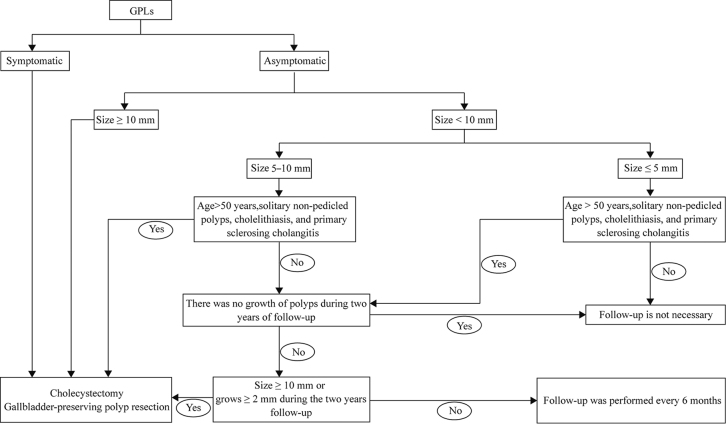
Gallbladder polypoid lesions (GPLs) refer to any elevated lesion of the mucosal surface of the gallbladder wall, and the prevalence is estimated to be between 0.9% and 12.1%. GPLs include benign polyps and malignant polyps. Benign polyps are further classified as non-neoplastic polyps and neoplastic polyps. Cholesterol polyps are the most common benign polyps and adenocarcinoma is the main type of malignant polyp. Hepatitis B virus infection, liver function abnormalities, dyslipidemia, and obesity are the main risk factors for GPLs. Studies of biological mechanisms have focused on malignant gallbladder polyps, the development of which is regulated by hormone levels in vivo , gut microbiota, inflammation, oxidative stress, Salmonella typhimurium , and related molecules. Diagnostic modalities include chemical examination and imaging examination, with imaging examination currently being the mainstay. Treatment of patients with GPLs is based on the presence or absence of symptoms, age, size of the polyps, tendency of the polyp to increase, and risk factors for symptomatic malignancy to determine whether surgery should be performed.
胆囊息肉样病变(GPLs)是指胆囊壁黏膜表面任何隆起性病变,其患病率估计在 0.9%至 12.1%之间。GPLs 包括良性息肉和恶性息肉。良性息肉进一步分为非肿瘤性息肉和肿瘤性息肉。胆固醇息肉是最常见的良性息肉,腺癌是恶性息肉的主要类型。乙型肝炎病毒感染、肝功能异常、血脂异常和肥胖是 GPLs 的主要危险因素。对生物学机制的研究主要集中在恶性胆囊息肉上,其发展受体内激素水平、肠道微生物群、炎症、氧化应激、鼠伤寒沙门氏菌和相关分子的调节。诊断方法包括化学检查和影像学检查,目前影像学检查是主要方法。胆囊息肉样病变患者的治疗取决于是否有症状、年龄、息肉大小、息肉增大趋势以及恶性症状的危险因素,以确定是否需要手术。