Carter Zorana, Creamer Declan, Kouvidi Aikaterini, Grant Chris M
Faculty of Biology, Medicine and Health, School of Biological Sciences, The University of Manchester, Michael Smith Building, Oxford Road, Manchester, United Kingdom.
PLoS Genet. 2024 Feb 29;20(2):e1011194. doi: 10.1371/journal.pgen.1011194. eCollection 2024 Feb.
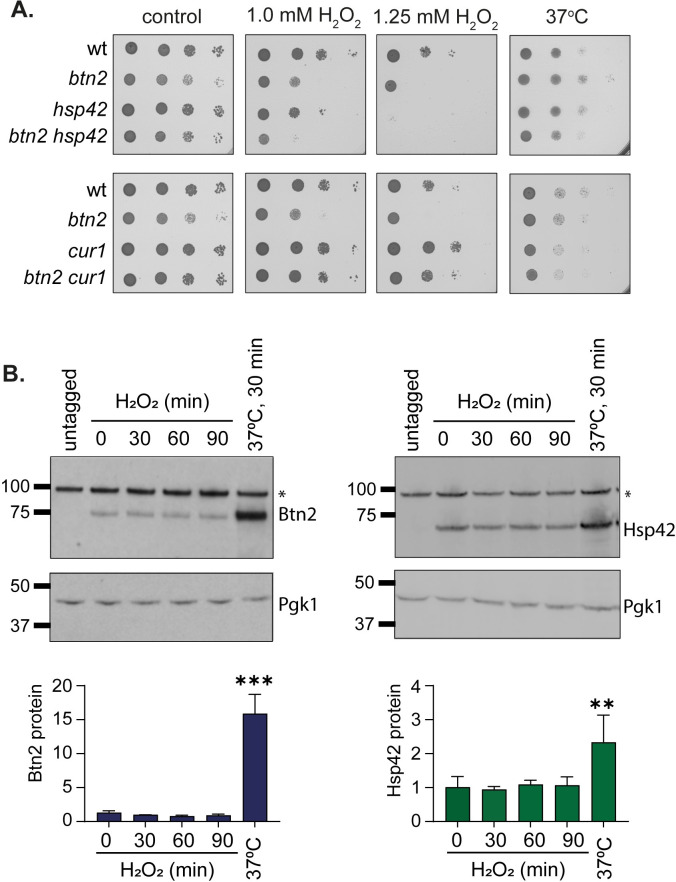
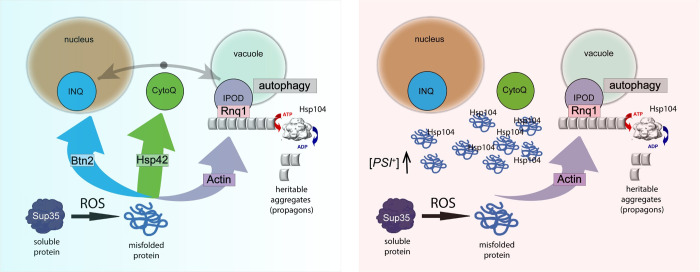
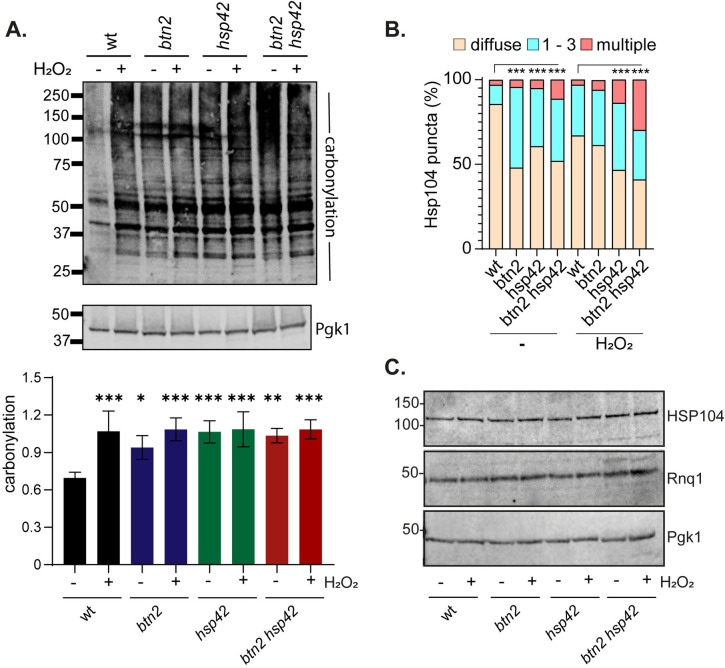
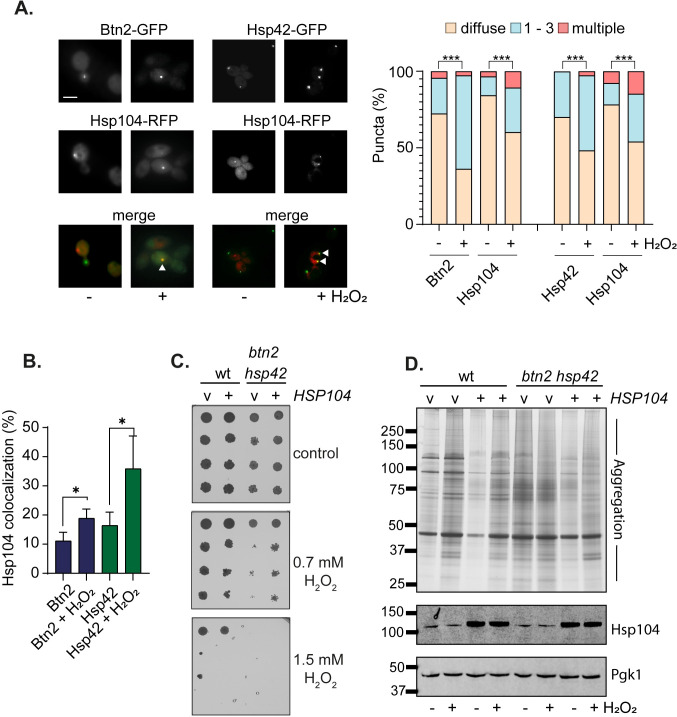
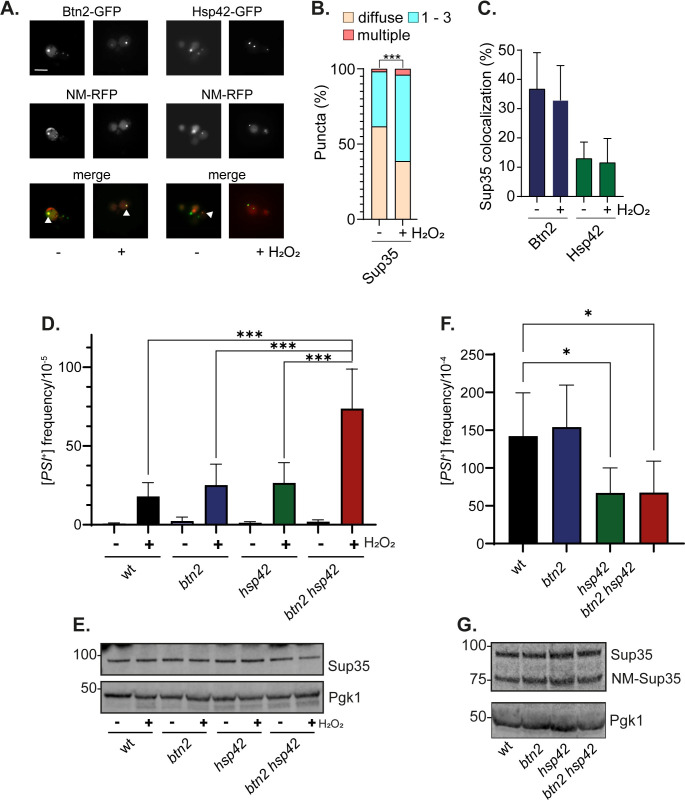
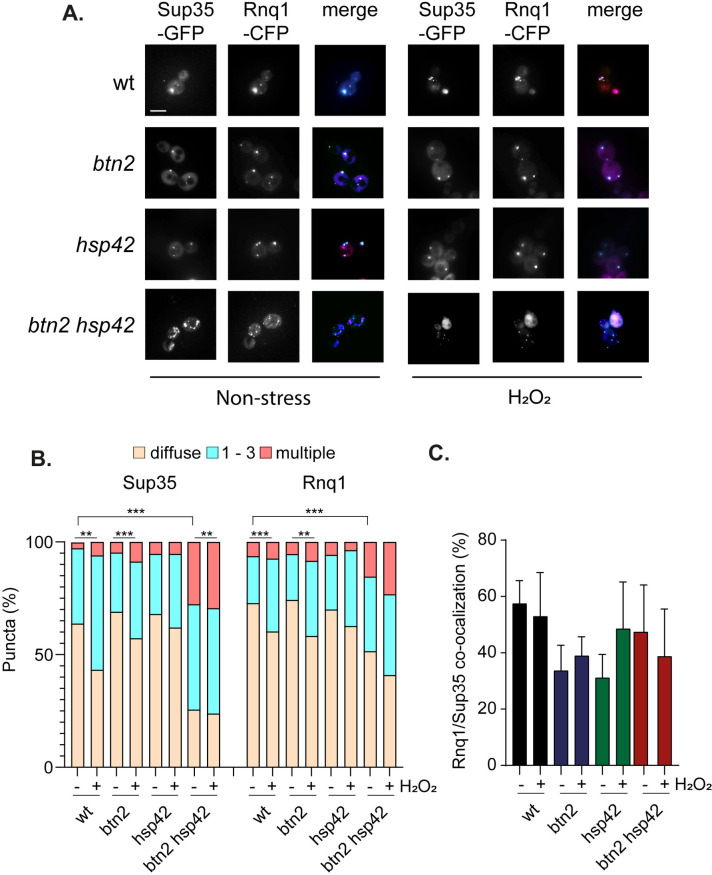
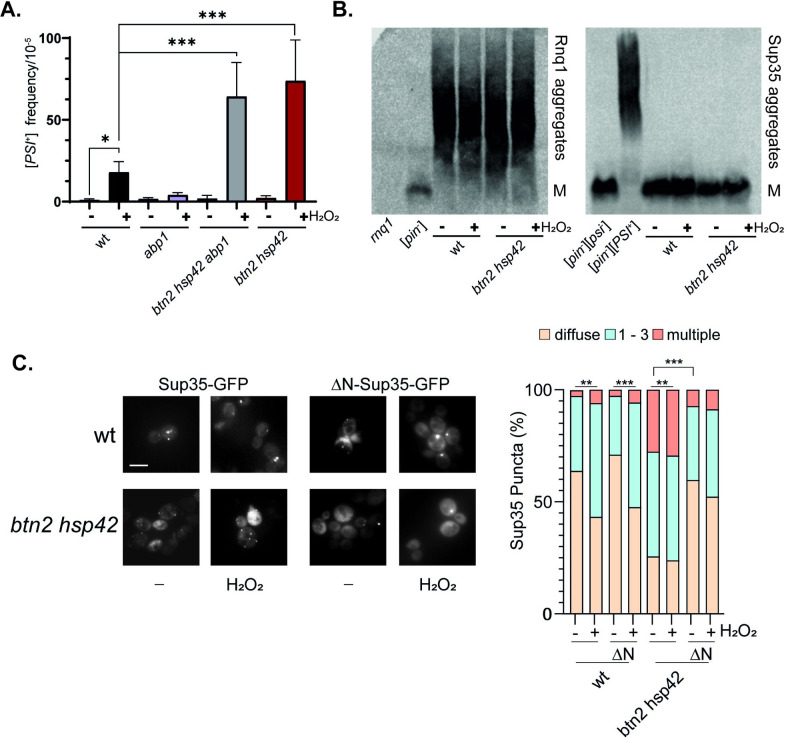
Misfolded proteins are usually refolded to their functional conformations or degraded by quality control mechanisms. When misfolded proteins evade quality control, they can be sequestered to specific sites within cells to prevent the potential dysfunction and toxicity that arises from protein aggregation. Btn2 and Hsp42 are compartment-specific sequestrases that play key roles in the assembly of these deposition sites. Their exact intracellular functions and substrates are not well defined, particularly since heat stress sensitivity is not observed in deletion mutants. We show here that Btn2 and Hsp42 are required for tolerance to oxidative stress conditions induced by exposure to hydrogen peroxide. Btn2 and Hsp42 act to sequester oxidized proteins into defined PQC sites following ROS exposure and their absence leads to an accumulation of protein aggregates. The toxicity of protein aggregate accumulation causes oxidant sensitivity in btn2 hsp42 sequestrase mutants since overexpression of the Hsp104 disaggregase rescues oxidant tolerance. We have identified the Sup35 translation termination factor as an in vivo sequestrase substrate and show that Btn2 and Hsp42 act to suppress oxidant-induced formation of the yeast [PSI+] prion, which is the amyloid form of Sup35. [PSI+] prion formation in sequestrase mutants does not require IPOD (insoluble protein deposit) localization which is the site where amyloids are thought to undergo fragmentation and seeding to propagate their heritable prion form. Instead, both amorphous and amyloid Sup35 aggregates are increased in btn2 hsp42 mutants consistent with the idea that prion formation occurs at multiple intracellular sites during oxidative stress conditions in the absence of sequestrase activity. Taken together, our data identify protein sequestration as a key antioxidant defence mechanism that functions to mitigate the damaging consequences of protein oxidation-induced aggregation.
错误折叠的蛋白质通常会重新折叠成其功能构象,或通过质量控制机制被降解。当错误折叠的蛋白质逃避质量控制时,它们可以被隔离到细胞内的特定部位,以防止蛋白质聚集产生的潜在功能障碍和毒性。Btn2和Hsp42是特定区域的隔离酶,在这些沉积位点的组装中起关键作用。它们确切的细胞内功能和底物尚未明确界定,特别是因为在缺失突变体中未观察到热应激敏感性。我们在此表明,Btn2和Hsp42是耐受过氧化氢诱导的氧化应激条件所必需的。Btn2和Hsp42在活性氧暴露后将氧化的蛋白质隔离到特定的蛋白质质量控制位点,它们的缺失会导致蛋白质聚集体的积累。蛋白质聚集体积累的毒性导致btn2 hsp42隔离酶突变体对氧化剂敏感,因为Hsp104解聚酶的过表达可恢复对氧化剂的耐受性。我们已确定Sup35翻译终止因子是体内隔离酶的底物,并表明Btn2和Hsp42可抑制氧化剂诱导的酵母[PSI+]朊病毒的形成,[PSI+]朊病毒是Sup35的淀粉样形式。隔离酶突变体中[PSI+]朊病毒的形成不需要不溶性蛋白质沉积物(IPOD)定位,IPOD被认为是淀粉样蛋白发生片段化和播种以传播其可遗传朊病毒形式的位点。相反,btn2 hsp42突变体中无定形和淀粉样Sup35聚集体均增加,这与以下观点一致:在没有隔离酶活性的情况下,在氧化应激条件下,朊病毒形成发生在多个细胞内位点。综上所述,我们的数据表明蛋白质隔离是一种关键的抗氧化防御机制,其作用是减轻蛋白质氧化诱导聚集的有害后果。