BK21 Graduate Program, Department of Biomedical Sciences, Korea University College of Medicine, Seoul, 02841, Republic of Korea.
Department of Cardiology, Cardiovascular Center, Guro Hospital, Korea University College of Medicine, Seoul, 08308, Republic of Korea.
Sci Rep. 2024 Feb 29;14(1):4976. doi: 10.1038/s41598-024-55682-6.
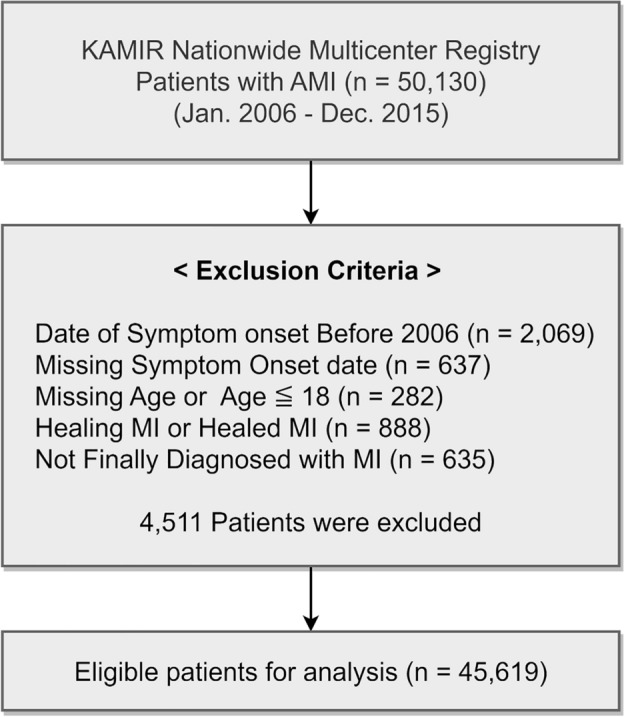
Previous studies have reported the association between myocardial infarction (MI) and air pollution (AP). However, limited information is available regarding the long-term effects of AP on the relative incidence rates of ST-elevation MI (STEMI) and Non-ST-elevation MI (NSTEMI). We investigated the association between long-term exposure to AP and the incidence of STEMI. Between January 2006 and December 2015, a total of 45,619 eligible patients with Acute Myocardial Infarction (AMI) were enrolled in the Korea Acute MI Registry (KAMIR) and KAMIR-National Institutes of Health. Mixed-effect regression models were used to examine the association between the annual average ambient AP before MI onset and the incidence of STEMI, and to evaluate the association of AP with the incidence of in-hospital cardiogenic shock. After mixed-effect regression model analysis, particulate matter (PM) 10 µm or less in diameter (PM) was associated with increased incidence of STEMI compared with NSTEMI (odds ratio [OR] 1.009, 95% Confidence Interval [CI] 1.002-1.016; p = 0.012). For in-hospital cardiogenic shock complication, PM and SO were associated with increased risk, PM (OR 1.033, 95% CI 1.018-1.050; p < 0.001), SO (OR 1.104, 95% CI 1.006-1.212; p = 0.037), respectively. Policy-level strategies and clinical efforts to reduce AP exposure are necessary to prevent the incidence of STEMI and severe cardiovascular complications.
先前的研究报告了心肌梗死(MI)与空气污染(AP)之间的关联。然而,关于 AP 对 ST 段抬高型心肌梗死(STEMI)和非 ST 段抬高型心肌梗死(NSTEMI)相对发病率的长期影响,信息有限。我们研究了长期暴露于 AP 与 STEMI 发病率之间的关系。2006 年 1 月至 2015 年 12 月期间,共有 45619 名符合条件的急性心肌梗死(AMI)患者被纳入韩国急性心肌梗死登记处(KAMIR)和 KAMIR-美国国立卫生研究院。混合效应回归模型用于检查 MI 发病前的年度平均环境 AP 与 STEMI 发病率之间的关系,并评估 AP 与住院心源性休克发病率的关系。经过混合效应回归模型分析,直径为 10μm 或更小的颗粒物(PM)与 NSTEMI 相比,STEMI 的发病率增加(比值比[OR]为 1.009,95%置信区间[CI]为 1.002-1.016;p=0.012)。对于住院心源性休克并发症,PM 和 SO 与风险增加相关,PM(OR 1.033,95%CI 1.018-1.050;p<0.001),SO(OR 1.104,95%CI 1.006-1.212;p=0.037)。有必要采取政策层面的策略和临床努力来减少 AP 暴露,以预防 STEMI 和严重心血管并发症的发生。