Department of Neurology, Shandong Province 960th Hospital of the People's Liberation Army, 250031, Jinan, Shandong, China.
BMC Geriatr. 2024 Feb 29;24(1):211. doi: 10.1186/s12877-024-04757-0.
To investigate the predictive value of neutrophil-to-lymphocyte ratio (NLR) in the short-term prognosis of elderly patients with severe sepsis combined with diabetes mellitus (DM).
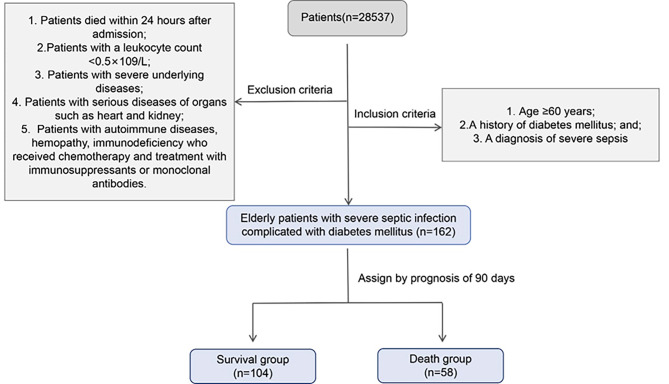
The clinical data of 162 elderly patients with severe sepsis combined with DM from January 2018 to December 2022 were retrospectively collected. These patients were divided into a survival group (n = 104) and a death group (n = 58) according to 90-day prognosis. The number of neutrophils, lymphocytes, and NLR were compared. The optimal cut-off value for NLR to predict 90-day prognosis in elderly patients with severe sepsis combined with DM was determined using Receiver Operator Characteristic (ROC) curves, and the patients were divided into high and low NLR groups depending on the optimal cut-off value. The Kaplan-Meier method was used to plot the survival curves of the high and low NLR groups. Risk factors for the 90-day death in elderly patients with severe sepsis combined with DM were analyzed by a multivariate cox regression model.
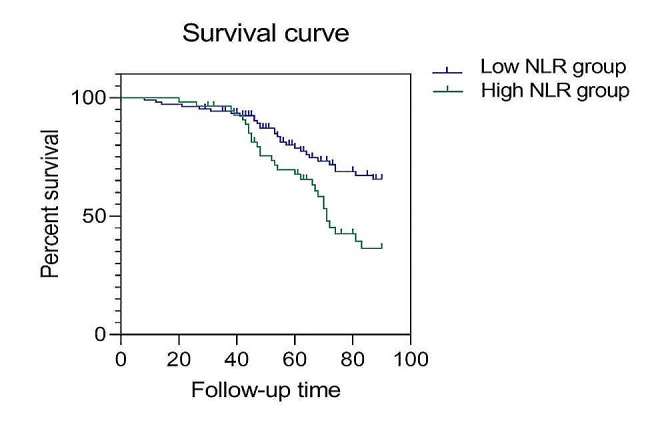
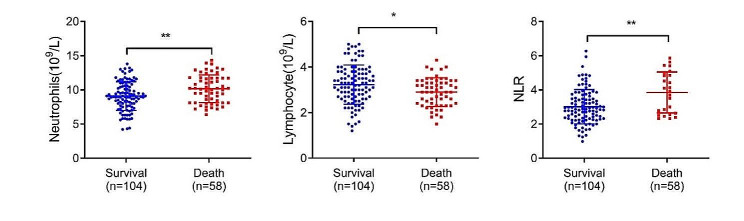
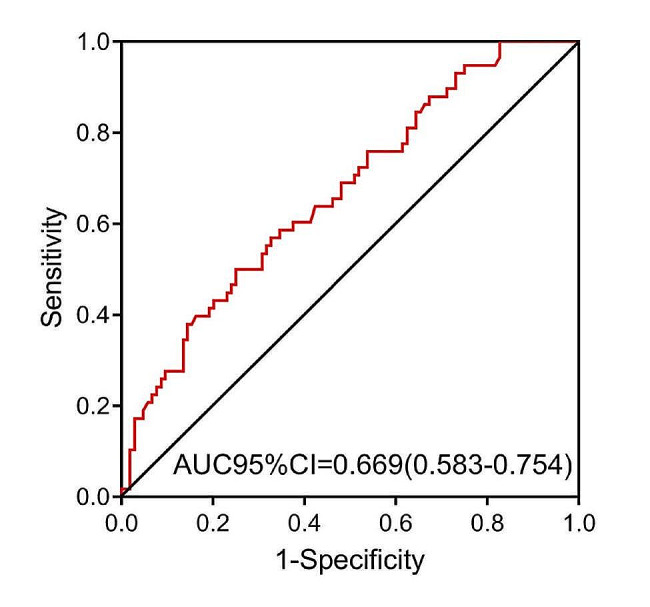
There were no significant differences in gender, age, history of hypertension and hyperlipidemia, intensive care unit (ICU) stay, duration of mechanical ventilation, and oxygenation index between the survival group and death group (p > 0.05). However, acute physiological and chronic health evaluation II (APACHE II) scores, and sepsis-related organ failure assessment (SOFA) scores were significantly lower in the survival group compared with the death group (p < 0.05). In the survival group, neutrophils counts and NLR were much lower than those in the death group, while lymphocytes counts were much higher (p < 0.05). ROC curves showed that the optimal cut-off value for NLR to predict 90-day mortality in elderly patients with severe sepsis combined with DM was 3.482. Patients were divided into high NLR and low NLR groups based on whether NLR was ≥ 3.482. In terms of the log-rank test results, patients in the low NLR group had a significantly higher 90-day survival rate than those in the high NLR group (Logrank χ = 8.635, p = 0.003). The multivariate cox regression model showed that the length of ICU stay longer than 15 days and NLR ≥ 3.482 were independent risk factors for 90-day prognosis in elderly patients with severe sepsis combined with DM.
NLR ≥ 3.482 can be used to predict whether poor prognosis occurs in the short term after illness in elderly patients with severe sepsis combined with DM, and has good assessment value.
探讨中性粒细胞与淋巴细胞比值(NLR)在老年重症脓毒症合并糖尿病患者短期预后中的预测价值。
回顾性收集 2018 年 1 月至 2022 年 12 月 162 例老年重症脓毒症合并糖尿病患者的临床资料,根据 90 天预后分为生存组(n=104)和死亡组(n=58)。比较两组中性粒细胞、淋巴细胞、NLR 计数,采用受试者工作特征(ROC)曲线确定 NLR 预测老年重症脓毒症合并糖尿病患者 90 天预后的最佳截断值,并根据最佳截断值将患者分为 NLR 高、低两组。采用 Kaplan-Meier 法绘制 NLR 高、低两组的生存曲线。采用多因素 COX 回归模型分析老年重症脓毒症合并糖尿病患者 90 天死亡的危险因素。
生存组与死亡组患者在性别、年龄、高血压和高脂血症病史、入住重症监护病房(ICU)时间、机械通气时间、氧合指数等方面比较差异均无统计学意义(p>0.05);而生存组急性生理学与慢性健康状况评分系统Ⅱ(APACHEⅡ)评分和脓毒症相关器官衰竭评估(SOFA)评分均明显低于死亡组(p<0.05)。生存组中性粒细胞计数和 NLR 均明显低于死亡组,而淋巴细胞计数明显高于死亡组(p<0.05)。ROC 曲线显示,NLR 预测老年重症脓毒症合并糖尿病患者 90 天死亡率的最佳截断值为 3.482。根据 NLR 是否≥3.482 将患者分为 NLR 高组和 NLR 低组。log-rank 检验结果显示,NLR 低组患者 90 天生存率明显高于 NLR 高组(Logrank χ²=8.635,p=0.003)。多因素 COX 回归模型显示,入住 ICU 时间超过 15 天和 NLR≥3.482 是老年重症脓毒症合并糖尿病患者 90 天预后的独立危险因素。
NLR≥3.482 可用于预测老年重症脓毒症合并糖尿病患者发病后短期预后不良,具有较好的评估价值。