Keck School of Medicine of University of Southern California, Los Angeles.
Kent State University College of Podiatric Medicine, Independence, Ohio.
JAMA Netw Open. 2024 Mar 4;7(3):e240801. doi: 10.1001/jamanetworkopen.2024.0801.
Patients with kidney failure have an increased risk of diabetes-related foot complications. The benefit of regular foot and ankle care in this at-risk population is unknown.
To investigate foot and ankle care by podiatrists and the outcomes of diabetic foot ulcers (DFUs) in patients with kidney failure.
DESIGN, SETTING, AND PARTICIPANTS: This retrospective cohort study included Medicare beneficiaries with type 2 diabetes receiving dialysis who had a new DFU diagnosis. The analysis of the calendar year 2016 to 2019 data from the United States Renal Data System was performed on June 15, 2023, with subsequent updates on December 11, 2023.
Foot and ankle care by podiatrists during 3 months prior to DFU diagnosis.
The outcomes were a composite of death and/or major amputation, as well as major amputation alone. Kaplan-Meier analysis was used to estimate 2 to 3 years of amputation-free survival. Foot and ankle care by podiatrists and the composite outcome was examined using inverse probability-weighted Cox regression, while competing risk regression models were used for the analysis of amputation alone.
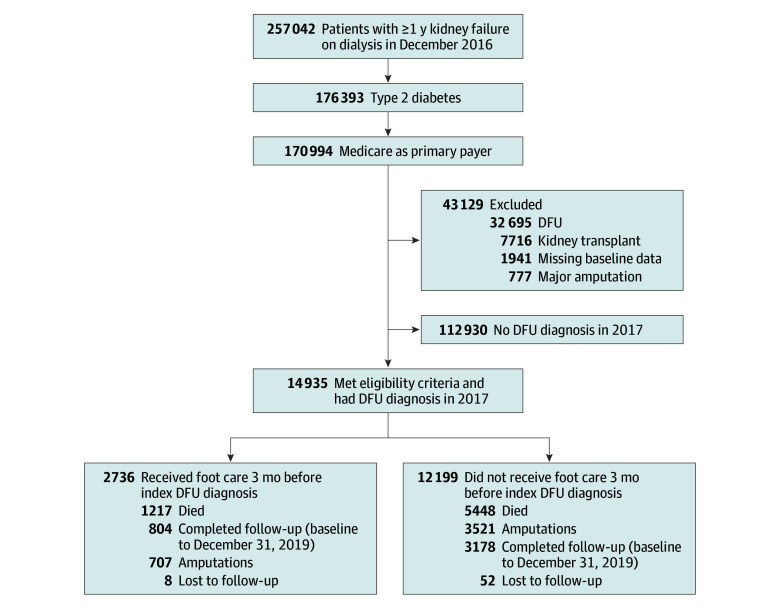
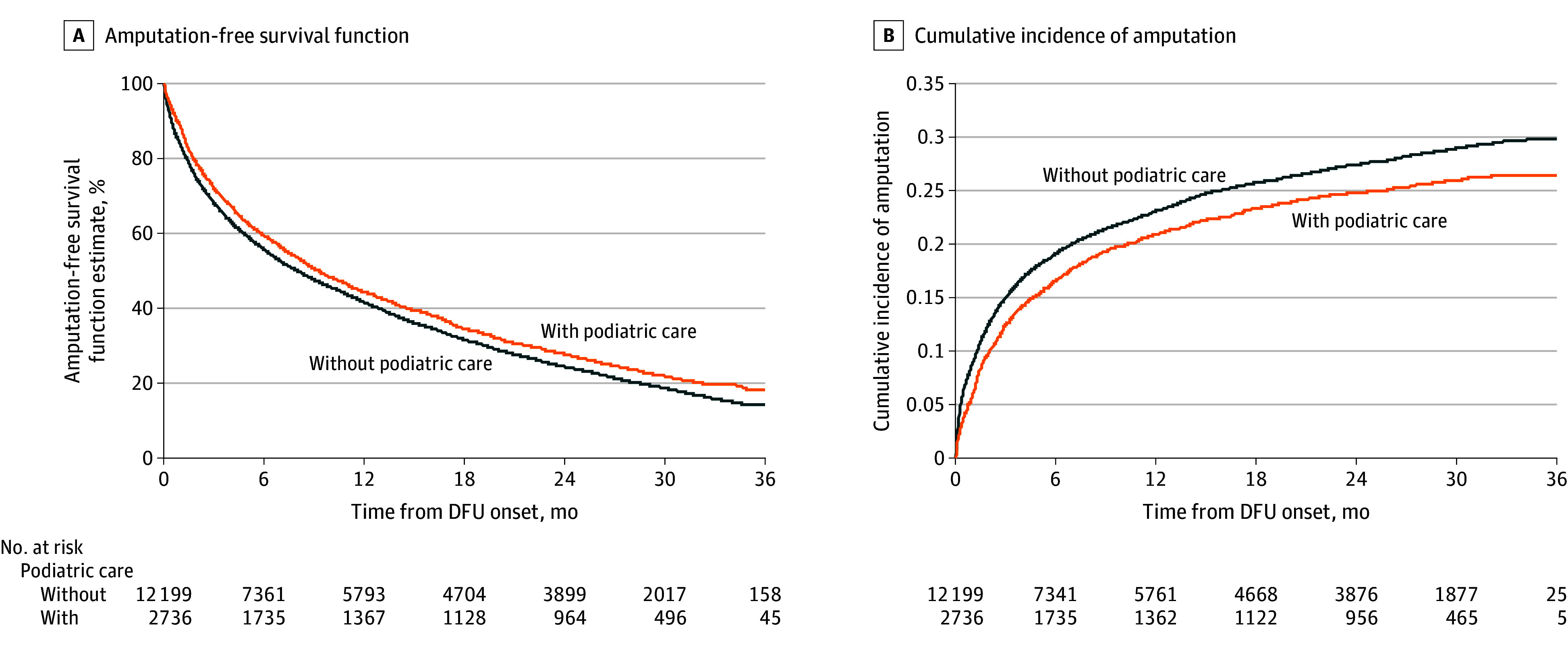
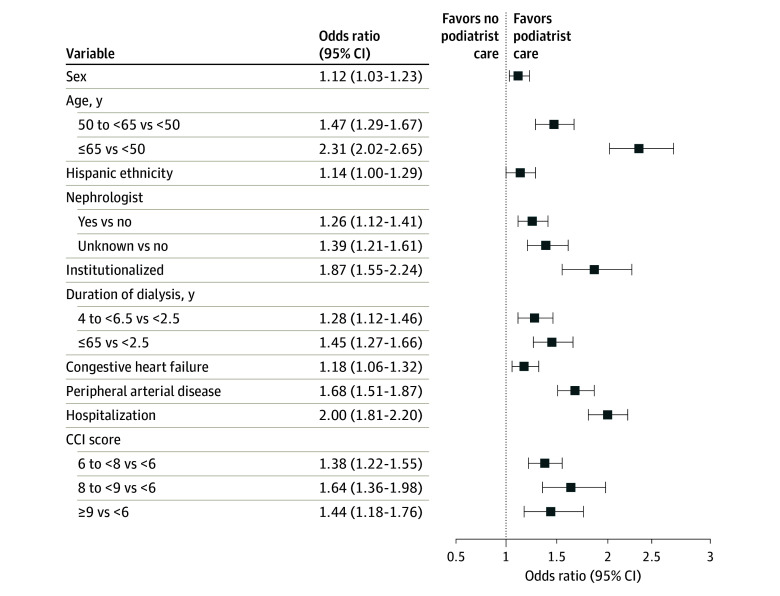
Among the 14 935 adult patients with kidney failure and a new DFU (mean [SD] age, 59.3 [12.7] years; 35.4% aged ≥65 years; 8284 men [55.4%]; Asian, 2.7%; Black/African American, 35.0%; Hispanic, 17.7%; White, 58.5%), 18.4% (n = 2736) received care by podiatrists in the 3 months before index DFU diagnosis. These patients were older, more likely to be male, and have more comorbidities than those without prior podiatrist visits. Over a mean (SD) 13.5 (12.0)-month follow-up, 70% of those with podiatric care experienced death and/or major amputation, compared with 74% in the nonpodiatric group. Survival probabilities at 36 months were 26.3% vs 22.8% (P < .001, unadjusted Kaplan-Meier survival analysis). In multivariate regression analysis, foot and ankle care was associated with an 11% lower likelihood of death and/or amputation (hazard ratio [HR], 0.89 95% CI, 0.84-0.93) and a 9% lower likelihood of major amputation (above or below knee) (HR, 0.91; 95% CI, 0.84-0.99) than those who did not.
The findings of this study suggest that patients with kidney failure at risk for DFUs who receive foot and ankle care from podiatrists may be associated with a reduced likelihood of diabetes-related amputations.
肾衰竭患者患糖尿病相关足部并发症的风险增加。在高危人群中定期进行足部和踝关节护理的益处尚不清楚。
调查肾衰竭患者的足病医生进行的足部和踝关节护理以及糖尿病足溃疡 (DFU) 的结局。
设计、地点和参与者:这是一项回顾性队列研究,纳入了接受透析的 2 型糖尿病合并肾衰竭的 Medicare 受益人群,这些患者新诊断为 DFU。对 2023 年 6 月 15 日从美国肾脏数据系统中提取的 2016 年至 2019 年的数据进行分析,并于 2023 年 12 月 11 日进行了后续更新。
DFU 诊断前 3 个月内接受足病医生的足部和踝关节护理。
结局为死亡和/或主要截肢,以及单纯截肢。Kaplan-Meier 分析用于估计 2 至 3 年的无截肢生存率。使用逆概率加权 Cox 回归分析足病医生的足部和踝关节护理与复合结局,而使用竞争风险回归模型分析单纯截肢。
在 14935 名患有肾衰竭和新发 DFU 的成年患者中(平均[标准差]年龄 59.3[12.7]岁;≥65 岁的占 35.4%;8284 名男性[55.4%];亚裔占 2.7%;黑人/非裔美国人占 35.0%;西班牙裔占 17.7%;白人占 58.5%),18.4%(n=2736)在指数 DFU 诊断前 3 个月内接受了足病医生的治疗。这些患者年龄更大,更可能是男性,并且比没有接受过足病医生就诊的患者有更多的合并症。在平均(标准差)13.5(12.0)个月的随访中,接受足病医生治疗的患者中有 70%经历了死亡和/或主要截肢,而未接受足病医生治疗的患者中这一比例为 74%。36 个月时的生存概率分别为 26.3%和 22.8%(P<0.001,未调整的 Kaplan-Meier 生存分析)。在多变量回归分析中,与未接受治疗的患者相比,足部和踝关节护理与死亡和/或截肢的可能性降低 11%(风险比[HR],0.89;95%置信区间[CI],0.84-0.93)以及主要截肢(膝下或膝上)的可能性降低 9%(HR,0.91;95% CI,0.84-0.99)相关。
这项研究的结果表明,患有肾衰竭且有 DFU 风险的患者如果接受足病医生的足部和踝关节护理,可能与降低糖尿病相关截肢的可能性相关。