Division of Hepatobiliary and Pancreatic Surgery, Department of Surgery, Asan Medical Center, Brain Korea21 Project, University of Ulsan College of Medicine, 88, Olympic-ro 43-gil, Songpa-gu, Seoul, 05505, Republic of Korea.
Department of Radiology and Research Institute of Radiology, Asan Medical Center, University of Ulsan College of Medicine, 88, Olympic-ro 43-gil, Songpa-gu, Seoul, 05505, Republic of Korea.
Sci Rep. 2024 Mar 1;14(1):5089. doi: 10.1038/s41598-024-51777-2.
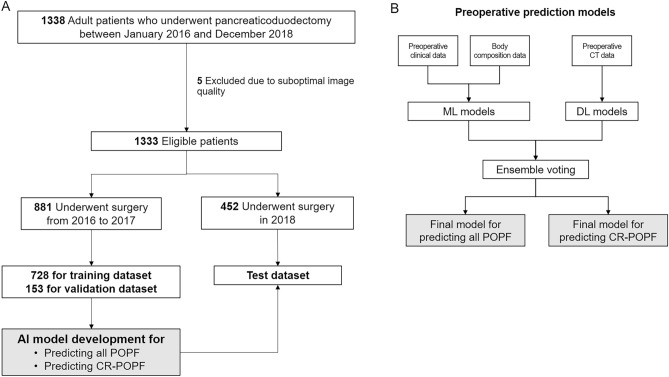
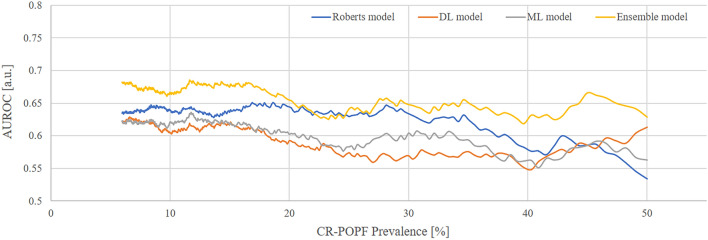
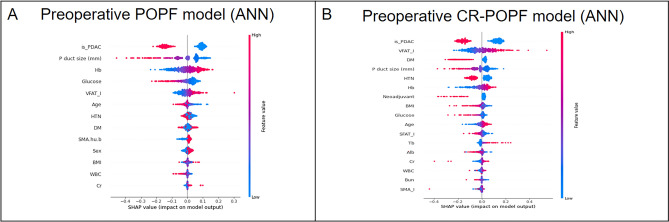
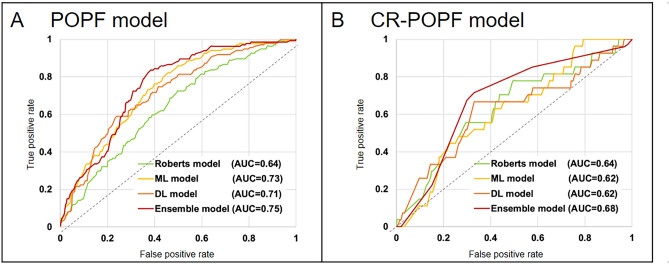
Postoperative pancreatic fistula is a life-threatening complication with an unmet need for accurate prediction. This study was aimed to develop preoperative artificial intelligence-based prediction models. Patients who underwent pancreaticoduodenectomy were enrolled and stratified into model development and validation sets by surgery between 2016 and 2017 or in 2018, respectively. Machine learning models based on clinical and body composition data, and deep learning models based on computed tomographic data, were developed, combined by ensemble voting, and final models were selected comparison with earlier model. Among the 1333 participants (training, n = 881; test, n = 452), postoperative pancreatic fistula occurred in 421 (47.8%) and 134 (31.8%) and clinically relevant postoperative pancreatic fistula occurred in 59 (6.7%) and 27 (6.0%) participants in the training and test datasets, respectively. In the test dataset, the area under the receiver operating curve [AUC (95% confidence interval)] of the selected preoperative model for predicting all and clinically relevant postoperative pancreatic fistula was 0.75 (0.71-0.80) and 0.68 (0.58-0.78). The ensemble model showed better predictive performance than the individual ML and DL models.
术后胰腺瘘是一种危及生命的并发症,目前仍需要准确的预测方法。本研究旨在开发基于术前人工智能的预测模型。将在 2016 年至 2017 年或 2018 年接受胰十二指肠切除术的患者分别按手术时间分层到模型建立和验证集中。建立了基于临床和身体成分数据的机器学习模型,以及基于 CT 数据的深度学习模型,并通过集成投票进行组合,最终模型通过与早期模型比较进行选择。在 1333 名参与者中(训练集,n=881;测试集,n=452),术后胰腺瘘在训练集和测试集中分别发生在 421 例(47.8%)和 134 例(31.8%),临床相关的术后胰腺瘘分别发生在 59 例(6.7%)和 27 例(6.0%)。在测试集中,所选术前模型预测所有和临床相关术后胰腺瘘的受试者工作特征曲线下面积(AUC(95%置信区间))分别为 0.75(0.71-0.80)和 0.68(0.58-0.78)。集成模型的预测性能优于单个 ML 和 DL 模型。