Hart David A, Ahmed Aisha S, Chen Junyu, Ackermann Paul W
Department of Surgery, Faculty of Kinesiology, McCaig Institute for Bone and Joint Health, University of Calgary, Calgary, AB, Canada.
Department of Molecular Medicine and Surgery, Karolinska Institutet, Stockholm, Sweden.
Front Bioeng Biotechnol. 2024 Feb 16;12:1357871. doi: 10.3389/fbioe.2024.1357871. eCollection 2024.
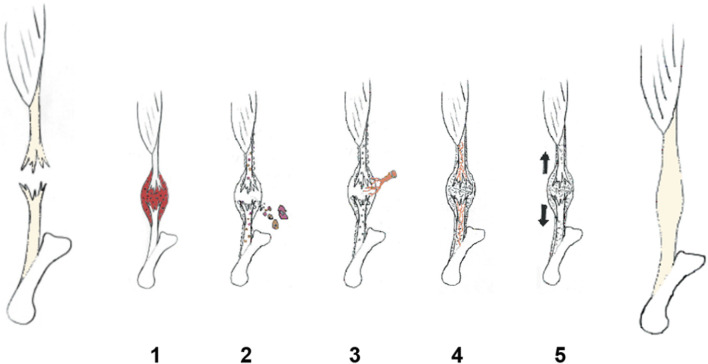
Risk for rupture of the Achilles tendon, and other tendons increases with age. Such injuries of tissues that function in high load environments generally are believed to heal with variable outcome. However, in many cases, the healing does not lead to a good outcome and the patient cannot return to the previous level of participation in active living activities, including sports. In the past few years, using proteomic approaches and other biological techniques, reports have appeared that identify biomarkers that are prognostic of good outcomes from healing, and others that are destined for poor outcomes using validated criteria at 1-year post injury. This review will discuss some of these recent findings and their potential implications for improving outcomes following connective tissue injuries, as well as implications for how clinical research and clinical trials may be conducted in the future where the goal is to assess the impact of specific interventions on the healing process, as well as focusing the emphasis on regeneration and not just repair.
跟腱及其他肌腱断裂的风险会随着年龄增长而增加。在高负荷环境下发挥功能的组织发生此类损伤,一般认为愈合结果存在差异。然而,在许多情况下,愈合并未带来良好的结果,患者无法恢复到之前参与积极生活活动(包括运动)的水平。在过去几年中,通过蛋白质组学方法和其他生物技术,已出现一些报告,这些报告识别出了可预测愈合良好结果的生物标志物,以及根据损伤后1年的验证标准预测愈合不良结果的其他生物标志物。本综述将讨论其中一些最新发现及其对改善结缔组织损伤后结果的潜在影响,以及对未来临床研究和临床试验可能如何开展的影响,未来的目标是评估特定干预措施对愈合过程的影响,并将重点放在再生而非仅仅是修复上。