Drake Tom, Chi Y-Ling, Morton Alec, Pitt Catherine
Department of Global Health, Centre for Global Development, London, UK.
Strathclyde Business School, University of Strathclyde, Strathclyde, UK.
F1000Res. 2024 Jan 18;12:214. doi: 10.12688/f1000research.131230.2. eCollection 2023.
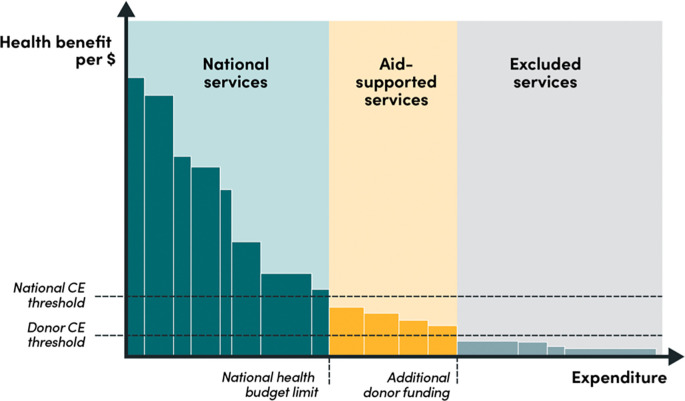
Healthcare cost-effectiveness analysis is increasingly used to inform priority-setting in low- and middle-income countries and by global health donors. As part of such analyses, cost-effectiveness thresholds are commonly used to determine what is, or is not, cost-effective. Recent years have seen a shift in best practice from a rule-of-thumb 1x or 3x per capita GDP threshold towards using thresholds that, in theory, reflect the opportunity cost of new investments within a given country. In this paper, we observe that international donors face both different resource constraints and opportunity costs compared to national decision-makers. Hence, their perspective on cost-effectiveness thresholds must be different. We discuss the potential implications of distinguishing between national and donor thresholds and outline broad options for how to approach setting a donor-perspective threshold. Further work is needed to clarify healthcare cost-effectiveness threshold theory in the context of international aid and to develop practical policy frameworks for implementation.
卫生保健成本效益分析越来越多地被用于为低收入和中等收入国家以及全球卫生捐助者的优先事项设定提供信息。作为此类分析的一部分,成本效益阈值通常用于确定什么具有成本效益或不具有成本效益。近年来,最佳实践已从经验法则的人均国内生产总值1倍或3倍阈值转向使用理论上反映特定国家新投资机会成本的阈值。在本文中,我们观察到,与国家决策者相比,国际捐助者面临着不同的资源限制和机会成本。因此,他们对成本效益阈值的看法必然不同。我们讨论了区分国家阈值和捐助者阈值的潜在影响,并概述了设定捐助者视角阈值的大致方法。需要进一步开展工作,以在国际援助背景下阐明卫生保健成本效益阈值理论,并制定实际的政策框架以供实施。