Shahrahmani Hadis, Kariman Nourossadat, Ahmadi Atefeh, Nasiri Malihe, Keshavarz Zohreh
Student Research Committee, School of Nursing and Midwifery, Shahid Beheshti University of Medical Sciences, Tehran, Iran.
Department of Midwifery and Reproductive Health Research, Midwifery and Reproductive Health Research Center, School of Nursing and Midwifery, Shahid Beheshti University of Medical Sciences, Tehran, Iran.
Med J Islam Repub Iran. 2023 Dec 19;37:138. doi: 10.47176/mjiri.37.138. eCollection 2023.
The identification of the determinants of health literacy is an essential prerequisite for developing health literacy promotion programs. While these factors have been reported in previous studies, there is a lack of a comprehensive review specifically focused on the Iranian population. Therefore, this review aimed to identify the factors related to health literacy in Iran.
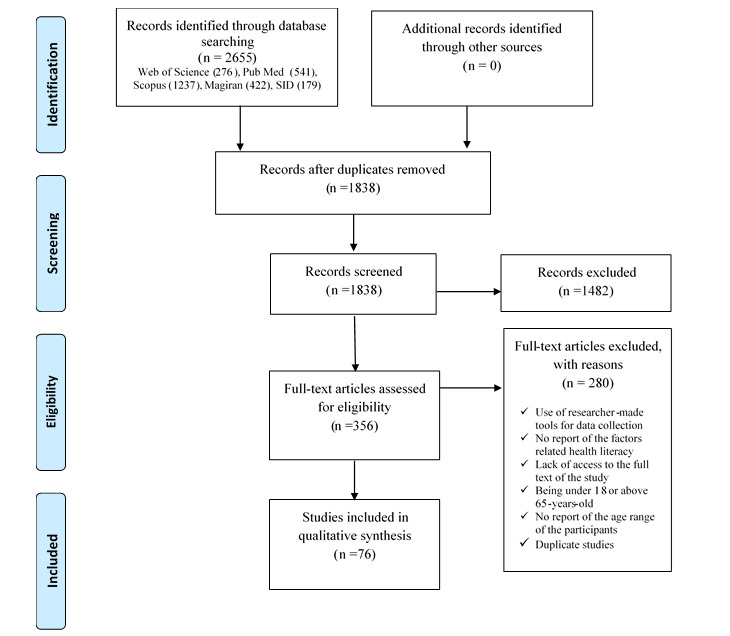
This scoping review used the Arksey and O'Malley methodological framework and the Joanna Briggs Institute framework. A search was performed in English-language databases-Web of Science, Scopus, and PubMed-using the MeSH keyword of "health literacy," and in Persian-language databases-Magirean and SID-using the related keywords. A narrative synthesis was conducted to describe all included studies' characteristics and explore factors associated with health literacy.
A total of 76 studies were included. Based on the results of the study, related factors included personal factors-including sex, age, education level, field of study, parents' education level, marital status, occupation, work experience, employment status, ethnicity, income, socioeconomic status, medical history, duration of disease, addiction, number of children, media literacy, information literacy, computer literacy, and self-efficacy-situational factors-including use of the internet, use of social networks, social support, source of information, and participation in health education classes-and societal and environmental factors-including place of residence and type of insurance.
Modifiable factors identified in this study were self-efficacy, social support, information sources, media literacy, information literacy, computer literacy, internet or social networks, and participation in health education classes. Planners can consider these factors when developing interventions to promote health literacy.
确定健康素养的决定因素是制定健康素养促进计划的重要前提。虽然先前的研究已经报道了这些因素,但缺乏专门针对伊朗人群的全面综述。因此,本综述旨在确定伊朗与健康素养相关的因素。
本范围综述采用了阿克西和奥马利的方法框架以及乔安娜·布里格斯研究所的框架。使用“健康素养”的医学主题词在英文数据库(科学网、Scopus和PubMed)中进行检索,并使用相关关键词在波斯文数据库(Magirean和SID)中进行检索。进行叙述性综合以描述所有纳入研究的特征,并探索与健康素养相关的因素。
共纳入76项研究。根据研究结果,相关因素包括个人因素(包括性别、年龄、教育水平、研究领域、父母教育水平、婚姻状况、职业、工作经验、就业状况、种族、收入、社会经济地位、病史、疾病持续时间、成瘾情况、子女数量、媒体素养、信息素养、计算机素养和自我效能感)、情境因素(包括互联网使用、社交网络使用、社会支持、信息来源以及参加健康教育课程)以及社会和环境因素(包括居住地点和保险类型)。
本研究确定的可改变因素包括自我效能感、社会支持、信息来源、媒体素养、信息素养、计算机素养、互联网或社交网络以及参加健康教育课程。规划者在制定促进健康素养的干预措施时可考虑这些因素。