Sansatan Ruetaichanok, Kanlayanaphotporn Rotsalai, Jensen Mark P, Correia Helena, Janwantanakul Prawit
Department of Physical Therapy, Faculty of Allied Health Sciences, Chulalongkorn University, Bangkok, Thailand.
Department of Rehabilitation Medicine, University of Washington School of Medicine, Harborview Medical Center, Seattle, Washington, USA.
J Patient Rep Outcomes. 2024 Mar 4;8(1):27. doi: 10.1186/s41687-024-00702-2.
The study aimed to cross-culturally adapt the Patient-Reported Outcomes Measurement Information System Short Form v1.0 - Depression 8a (PROMIS SF v1.0 - Depression 8a) into Thai and evaluate its psychometric properties in individuals with chronic low back pain (CLBP).
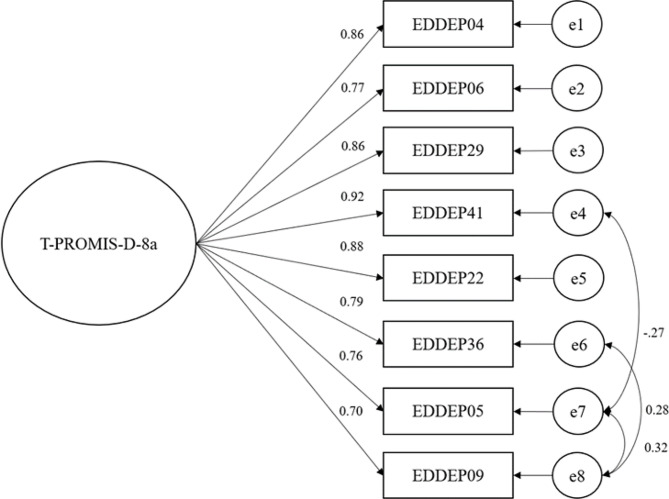
The PROMIS SF v1.0- Depression 8a was translated and cross-culturally adapted into Thai using the Functional Assessment of Chronic Illness Therapy translation methodology. Two hundred and sixty-nine individuals with CLBP completed the Thai version of PROMIS SF v1.0- Depression 8a (T-PROMIS-D-8a) scale and a set of measures assessing validity criterion domains. Structural validity, internal consistency, and test-retest reliability at a 7-day interval of the T-PROMIS-D-8a scale were computed and its construct validity was evaluated by computing correlations with the Thai version of Patient Health Questionnaire-9 (T-PHQ-9), Numeric Rating Scale of pain intensity (T-NRS), and Fear Avoidance Beliefs Questionnaire (T-FABQ).
Data from 269 participants were analyzed. Most participants were women (70%), and the sample had a mean age of 42.5 (SD 16.6) years. The findings supported the unidimensionality, internal consistency (Cronbach's alpha = 0.94), and test-retest reliability (ICC = 0.86) of the T-PROMIS-D-8a. A floor effect was observed for 16% of the sample. Associations with the T-PHQ-9, T-NRS, and T-FABQ supported the construct validity of the T-PROMIS-D-8a.
The T-PROMIS-D-8a was successfully translated and culturally adapted. The findings indicated that the scale is reliable and valid for assessing depression in Thai individuals with CLBP.
本研究旨在对患者报告结局测量信息系统简表v1.0 - 抑郁8a(PROMIS SF v1.0 - 抑郁8a)进行跨文化调适,使其适用于泰语,并评估其在慢性下腰痛(CLBP)患者中的心理测量学特性。
采用慢性病治疗功能评估翻译方法,将PROMIS SF v1.0 - 抑郁8a翻译成泰语并进行跨文化调适。269例CLBP患者完成了泰语版PROMIS SF v1.0 - 抑郁8a(T - PROMIS - D - 8a)量表以及一组评估效度标准领域的测量。计算了T - PROMIS - D - 8a量表的结构效度、内部一致性以及7天间隔的重测信度,并通过计算与泰语版患者健康问卷 - 9(T - PHQ - 9)、疼痛强度数字评定量表(T - NRS)和恐惧回避信念问卷(T - FABQ)的相关性来评估其构想效度。
对269名参与者的数据进行了分析。大多数参与者为女性(70%),样本的平均年龄为42.5(标准差16.6)岁。研究结果支持了T - PROMIS - D - 8a的单维度性、内部一致性(Cronbach's α = 0.94)和重测信度(ICC = 0.86)。16%的样本出现了地板效应。与T - PHQ - 九、T - NRS和T - FABQ的相关性支持了T - PROMIS - D - 8a的构想效度。
T - PROMIS - D - 8a已成功翻译并进行了文化调适。研究结果表明,该量表在评估泰国CLBP患者的抑郁情况时具有可靠性和有效性。