Claußen Lisa, Heidelbach Tabea
Institute of Sports and Sport Science, University of Kassel, Kassel, Germany.
BMC Sports Sci Med Rehabil. 2024 Mar 4;16(1):62. doi: 10.1186/s13102-024-00858-w.
Chronic resistance training and acute resistance exercises improve physical performance and can enhance cognitive performance. However, there is still uncertainty about the mechanism(s) responsible for cognitive improvement following resistance training and exercise. Recent findings suggest that resistance exercise has metabolic as well as cognitive demands, which potentially activate similar neural circuitry associated with higher-order cognitive function tasks. Exercising on unstable devices increases the coordinative and metabolic demands and thus may further increase cognitive activation during resistance exercise. The measurement of pupil diameter could provide indications of cognitive activation and arousal during resistance exercise. Pupil dilation is linked to the activity in multiple neuromodulatory systems (e.g., activation of the locus coeruleus and the release of the neurotransmitter norepinephrine (LC-NE system)), which are involved in supporting processes for executive control. Therefore, the purpose of this study was to compare the cognitive activation measured by pupil diameter during an acute bout of resistance exercise on stable and unstable surfaces.
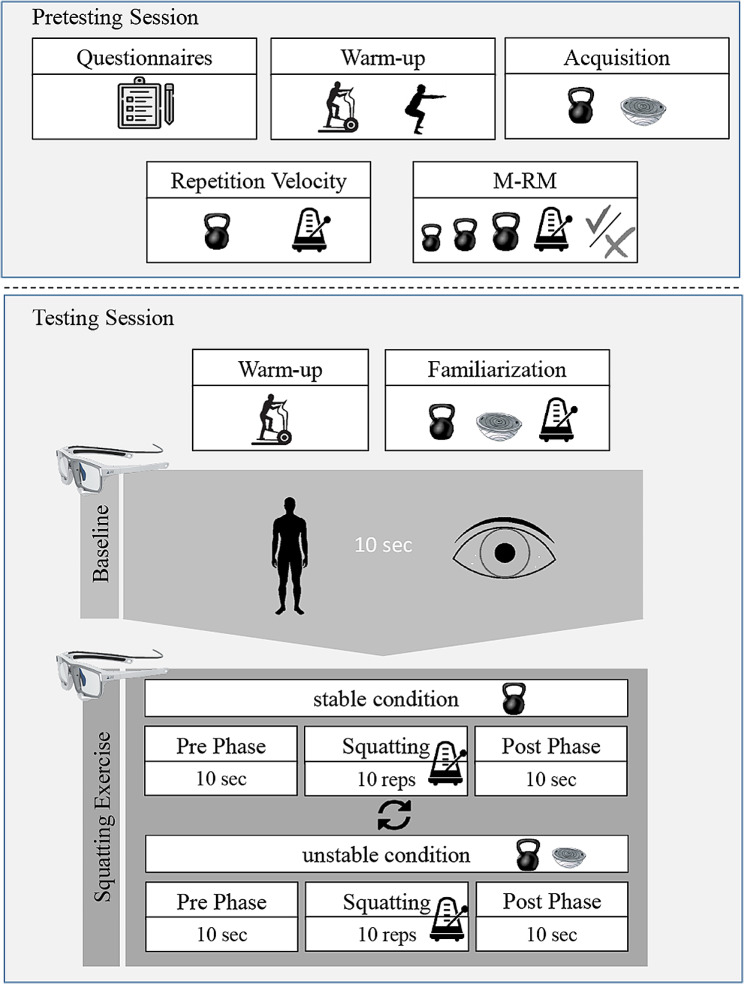
18 participants (23.5 ± 1.5 years; 10 females) performed ten kettlebell squats in a preferred repetition velocity in stable and unstable (BOSU® Balance Trainer) ground conditions. Pupil diameter was recorded with eye tracking glasses (SMI ETG) during standing (baseline) and during squatting. Raw pupil data were cleaned of artifacts (missing values were linearly interpolated) and subjected to a subtractive baseline correction. A student t-test was used to compare mean pupil diameter between ground conditions.
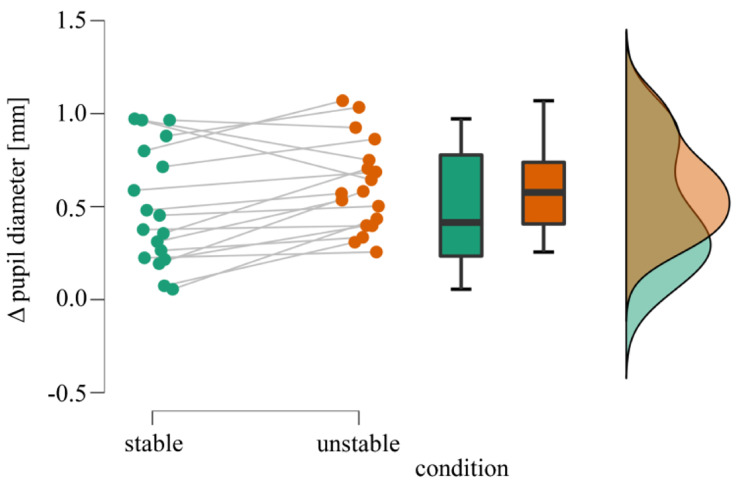
The mean pupil diameter was significantly greater during squats in the unstable condition than in the stable condition, t (17) = -2.63, p =.018, Cohen's d = -0.62; stable: 0.49 ± 0.32 mm; unstable: 0.61 ± 0.25 mm).
As indicated by pupil dilation, the use of unstable devices can increase the cognitive activation and effort during acute bouts of resistance exercise. Since pupil dilation is only an indirect method, further investigations are necessary to describe causes and effects of neuromodulatory system activity during resistance exercise. Resistance training with and without surface instability can be recommended to people of all ages as a physically and cognitively challenging training program contributing to the preservation of both physical and cognitive functioning.
长期抗阻训练和急性抗阻运动可改善身体机能,并能提升认知表现。然而,抗阻训练和运动后认知改善的机制仍不明确。近期研究结果表明,抗阻运动兼具代谢和认知需求,这可能会激活与高阶认知功能任务相关的类似神经回路。在不稳定器械上进行锻炼会增加协调和代谢需求,进而可能在抗阻运动期间进一步增强认知激活。瞳孔直径的测量可为抗阻运动期间的认知激活和唤醒提供指示。瞳孔扩张与多个神经调节系统的活动有关(例如蓝斑核的激活和神经递质去甲肾上腺素的释放(蓝斑 - 去甲肾上腺素系统)),这些系统参与执行控制的支持过程。因此,本研究的目的是比较在稳定和不稳定表面进行急性抗阻运动期间通过瞳孔直径测量的认知激活情况。
18名参与者(23.5±1.5岁;10名女性)在稳定和不稳定(BOSU®平衡训练器)地面条件下,以偏好的重复速度进行10次壶铃深蹲。在站立(基线)和深蹲期间,使用眼动追踪眼镜(SMI ETG)记录瞳孔直径。对原始瞳孔数据进行伪迹清理(缺失值进行线性插值)并进行减法基线校正。使用学生t检验比较不同地面条件下的平均瞳孔直径。
不稳定条件下深蹲时的平均瞳孔直径显著大于稳定条件下,t(17)=-2.63,p = 0.018,科恩d值=-0.62;稳定:0.49±0.32毫米;不稳定:0.61±0.25毫米)。
如瞳孔扩张所示,使用不稳定器械可在急性抗阻运动期间增加认知激活和努力程度。由于瞳孔扩张只是一种间接方法,因此有必要进行进一步研究以描述抗阻运动期间神经调节系统活动的因果关系。对于所有年龄段的人,均可推荐进行有或无表面不稳定性的抗阻训练,作为一项对身体和认知都具有挑战性的训练计划,有助于维持身体和认知功能。