Latt Phyu M, Soe Nyi N, Xu Xianglong, Ong Jason J, Chow Eric P F, Fairley Christopher K, Zhang Lei
Artificial Intelligence and Modelling in Epidemiology Program, Melbourne Sexual Health Centre, Alfred Health, Melbourne, Australia.
Central Clinical School, Faculty of Medicine, Nursing and Health Sciences, Monash University, Melbourne, Australia.
Open Forum Infect Dis. 2024 Jan 8;11(3):ofae011. doi: 10.1093/ofid/ofae011. eCollection 2024 Mar.
We have previously developed an artificial intelligence-based risk assessment tool to identify the individual risk of HIV and sexually transmitted infections (STIs) in a sexual health clinical setting. Based on this tool, this study aims to determine the optimal risk score thresholds to identify individuals at high risk for HIV/STIs.
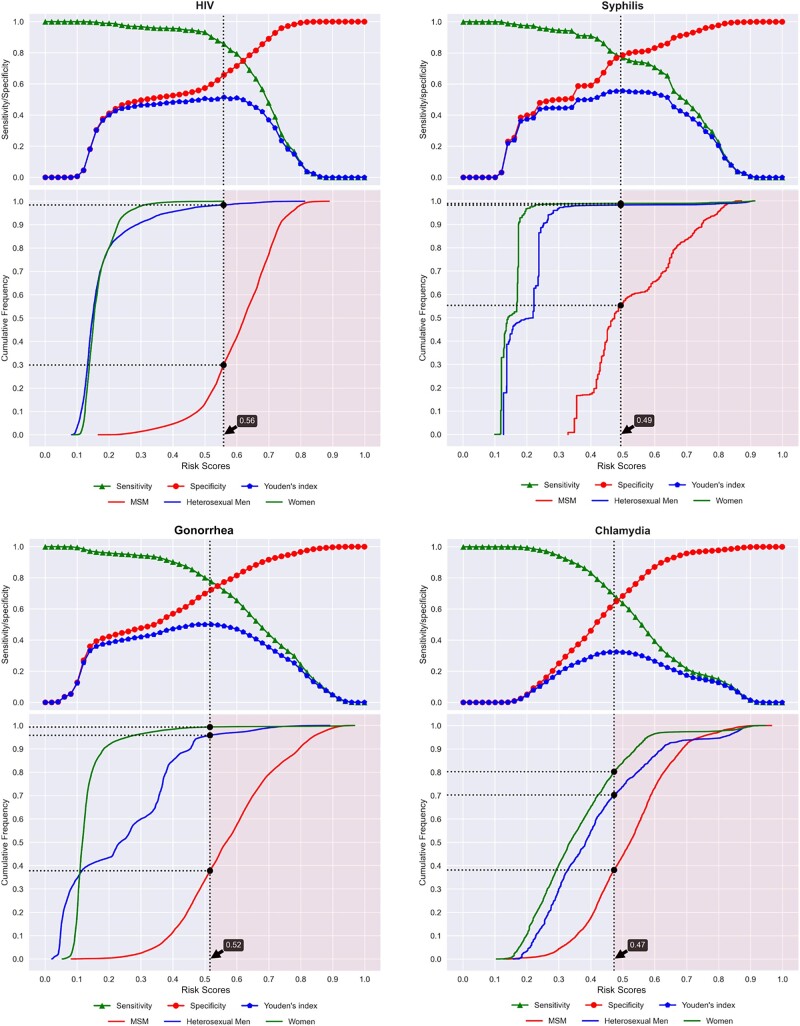
Using 2008-2022 data from 216 252 HIV, 227 995 syphilis, 262 599 gonorrhea, and 320 355 chlamydia consultations at a sexual health center, we applied machine learning models to estimate infection risk scores. Optimal cutoffs for determining high-risk individuals were determined using Youden's index.
The HIV risk score cutoff for high risk was 0.56, with 86.0% sensitivity (95% CI, 82.9%-88.7%) and 65.6% specificity (95% CI, 65.4%-65.8%). Thirty-five percent of participants were classified as high risk, which accounted for 86% of HIV cases. The corresponding cutoffs were 0.49 for syphilis (sensitivity, 77.6%; 95% CI, 76.2%-78.9%; specificity, 78.1%; 95% CI, 77.9%-78.3%), 0.52 for gonorrhea (sensitivity, 78.3%; 95% CI, 77.6%-78.9%; specificity, 71.9%; 95% CI, 71.7%-72.0%), and 0.47 for chlamydia (sensitivity, 68.8%; 95% CI, 68.3%-69.4%; specificity, 63.7%; 95% CI, 63.5%-63.8%). High-risk groups identified using these thresholds accounted for 78% of syphilis, 78% of gonorrhea, and 69% of chlamydia cases. The odds of positivity were significantly higher in the high-risk group than otherwise across all infections: 11.4 (95% CI, 9.3-14.8) times for HIV, 12.3 (95% CI, 11.4-13.3) for syphilis, 9.2 (95% CI, 8.8-9.6) for gonorrhea, and 3.9 (95% CI, 3.8-4.0) for chlamydia.
Risk scores generated by the AI-based risk assessment tool , together with Youden's index, are effective in determining high-risk subgroups for HIV/STIs. The thresholds can aid targeted HIV/STI screening and prevention.
我们之前开发了一种基于人工智能的风险评估工具,用于在性健康临床环境中识别个体感染艾滋病毒和性传播感染(STIs)的风险。基于该工具,本研究旨在确定用于识别艾滋病毒/性传播感染高风险个体的最佳风险评分阈值。
利用2008年至2022年期间在一家性健康中心进行的216252例艾滋病毒、227995例梅毒、262599例淋病和320355例衣原体咨询数据,我们应用机器学习模型来估计感染风险评分。使用约登指数确定用于判定高风险个体的最佳临界值。
艾滋病毒高风险的风险评分临界值为0.56,灵敏度为86.0%(95%置信区间,82.9%-88.7%),特异度为65.6%(95%置信区间,65.4%-65.8%)。35%的参与者被归类为高风险,这部分人占艾滋病毒病例的86%。梅毒的相应临界值为0.49(灵敏度,77.6%;95%置信区间,76.2%-78.9%;特异度,78.1%;95%置信区间,77.9%-78.3%),淋病为0.52(灵敏度,78.3%;95%置信区间,77.6%-78.9%;特异度,71.9%;95%置信区间,71.7%-72.0%),衣原体为0.47(灵敏度,68.8%;95%置信区间,68.3%-69.4%;特异度,63.7%;95%置信区间,63.5%-63.8%)。使用这些临界值识别出的高风险组占梅毒病例的78%、淋病病例的78%和衣原体病例的69%。在所有感染中,高风险组检测呈阳性的几率显著高于其他组:艾滋病毒为11.4(95%置信区间,9.3-14.8)倍,梅毒为12.3(95%置信区间,11.4-13.3)倍,淋病为9.2(95%置信区间,8.8-9.6)倍,衣原体为3.9(95%置信区间,3.8-4.0)倍。
基于人工智能的风险评估工具生成的风险评分,结合约登指数,可有效确定艾滋病毒/性传播感染的高风险亚组。这些临界值有助于有针对性的艾滋病毒/性传播感染筛查和预防。