Xu Xianglong, Ge Zongyuan, Chow Eric P F, Yu Zhen, Lee David, Wu Jinrong, Ong Jason J, Fairley Christopher K, Zhang Lei
Melbourne Sexual Health Centre, Alfred Health, Melbourne, VIC 3053, Australia.
Central Clinical School, Faculty of Medicine, Nursing and Health Sciences, Monash University, Melbourne, VIC 3800, Australia.
J Clin Med. 2022 Mar 25;11(7):1818. doi: 10.3390/jcm11071818.
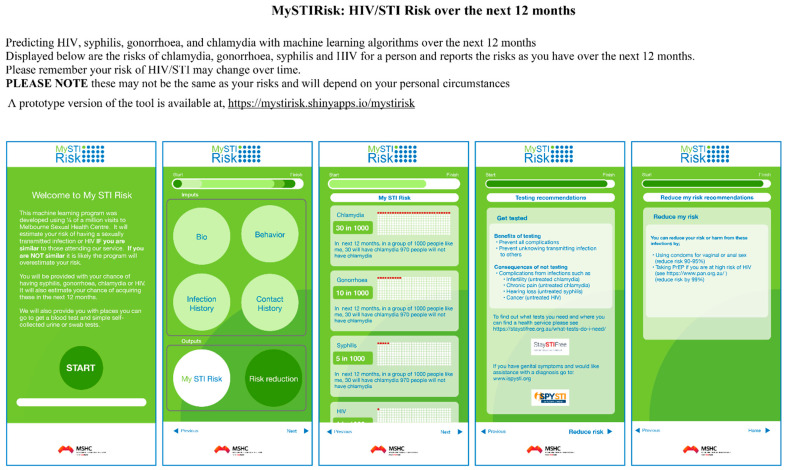
More than one million people acquire sexually transmitted infections (STIs) every day globally. It is possible that predicting an individual's future risk of HIV/STIs could contribute to behaviour change or improve testing. We developed a series of machine learning models and a subsequent risk-prediction tool for predicting the risk of HIV/STIs over the next 12 months.
Our data included individuals who were re-tested at the clinic for HIV (65,043 consultations), syphilis (56,889 consultations), gonorrhoea (60,598 consultations), and chlamydia (63,529 consultations) after initial consultations at the largest public sexual health centre in Melbourne from 2 March 2015 to 31 December 2019. We used the receiver operating characteristic (AUC) curve to evaluate the model's performance. The HIV/STI risk-prediction tool was delivered via a web application.
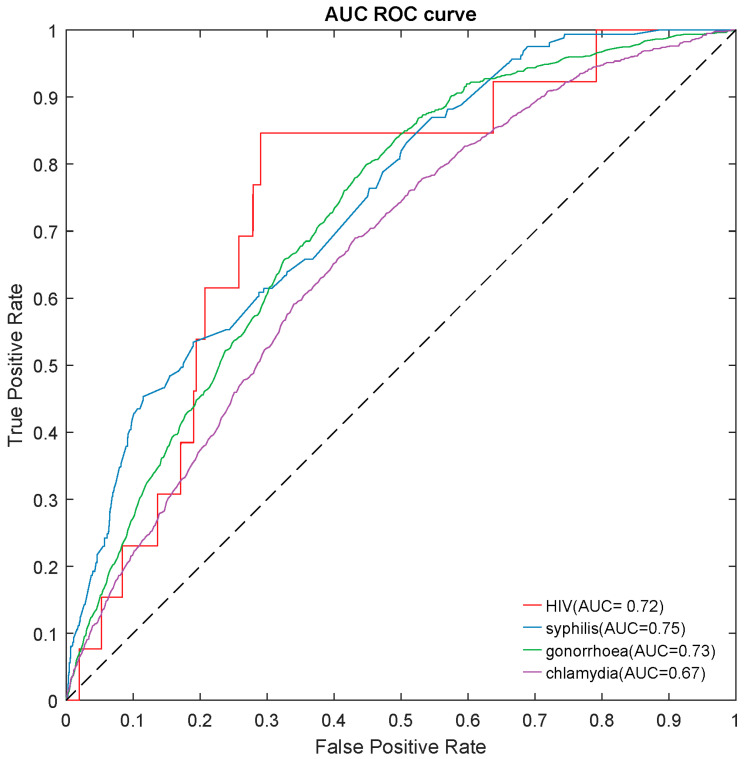
Our risk-prediction tool had an acceptable performance on the testing datasets for predicting HIV (AUC = 0.72), syphilis (AUC = 0.75), gonorrhoea (AUC = 0.73), and chlamydia (AUC = 0.67) acquisition.
Using machine learning techniques, our risk-prediction tool has acceptable reliability in predicting HIV/STI acquisition over the next 12 months. This tool may be used on clinic websites or digital health platforms to form part of an intervention tool to increase testing or reduce future HIV/STI risk.
全球每天有超过100万人感染性传播感染(STIs)。预测个体未来感染艾滋病毒/性传播感染的风险可能有助于改变行为或改进检测。我们开发了一系列机器学习模型以及一个后续的风险预测工具,用于预测未来12个月内感染艾滋病毒/性传播感染的风险。
我们的数据包括2015年3月2日至2019年12月31日在墨尔本最大的公共性健康中心初次咨询后,在该诊所再次接受艾滋病毒(65,043次咨询)、梅毒(56,889次咨询)、淋病(60,598次咨询)和衣原体(63,529次咨询)检测的个体。我们使用受试者工作特征(AUC)曲线来评估模型的性能。艾滋病毒/性传播感染风险预测工具通过网络应用程序提供。
我们的风险预测工具在预测艾滋病毒(AUC = 0.72)、梅毒(AUC = 0.75)、淋病(AUC = 0.73)和衣原体(AUC = 0.67)感染的测试数据集上具有可接受的性能。
使用机器学习技术,我们的风险预测工具在预测未来12个月内感染艾滋病毒/性传播感染方面具有可接受的可靠性。该工具可用于诊所网站或数字健康平台,作为干预工具的一部分,以增加检测或降低未来感染艾滋病毒/性传播感染的风险。