Teiti Iotefa, Aubry Maite, Glaziou Philippe, Mendiboure Vincent, Teissier Anita, Paoaafaite Tuterarii, Simon Aurélie, Chung Kiyojiken, Dian Lisa, Olivier Sophie, Pineau Pascal, Fontanet Arnaud, Condat Bertrand, Madec Yoann, Lastère Stéphane, Cao-Lormeau Van-Mai
Laboratory of Research on Emerging Viral Diseases, Institut Louis Malardé, Papeete, Tahiti, French Polynesia.
Non-communicable Diseases Laboratory, Institut Louis Malardé, Papeete, Tahiti, French Polynesia.
Lancet Reg Health West Pac. 2024 Mar 2;45:101035. doi: 10.1016/j.lanwpc.2024.101035. eCollection 2024 Apr.
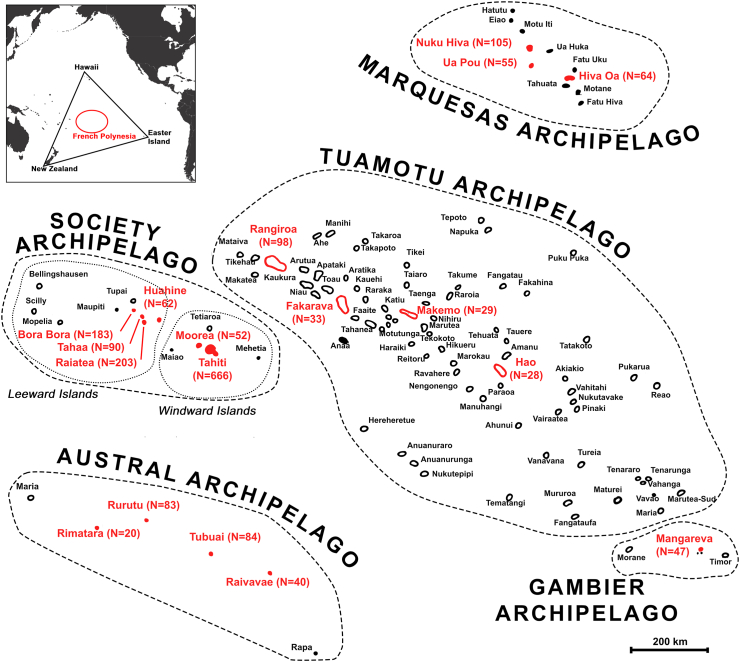
In French Polynesia, hepatitis B virus (HBV) infection appears as a major risk factor for hepatocellular carcinoma (HCC), which detection rate in the Austral archipelago is among the highest in the world. Through a nationally representative cross-sectional survey of the adult population, this study aimed at assessing the prevalence of HBV, but also hepatitis C virus (HCV), and hepatitis delta virus (HDV).
A total of 1942 blood samples from participants aged 18-69 years were tested for anti-HBc, anti-HBs, HBsAg, anti-HCV IgG, and HDV RNA. Complete genome sequencing of detected HBV strains was performed.
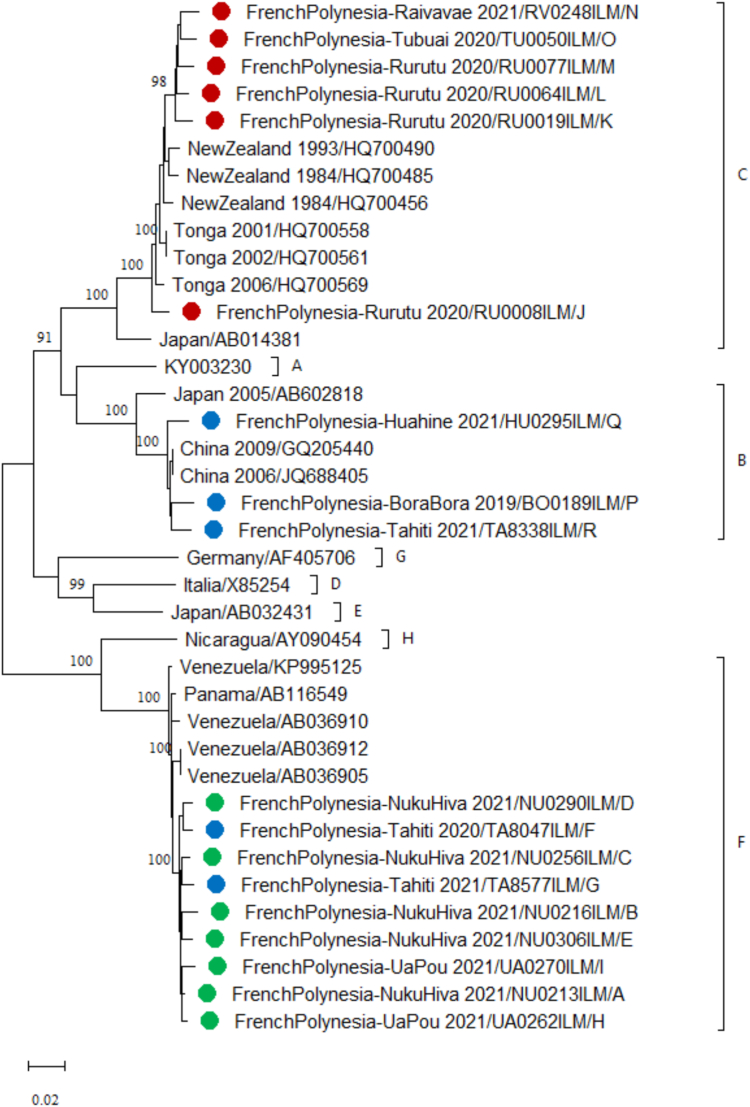
Among participants, 315/1834, 582/1834, 33/1834, 0/1857, and 0/33 tested positive for anti-HBc, anti-HBs, HBsAg, anti-HCV IgG, and HDV RNA, respectively. The population prevalence of HBsAg was estimated at 1.0% (95% CI: 0.6-1.7). All HBsAg carriers were born in French Polynesia before vaccination at birth became mandatory. In multivariate analyses, identified factors associated with HBsAg carriage included: the archipelago of residence ( < 0.0001), age ( < 0.0001), and education level ( = 0.0077). HBV genotypes B, C, and F were detected.
French Polynesia has a low endemicity level of HBV and its population may be considered at low risk for HCV and HDV infection. However, prevalence of HBsAg was found concerning in Austral (3.8%; 95% CI: 1.9-7.5) and Marquesas (6.5%; 95% CI: 3.8-11) archipelagoes. In the Austral archipelago, the presence of genotype C may account for the elevated rate of HCC. Our findings warrant more efforts to improve access to detection, prevention and care to people born before the systematic vaccination policy application, and residing in higher-risk areas, to achieve HBV elimination in French Polynesia.
Research Delegation of French Polynesia.
在法属波利尼西亚,乙型肝炎病毒(HBV)感染似乎是肝细胞癌(HCC)的主要危险因素,该疾病在奥斯塔拉群岛的检出率位居世界前列。通过一项具有全国代表性的成年人口横断面调查,本研究旨在评估HBV、丙型肝炎病毒(HCV)和丁型肝炎病毒(HDV)的流行情况。
对1942名年龄在18 - 69岁的参与者的血液样本进行抗-HBc、抗-HBs、HBsAg、抗-HCV IgG和HDV RNA检测。对检测到的HBV毒株进行全基因组测序。
在参与者中,抗-HBc、抗-HBs、HBsAg、抗-HCV IgG和HDV RNA检测呈阳性的分别有315/1834、582/1834、33/1834、0/1857和0/33。HBsAg的人群患病率估计为1.0%(95%置信区间:0.6 - 1.7)。所有HBsAg携带者均在法属波利尼西亚出生,且出生时强制接种疫苗政策尚未实施。在多变量分析中,与HBsAg携带相关的因素包括:居住群岛(<0.0001)、年龄(<0.0001)和教育水平(=0.0077)。检测到HBV基因型B、C和F。
法属波利尼西亚的HBV地方流行程度较低,其人群可被视为HCV和HDV感染的低风险人群。然而,在奥斯塔拉群岛(3.8%;95%置信区间:1.9 - 7.5)和马克萨斯群岛(6.5%;95%置信区间:3.8 - 11)发现HBsAg患病率令人担忧。在奥斯塔拉群岛,C基因型的存在可能是HCC发病率升高的原因。我们的研究结果表明,需要做出更多努力,以改善在系统性疫苗接种政策实施之前出生且居住在高风险地区的人群获得检测、预防和治疗的机会,从而在法属波利尼西亚实现HBV的消除。
法属波利尼西亚研究代表团。