Teiti Iotefa, Aubry Maite, Fernandes-Pellerin Sandrine, Patin Etienne, Madec Yoann, Boucheron Pauline, Vanhomwegen Jessica, Torterat Jérémie, Lastère Stéphane, Olivier Sophie, Jaquaniello Anthony, Roux Maguelonne, Mendiboure Vincent, Harmant Christine, Bisiaux Aurélie, Rijo de León Gaston, Liu Dang, Bossin Hervé, Mathieu-Daudé Françoise, Gatti Clémence, Suhas Edouard, Chung Kiyojiken, Condat Bertrand, Ayotte Pierre, Conte Eric, Jolly Nathalie, Manuguerra Jean-Claude, Sakuntabhai Anavaj, Fontanet Arnaud, Quintana-Murci Lluis, Cao-Lormeau Van-Mai
Laboratory of Research on Emerging Viral Diseases, Institut Louis Malardé, Papeete, French Polynesia.
Center for Translational Sciences, Institut Pasteur, Paris, France.
Front Epidemiol. 2023 Nov 27;3:1201038. doi: 10.3389/fepid.2023.1201038. eCollection 2023.
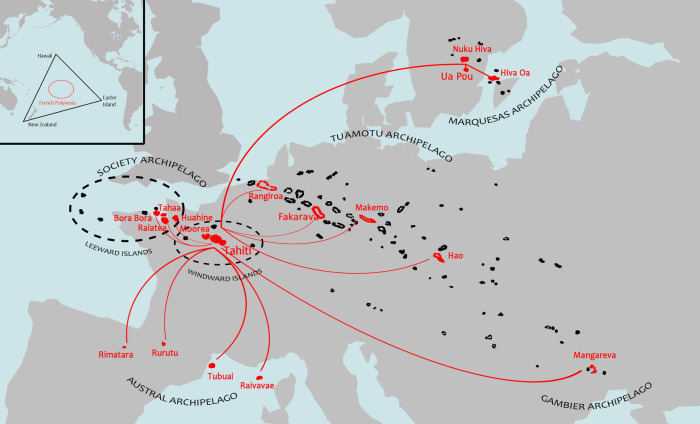
French Polynesia is a French overseas collectivity in the Southeast Pacific, comprising 75 inhabited islands across five archipelagoes. The human settlement of the region corresponds to the last massive migration of humans to empty territories, but its timeline is still debated. Despite their recent population history and geographical isolation, inhabitants of French Polynesia experience health issues similar to those of continental countries. Modern lifestyles and increased longevity have led to a rise in non-communicable diseases (NCDs) such as obesity, diabetes, hypertension, and cardiovascular diseases. Likewise, international trade and people mobility have caused the emergence of communicable diseases (CDs) including mosquito-borne and respiratory diseases. Additionally, chronic pathologies including acute rheumatic fever, liver diseases, and ciguatera, are highly prevalent in French Polynesia. However, data on such diseases are scarce and not representative of the geographic fragmentation of the population.
The present project aims to estimate the prevalence of several NCDs and CDs in the population of the five archipelagoes, and identify associated risk factors. Moreover, genetic analyses will contribute to determine the sequence and timings of the peopling history of French Polynesia, and identify causal links between past genetic adaptation to island environments, and present-day susceptibility to certain diseases.
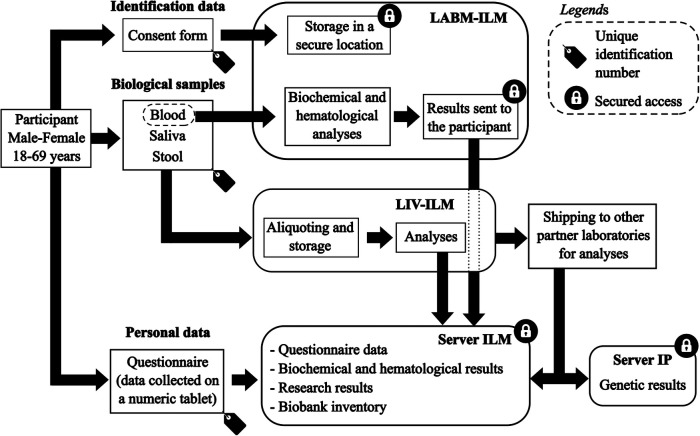
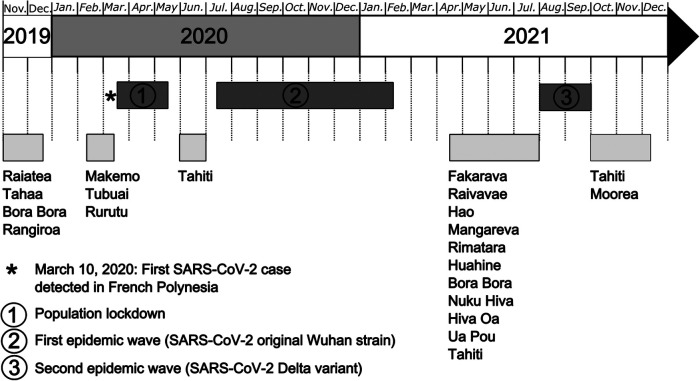
This cross-sectional survey is based on the random selection of 2,100 adults aged 18-69 years and residing on 18 islands from the five archipelagoes. Each participant answered a questionnaire on a wide range of topics (including demographic characteristics, lifestyle habits and medical history), underwent physical measurements (height, weight, waist circumference, arterial pressure, and skin pigmentation), and provided biological samples (blood, saliva, and stool) for biological, genetic and microbiological analyses.
For the first time in French Polynesia, the present project allows to collect a wide range of data to explore the existence of indicators and/or risk factors for multiple pathologies of public health concern. The results will help health authorities to adapt actions and preventive measures aimed at reducing the incidence of NCDs and CDs. Moreover, the new genomic data generated in this study, combined with anthropological data, will increase our understanding of the peopling history of French Polynesia.
https://clinicaltrials.gov/, identifier: NCT06133400.
法属波利尼西亚是法国在东南太平洋的一个海外领地,由五个群岛中的75个有人居住的岛屿组成。该地区的人类定居对应于人类最后一次大规模迁移到空旷地区,但具体时间线仍存在争议。尽管法属波利尼西亚居民近期有其人口历史且地理上相对隔离,但他们面临的健康问题与大陆国家相似。现代生活方式和寿命延长导致肥胖、糖尿病、高血压和心血管疾病等非传染性疾病(NCDs)增多。同样,国际贸易和人员流动导致了包括蚊媒疾病和呼吸道疾病在内的传染病(CDs)的出现。此外,包括急性风湿热、肝病和雪卡毒素中毒在内的慢性疾病在法属波利尼西亚也非常普遍。然而,关于这些疾病的数据稀缺,且不能代表该地区人口的地理分布情况。
本项目旨在估计五个群岛人口中几种非传染性疾病和传染病的患病率,并确定相关风险因素。此外,基因分析将有助于确定法属波利尼西亚人类定居历史的顺序和时间,并确定过去对岛屿环境的基因适应与当今对某些疾病易感性之间的因果联系。
这项横断面调查基于从五个群岛的18个岛屿中随机选择2100名年龄在18 - 69岁的成年人。每位参与者回答了一份关于广泛主题的问卷(包括人口统计学特征、生活方式习惯和病史),接受了身体测量(身高、体重、腰围、动脉血压和皮肤色素沉着),并提供了生物样本(血液、唾液和粪便)用于生物学、基因和微生物学分析。
本项目首次在法属波利尼西亚收集了广泛的数据,以探索公共卫生关注的多种疾病的指标和/或风险因素的存在情况。研究结果将有助于卫生当局调整旨在降低非传染性疾病和传染病发病率的行动和预防措施。此外,本研究产生的新基因组数据与人类学数据相结合,将增进我们对法属波利尼西亚人类定居历史的理解。