
SARS-CoV-2 毒力因子 ORF3a 通过调节 TBC1D5 依赖性 Rab7 GTP 酶循环来阻断溶酶体功能。
SARS-CoV-2 virulence factor ORF3a blocks lysosome function by modulating TBC1D5-dependent Rab7 GTPase cycle.
机构信息
Division of Cell Biology and Immunology, CSIR-Institute of Microbial Technology (IMTECH), Chandigarh, India.
Academy of Scientific and Innovative Research (AcSIR), Ghaziabad, Uttar Pradesh, India.
出版信息
Nat Commun. 2024 Mar 6;15(1):2053. doi: 10.1038/s41467-024-46417-2.
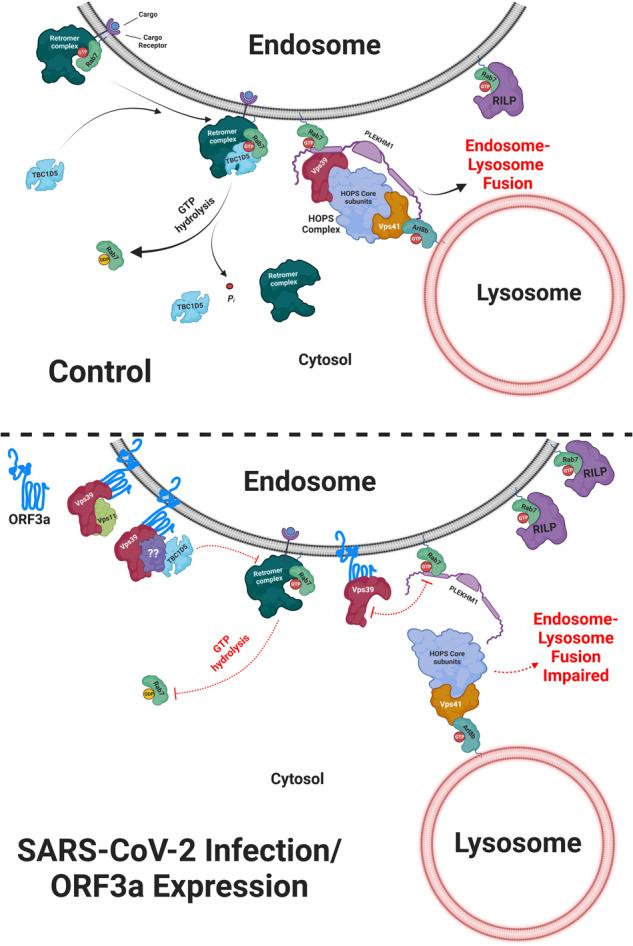
SARS-CoV-2, the causative agent of COVID-19, uses the host endolysosomal system for entry, replication, and egress. Previous studies have shown that the SARS-CoV-2 virulence factor ORF3a interacts with the lysosomal tethering factor HOPS complex and blocks HOPS-mediated late endosome and autophagosome fusion with lysosomes. Here, we report that SARS-CoV-2 infection leads to hyperactivation of the late endosomal and lysosomal small GTP-binding protein Rab7, which is dependent on ORF3a expression. We also observed Rab7 hyperactivation in naturally occurring ORF3a variants encoded by distinct SARS-CoV-2 variants. We found that ORF3a, in complex with Vps39, sequesters the Rab7 GAP TBC1D5 and displaces Rab7 from this complex. Thus, ORF3a disrupts the GTP hydrolysis cycle of Rab7, which is beneficial for viral production, whereas the Rab7 GDP-locked mutant strongly reduces viral replication. Hyperactivation of Rab7 in ORF3a-expressing cells impaired CI-M6PR retrieval from late endosomes to the trans-Golgi network, disrupting the biosynthetic transport of newly synthesized hydrolases to lysosomes. Furthermore, the tethering of the Rab7- and Arl8b-positive compartments was strikingly reduced upon ORF3a expression. As SARS-CoV-2 egress requires Arl8b, these findings suggest that ORF3a-mediated hyperactivation of Rab7 serves a multitude of functions, including blocking endolysosome formation, interrupting the transport of lysosomal hydrolases, and promoting viral egress.
SARS-CoV-2 是 COVID-19 的病原体,它利用宿主内体溶酶体系统进行进入、复制和出芽。先前的研究表明,SARS-CoV-2 的毒力因子 ORF3a 与溶酶体连接因子 HOPS 复合物相互作用,并阻断 HOPS 介导的晚期内体和自噬体与溶酶体融合。在这里,我们报告 SARS-CoV-2 感染导致晚期内体和溶酶体小 GTP 结合蛋白 Rab7 的过度激活,这依赖于 ORF3a 的表达。我们还观察到由不同 SARS-CoV-2 变体编码的天然存在的 ORF3a 变体导致 Rab7 过度激活。我们发现,ORF3a 与 Vps39 形成复合物,将 Rab7 GAP TBC1D5 隔离,并将 Rab7 从该复合物中置换出来。因此,ORF3a 破坏了 Rab7 的 GTP 水解循环,这有利于病毒的产生,而 Rab7 GDP 锁定突变体则强烈降低病毒的复制。ORF3a 表达细胞中 Rab7 的过度激活损害了 CI-M6PR 从晚期内体到反式高尔基网络的回收,破坏了新合成的水解酶到溶酶体的生物合成运输。此外,在表达 ORF3a 后,Rab7 和 Arl8b 阳性隔室的连接明显减少。由于 SARS-CoV-2 的出芽需要 Arl8b,这些发现表明,ORF3a 介导的 Rab7 过度激活具有多种功能,包括阻断内体溶酶体的形成、中断溶酶体水解酶的运输以及促进病毒出芽。


 Zotero 插件