School of Biological and Behavioural Sciences, Queen Mary University of London, London, UK.
School of Biosciences, University of Sheffield, Sheffield, UK.
Nature. 2024 Mar;627(8004):572-578. doi: 10.1038/s41586-024-07126-4. Epub 2024 Mar 6.
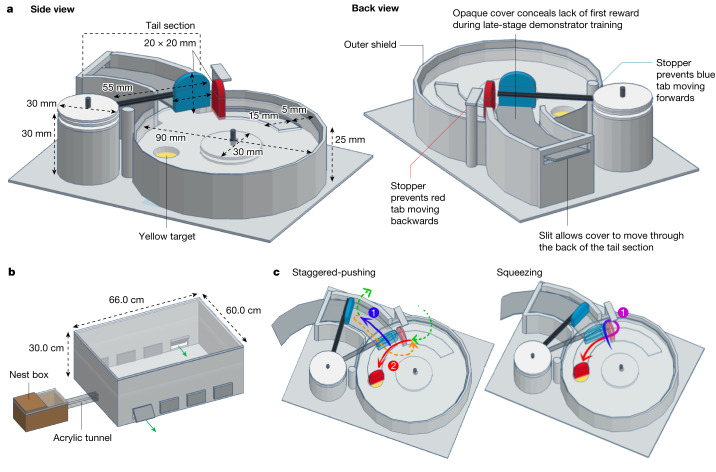
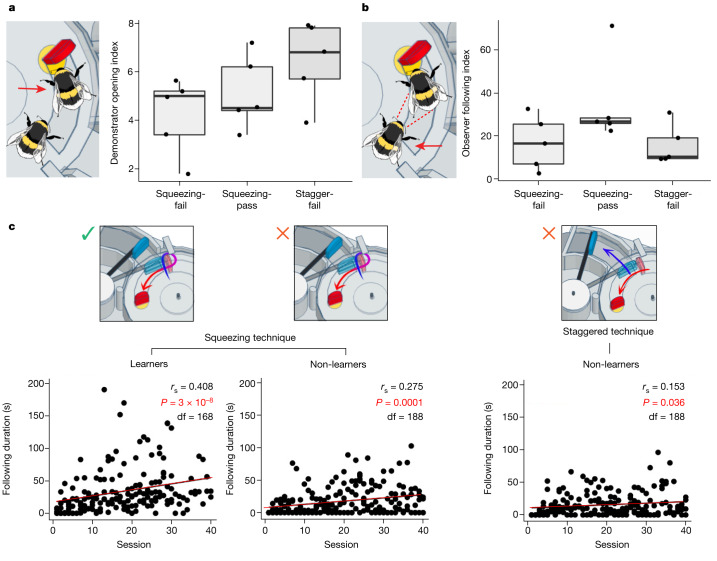
Culture refers to behaviours that are socially learned and persist within a population over time. Increasing evidence suggests that animal culture can, like human culture, be cumulative: characterized by sequential innovations that build on previous ones. However, human cumulative culture involves behaviours so complex that they lie beyond the capacity of any individual to independently discover during their lifetime. To our knowledge, no study has so far demonstrated this phenomenon in an invertebrate. Here we show that bumblebees can learn from trained demonstrator bees to open a novel two-step puzzle box to obtain food rewards, even though they fail to do so independently. Experimenters were unable to train demonstrator bees to perform the unrewarded first step without providing a temporary reward linked to this action, which was removed during later stages of training. However, a third of naive observer bees learned to open the two-step box from these demonstrators, without ever being rewarded after the first step. This suggests that social learning might permit the acquisition of behaviours too complex to 're-innovate' through individual learning. Furthermore, naive bees failed to open the box despite extended exposure for up to 24 days. This finding challenges a common opinion in the field: that the capacity to socially learn behaviours that cannot be innovated through individual trial and error is unique to humans.
文化是指在一段时间内,在一个群体中通过社会学习而持续存在的行为。越来越多的证据表明,动物文化可以像人类文化一样是累积的:以连续创新为特征,这些创新建立在前一个创新的基础上。然而,人类的累积文化涉及到如此复杂的行为,以至于任何个体在其一生中都无法独立发现。据我们所知,目前还没有研究在无脊椎动物中证明这一现象。在这里,我们表明,熊蜂可以向经过训练的示教蜂学习,打开一个新颖的两步解谜盒来获得食物奖励,尽管它们无法独立完成。实验者无法在不提供与该动作相关的临时奖励的情况下,训练示教蜂执行无奖励的第一步,而在训练的后期阶段会移除这个奖励。然而,三分之一的无经验观察蜂从这些示教蜂那里学会了打开两步箱,在第一步之后从未得到过奖励。这表明,社会学习可能允许获得过于复杂而无法通过个体学习“重新创新”的行为。此外,尽管无经验的蜜蜂暴露在盒子前长达 24 天,但它们仍然无法打开盒子。这一发现挑战了该领域的一个普遍观点,即通过个体反复试验和错误来学习无法创新的行为的能力是人类所独有的。