Cognitive and Cultural Ecology Research Group, Max Planck Institute of Animal Behavior, Am Obstberg 1, 78315, Radolfzell, Germany.
Centre for the Advanced Study of Collective Behaviour, University of Konstanz, Konstanz, Germany.
Philos Trans R Soc Lond B Biol Sci. 2022 Jan 31;377(1843):20200307. doi: 10.1098/rstb.2020.0307. Epub 2021 Dec 13.
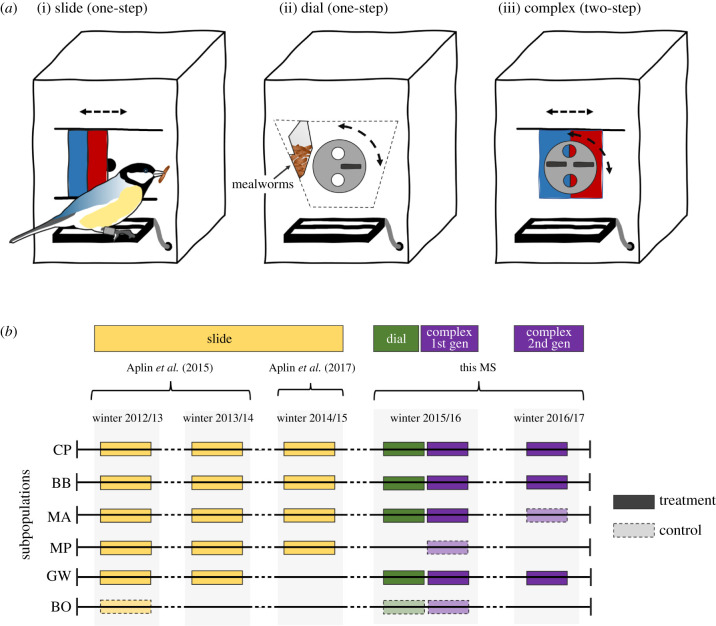
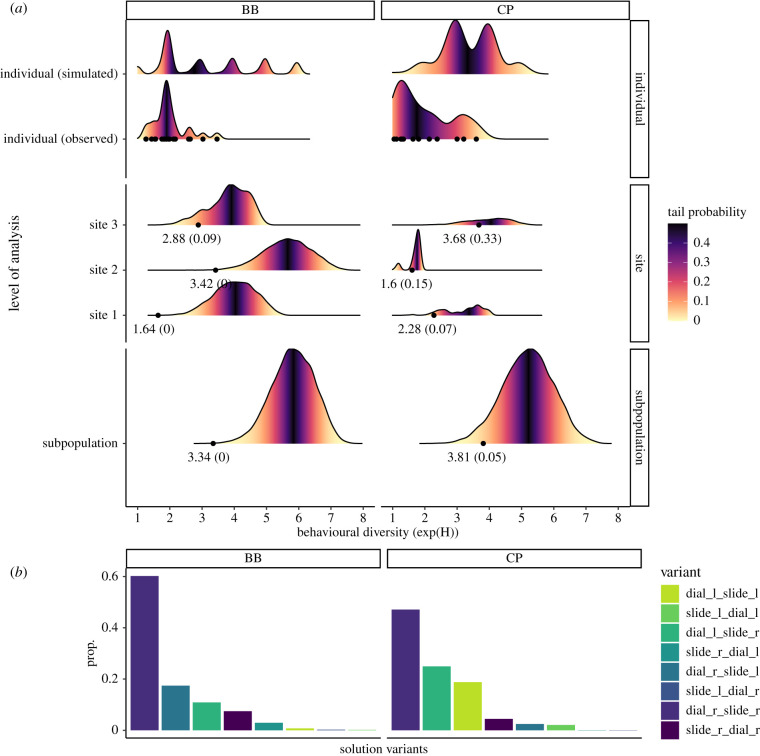
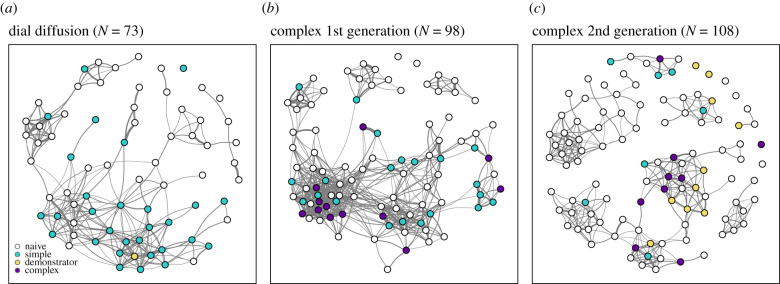
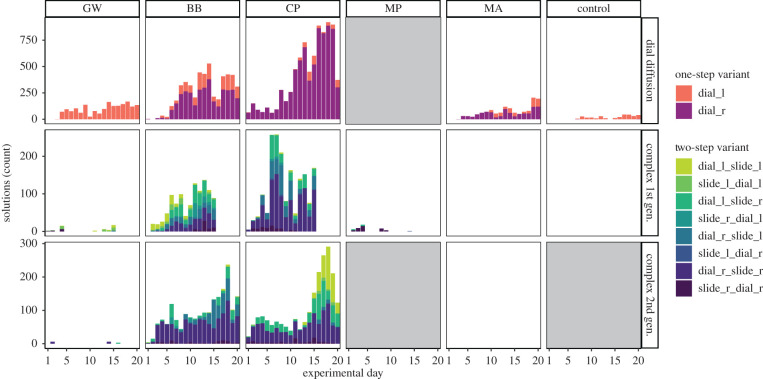
Recent well-documented cases of cultural evolution towards increasing efficiency in non-human animals have led some authors to propose that other animals are also capable of cumulative cultural evolution, where traits become more refined and/or complex over time. Yet few comparative examples exist of traits increasing in complexity, and experimental tests remain scarce. In a previous study, we introduced a foraging innovation into replicate subpopulations of great tits, the 'sliding-door puzzle'. Here, we track diffusion of a second 'dial puzzle', before introducing a two-step puzzle that combines both actions. We mapped social networks across two generations to ask if individuals could: (1) recombine socially-learned traits and (2) socially transmit a two-step trait. Our results show birds could recombine skills into more complex foraging behaviours, and naïve birds across both generations could learn the two-step trait. However, closer interrogation revealed that acquisition was not achieved entirely through social learning-rather, birds socially learned components before reconstructing full solutions asocially. As a consequence, singular cultural traditions failed to emerge, although subpopulations of birds shared preferences for a subset of behavioural variants. Our results show that while tits can socially learn complex foraging behaviours, these may need to be scaffolded by rewarding each component. This article is part of a discussion meeting issue 'The emergence of collective knowledge and cumulative culture in animals, humans and machines'.
最近有大量文献记载的非人类动物文化进化的案例,促使一些作者提出其他动物也能够进行累积文化进化,即特征随着时间的推移变得更加精细和/或复杂。然而,具有复杂特征增加的比较案例很少,实验测试仍然很少。在之前的一项研究中,我们在大山雀的重复亚种群中引入了一种觅食创新,即“滑动门谜题”。在这里,我们在引入两步谜题之前,追踪了第二个“拨号谜题”的扩散情况,该谜题结合了两种动作。我们绘制了两代人的社交网络,以询问个体是否可以:(1)重新组合社会习得的特征,以及(2)社会传播两步特征。我们的结果表明,鸟类可以将技能组合成更复杂的觅食行为,并且两代的天真鸟类都可以学习两步特征。然而,更仔细的询问表明,获得该特征并非完全通过社会学习——相反,鸟类是在非社会性地重建完整解决方案之前,先从社会中学习各个组成部分。因此,虽然单个文化传统没有出现,但鸟类的亚种群对行为变体的子集存在偏好。我们的结果表明,虽然山雀可以通过社会学习来掌握复杂的觅食行为,但这些行为可能需要通过奖励每个组成部分来进行支撑。本文是关于“动物、人类和机器中集体知识和累积文化的出现”讨论会议的一部分。