London Centre for Neglected Tropical Disease Research, Department of Infectious Disease Epidemiology, Faculty of Medicine, St Marys Campus, Imperial College London, London, UK.
Bacterial, Parasitic and Zoonotic Disease Research Directorate, Ethiopian Public Health Institute, Addis Ababa, Ethiopia.
Parasit Vectors. 2024 Mar 6;17(1):113. doi: 10.1186/s13071-024-06156-1.
This paper describes changes in the prevalence and intensity of schistosome parasite infections in a project integrating mass drug administration (MDA), water, sanitation, and hygiene (WaSH), and behavioral change interventions.
The Geshiyaro Project comprises three intervention arms. Arm 1 is subdivided into "Arm 1 pilot" (one district) and Arm 1 (four other districts), both receiving integrated community-wide MDA with intensive WaSH interventions. Arm 2 involves 17 districts with community-wide MDA interventions, while Arm 3 serves as a control with school-based MDA interventions in three districts. A total of 150 individuals, stratified by age group, were randomly selected from each of the 45 sentinel sites. Arm sizes were 584 (Arm 1 pilot), 1636 (Arm 1), 2203 (Arm 2), and 2238 (Arm 3). Statistical tests were employed to compare infection prevalence and intensity across the different arms.
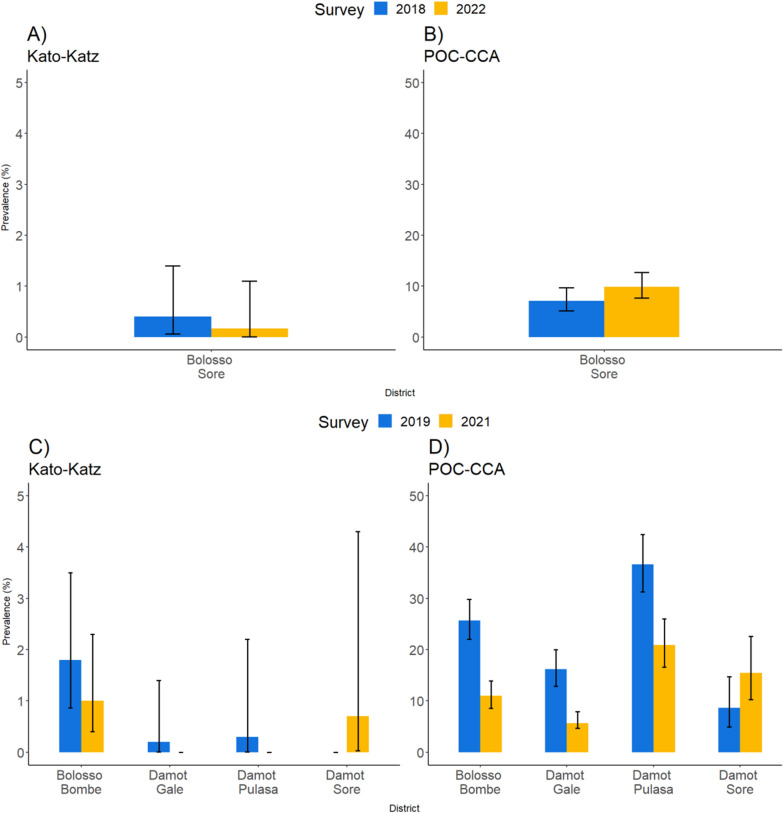
The prevalence of schistosome parasite infection ranged from 0% to 2.6% and from 1.7% to 25.7% across districts, employing the Kato-Katz (KK) and point-of-care circulating cathodic antigen (POC-CCA) diagnostics, respectively. The mean infection intensity level showed no marked difference between baseline and follow-up surveys when measured by KK, except in Arm 2 (t = 6.89, P < 0.0001). Infection prevalence decreased significantly in Arm 1 (t = 8.62, P < 0.0001), Arm 2 (t = 6.94, P < 0.0001), and Arm 3 (t = 8.83, P < 0.0001), but not in Arm 1 pilot (t = 1.69, P = 0.09) by POC-CCA, when trace was considered positive. The decrease was significant only in Arm 1 (t = 3.28, P = 0.0001) and Arm 2 (t = 7.62, P < 0.0001) when the trace was considered negative in POC-CCA. Arm 2 demonstrated a significant difference in difference (DID) compared to the control group, Arm 3, regardless of whether trace in POC-CCA was considered positive (DID = 3.9%, df = 8780, P = 0.025) or negative (DID = -5.2, df = 8780, P = 0.0004).
The prevalence of schistosomiasis was low when employing the KK diagnostic but moderate in some locations by the POC-CCA diagnostic. The infection level had decreased across all arms of the Geshiyaro study at mid-term of the 7-year project, but further efforts are needed to reduce the rate of parasite transmission based on the POC-CCA diagnostic scores.
本研究描述了在一个整合大规模药物治疗(MDA)、水、环境卫生和个人卫生(WaSH)以及行为改变干预措施的项目中,血吸虫寄生虫感染的流行率和强度的变化。
Geshiyaro 项目包括三个干预组。第 1 组分为“第 1 组试点”(一个区)和第 1 组(其他四个区),均接受综合社区范围的 MDA 以及强化 WaSH 干预。第 2 组涉及 17 个区的社区范围 MDA 干预,而第 3 组作为对照,在三个区进行基于学校的 MDA 干预。每个哨点从年龄组中随机选择 150 人。各组规模分别为 584(第 1 组试点)、1636(第 1 组)、2203(第 2 组)和 2238(第 3 组)。采用统计学检验比较不同组的感染流行率和强度。
采用加藤厚涂片法(KK)和即时检测循环阴性质控(POC-CCA)诊断时,各地区的血吸虫寄生虫感染流行率分别为 0%至 2.6%和 1.7%至 25.7%。除第 2 组(t=6.89,P<0.0001)外,KK 测量的平均感染强度水平在基线和随访调查之间没有明显差异。当将痕迹视为阳性时,采用 POC-CCA 检测时,第 1 组(t=8.62,P<0.0001)、第 2 组(t=6.94,P<0.0001)和第 3 组(t=8.83,P<0.0001)的感染流行率显著下降,但第 1 组试点(t=1.69,P=0.09)没有下降。当将痕迹视为阴性时,仅第 1 组(t=3.28,P=0.0001)和第 2 组(t=7.62,P<0.0001)的下降具有统计学意义。无论 POC-CCA 中的痕迹是否被视为阳性(差异为 3.9%,df=8780,P=0.025)或阴性(差异为-5.2,df=8780,P=0.0004),第 2 组与对照组第 3 组相比均存在显著差异。
采用加藤厚涂片法诊断时,血吸虫病的流行率较低,但采用即时检测循环阴性质控诊断时,一些地区的流行率中等。在项目的中期,Geshiyaro 研究的所有组均观察到感染水平下降,但根据即时检测循环阴性质控检测结果,需要进一步努力降低寄生虫传播率。