Department of Neurology and Department of Cardiology, The Second Affiliated Hospital of Zhejiang University School of Medicine, Hangzhou, People's Republic of China.
New Cornerstone Science Laboratory, Liangzhu Laboratory and School of Basic Medical Sciences, Zhejiang University, Hangzhou, People's Republic of China.
Physiol Rev. 2024 Jul 1;104(3):1335-1385. doi: 10.1152/physrev.00025.2023. Epub 2024 Mar 7.
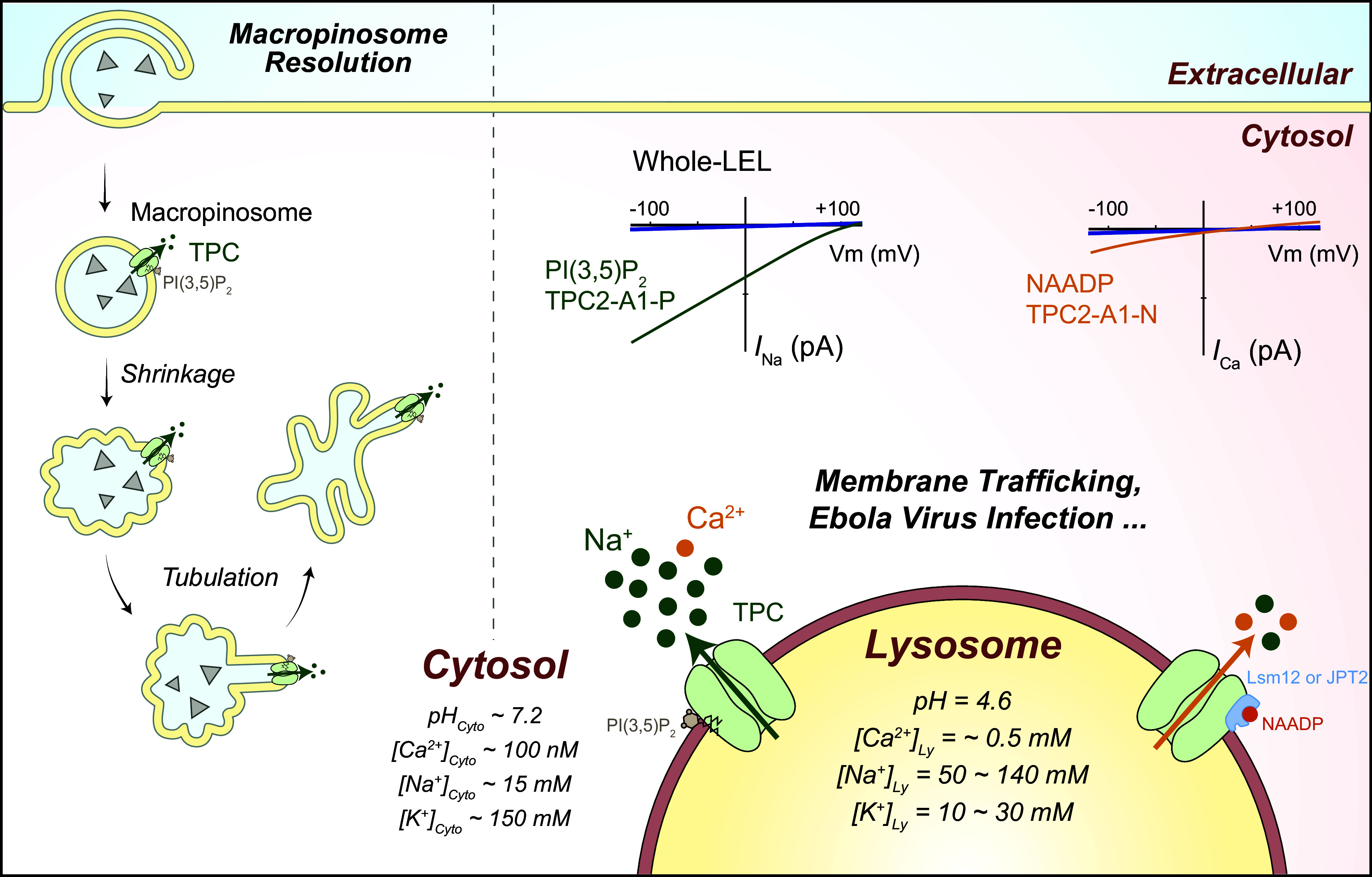
The endomembrane system consists of organellar membranes in the biosynthetic pathway [endoplasmic reticulum (ER), Golgi apparatus, and secretory vesicles] as well as those in the degradative pathway (early endosomes, macropinosomes, phagosomes, autophagosomes, late endosomes, and lysosomes). These endomembrane organelles/vesicles work together to synthesize, modify, package, transport, and degrade proteins, carbohydrates, and lipids, regulating the balance between cellular anabolism and catabolism. Large ion concentration gradients exist across endomembranes: Ca gradients for most endomembrane organelles and H gradients for the acidic compartments. Ion (Na, K, H, Ca, and Cl) channels on the organellar membranes control ion flux in response to cellular cues, allowing rapid informational exchange between the cytosol and organelle lumen. Recent advances in organelle proteomics, organellar electrophysiology, and luminal and juxtaorganellar ion imaging have led to molecular identification and functional characterization of about two dozen endomembrane ion channels. For example, whereas IP3R1-3 channels mediate Ca release from the ER in response to neurotransmitter and hormone stimulation, TRPML1-3 and TMEM175 channels mediate lysosomal Ca and H release, respectively, in response to nutritional and trafficking cues. This review aims to summarize the current understanding of these endomembrane channels, with a focus on their subcellular localizations, ion permeation properties, gating mechanisms, cell biological functions, and disease relevance.
内质网(endoplasmic reticulum,ER)、高尔基体和分泌小泡等生物合成途径中的细胞器膜以及早期内体、大胞饮泡、吞噬体、自噬体、晚期内体和溶酶体等降解途径中的细胞器膜共同构成了内膜系统。这些内膜系统中的细胞器/小泡共同作用,合成、修饰、包装、运输和降解蛋白质、碳水化合物和脂质,调节细胞合成代谢和分解代谢之间的平衡。在内膜系统中存在着大的离子浓度梯度:大多数内膜系统细胞器中的 Ca 梯度和酸性隔室中的 H 梯度。细胞器膜上的离子(Na、K、H、Ca 和 Cl)通道根据细胞信号控制离子流,允许细胞质和细胞器腔之间快速进行信息交换。近年来,在内质网蛋白组学、细胞器电生理学和腔内外离子成像方面的进展,使大约二十几种内膜系统离子通道的分子鉴定和功能特征得以确定。例如,IP3R1-3 通道介导神经递质和激素刺激时 ER 中的 Ca 释放,而 TRPML1-3 和 TMEM175 通道分别响应营养和运输信号介导溶酶体 Ca 和 H 释放。本综述旨在总结这些内膜系统通道的最新研究进展,重点介绍它们的亚细胞定位、离子渗透特性、门控机制、细胞生物学功能和疾病相关性。