Department of Oncology, The First Affiliated Hospital, Jiangxi Medical College, Nanchang University, Nanchang, Jiangxi Province, 330006, China.
Jiangxi Key Laboratory for Individual Cancer Therapy, 17 Yongwai Street, Nanchang, Jiangxi Province, 330006, China.
Cell Commun Signal. 2024 Mar 7;22(1):168. doi: 10.1186/s12964-024-01541-w.
The effectiveness of anti-programmed cell death protein 1(PD-1)/programmed cell death 1 ligand 1(PD-L1) therapy in treating certain types of cancer is associated with the level of PD-L1. However, this relationship has not been observed in colorectal cancer (CRC), and the underlying regulatory mechanism of PD-L1 in CRC remains unclear.
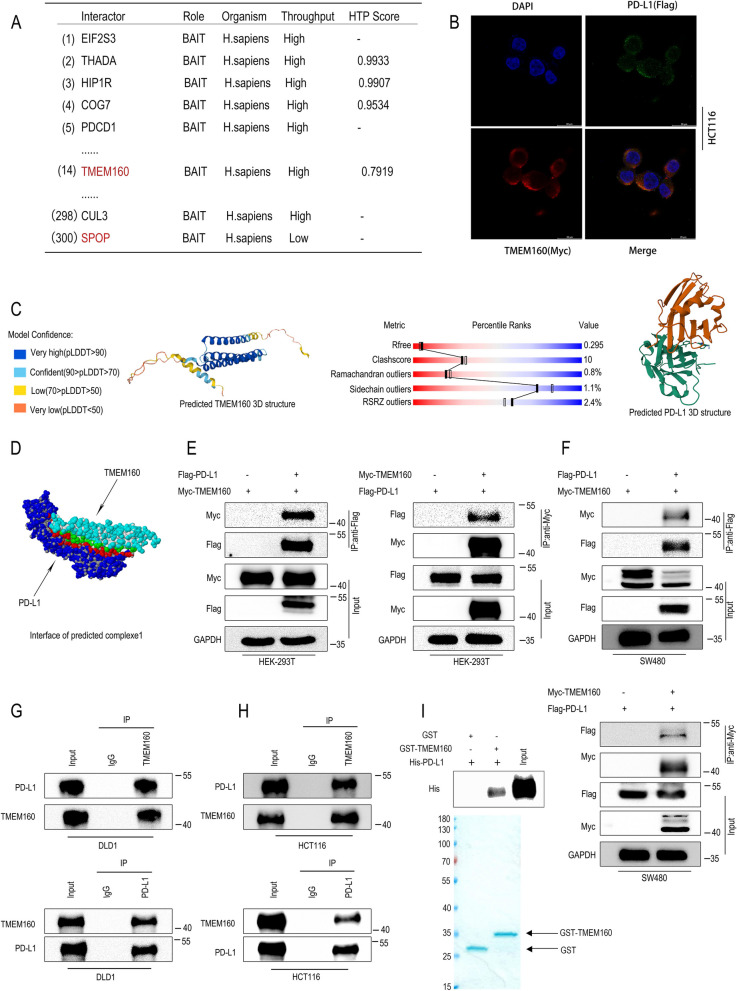
Binding of TMEM160 to PD-L1 was determined by co-immunoprecipitation (Co-IP) and GST pull-down assay.The ubiquitination levels of PD-L1 were verified using the ubiquitination assay. Phenotypic experiments were conducted to assess the role of TMEM160 in CRC cells. Animal models were employed to investigate how TMEM160 contributes to tumor growth.The expression and clinical significance of TMEM160 and PD-L1 in CRC tissues were evaluated by immunohistochemistry(IHC).
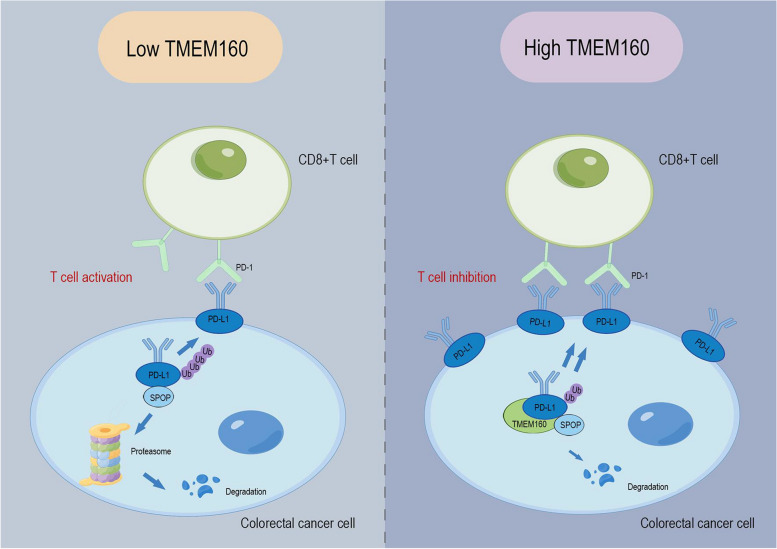
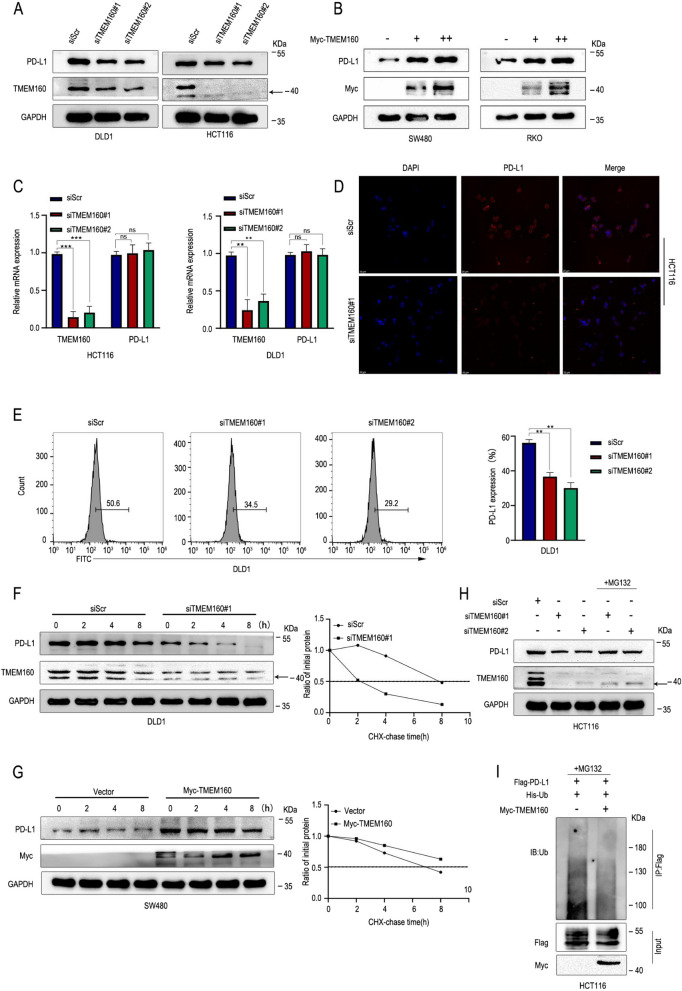
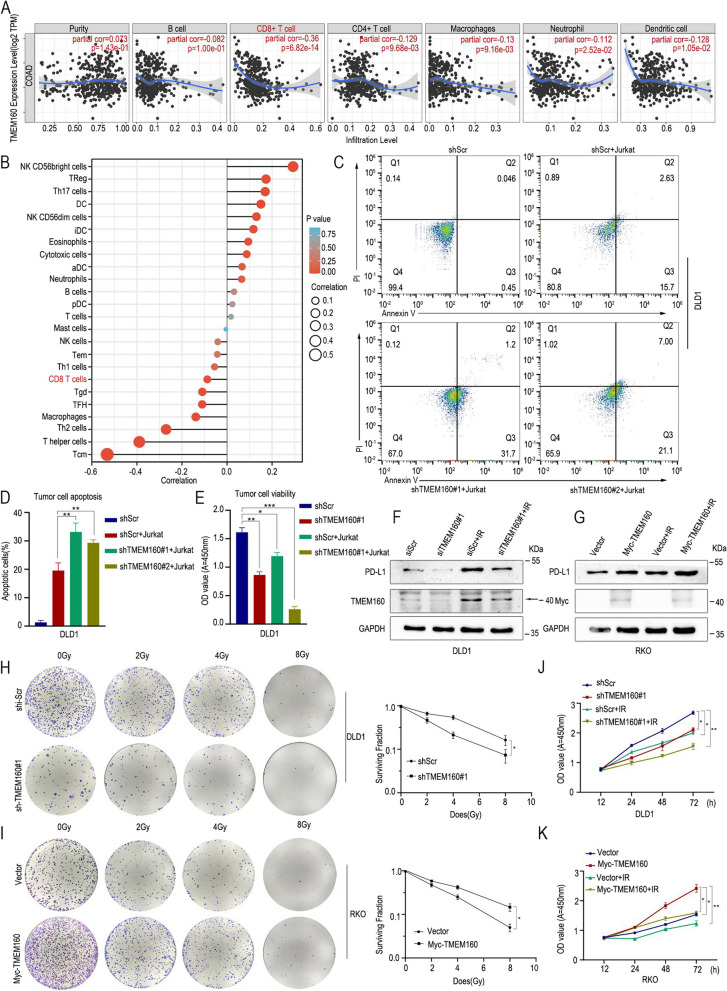
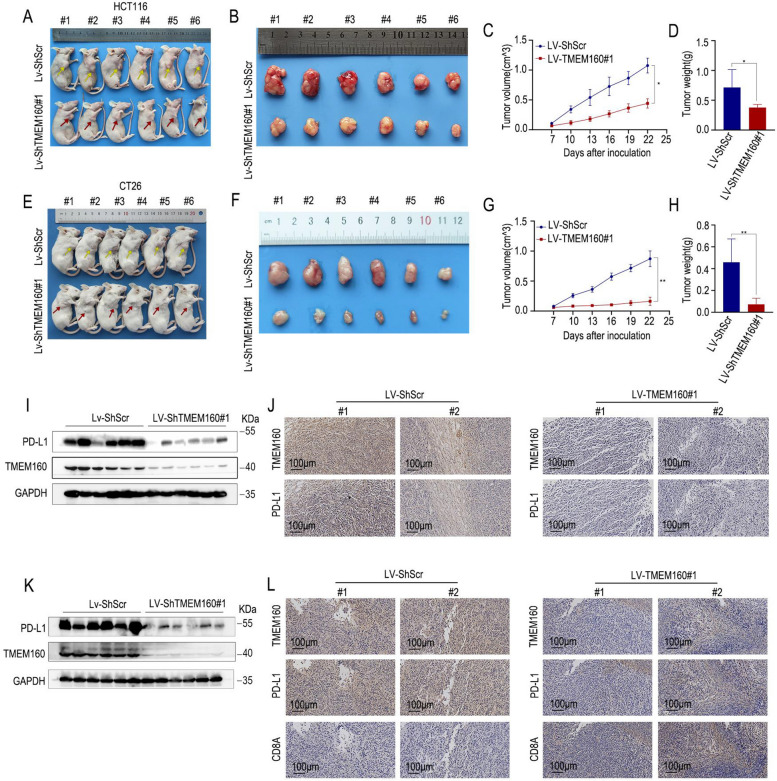
In our study, we made a discovery that TMEM160 interacts with PD-L1 and plays a role in stabilizing its expression within a CRC model. Furthermore, we demonstrated that TMEM160 hinders the ubiquitination-dependent degradation of PD-L1 by competing with SPOP for binding to PD-L1 in CRC cells. Regarding functionality, the absence of TMEM160 significantly inhibited the proliferation, invasion, metastasis, clonogenicity, and radioresistance of CRC cells, while simultaneously enhancing the cytotoxic effect of CD8 + T cells on tumor cells. Conversely, the upregulation of TMEM160 substantially increased these capabilities. In severely immunodeficient mice, tumor growth derived from lentiviral vector shTMEM160 cells was lower compared with that derived from shNC control cells. Furthermore, the downregulation of TMEM160 significantly restricted tumor growth in immune-competent BALB/c mice. In clinical samples from patients with CRC, we observed a strong positive correlation between TMEM160 expression and PD-L1 expression, as well as a negative correlation with CD8A expression. Importantly, patients with high TMEM160 expression exhibited a worse prognosis compared with those with low or no TMEM160 expression.
Our study reveals that TMEM160 inhibits the ubiquitination-dependent degradation of PD-L1 that is mediated by SPOP, thereby stabilizing PD-L1 expression to foster the malignant progress, radioresistance, and immune evasion of CRC cells. These findings suggest that TMEM160 holds potential as a target for the treatment of patients with CRC.
抗程序性细胞死亡蛋白 1(PD-1)/程序性细胞死亡配体 1(PD-L1)治疗某些类型癌症的疗效与 PD-L1 水平相关。然而,这一关系并未在结直肠癌(CRC)中观察到,PD-L1 在 CRC 中的潜在调节机制仍不清楚。
通过免疫共沉淀(Co-IP)和 GST 下拉实验确定 TMEM160 与 PD-L1 的结合。使用泛素化实验验证 PD-L1 的泛素化水平。进行表型实验以评估 TMEM160 在 CRC 细胞中的作用。使用动物模型研究 TMEM160 如何促进肿瘤生长。通过免疫组织化学(IHC)评估 CRC 组织中 TMEM160 和 PD-L1 的表达及临床意义。
在本研究中,我们发现 TMEM160 与 PD-L1 相互作用,并在 CRC 模型中发挥稳定其表达的作用。此外,我们证明 TMEM160 通过与 SPOP 竞争结合 PD-L1 来抑制 CRC 细胞中 PD-L1 的泛素化依赖性降解。在功能方面,TMEM160 的缺失显著抑制了 CRC 细胞的增殖、侵袭、转移、克隆形成和放射抵抗能力,同时增强了 CD8+T 细胞对肿瘤细胞的细胞毒性作用。相反,TMEM160 的上调则显著增强了这些能力。在严重免疫缺陷小鼠中,来自慢病毒载体 shTMEM160 细胞的肿瘤生长低于来自 shNC 对照细胞的肿瘤生长。此外,在免疫功能正常的 BALB/c 小鼠中,TMEM160 的下调显著限制了肿瘤生长。在 CRC 患者的临床样本中,我们观察到 TMEM160 表达与 PD-L1 表达之间存在强正相关,与 CD8A 表达之间存在负相关。重要的是,高 TMEM160 表达的患者预后较差,而低表达或无 TMEM160 表达的患者预后较好。
本研究揭示了 TMEM160 通过 SPOP 介导抑制 PD-L1 的泛素化依赖性降解,从而稳定 PD-L1 的表达,促进 CRC 细胞的恶性进展、放射抵抗和免疫逃逸。这些发现表明 TMEM160 可能成为治疗 CRC 患者的靶点。