
肿瘤浸润细胞在推动治疗抵抗途径中的复杂相互作用。
The complex interplay of tumor-infiltrating cells in driving therapeutic resistance pathways.
机构信息
Department of Urology, Institute of Urology, West China Hospital, Sichuan University, Chengdu, 610041, China.
Department of Rehabilitation, The Affiliated Hospital of Southwest Medical University, Luzhou, 646000, China.
出版信息
Cell Commun Signal. 2024 Aug 19;22(1):405. doi: 10.1186/s12964-024-01776-7.
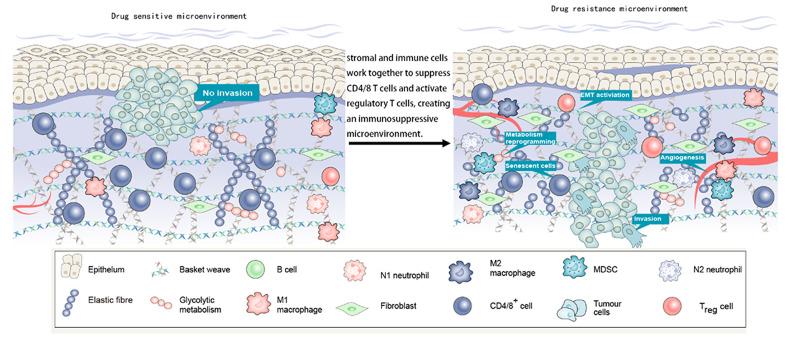
Drug resistance remains a significant challenge in cancer treatment. Recently, the interactions among various cell types within the tumor microenvironment (TME) have deepened our understanding of the mechanisms behind treatment resistance. Therefore, this review aims to synthesize current research focusing on infiltrating cells and drug resistance suggesting that targeting the TME could be a viable strategy to combat this issue. Numerous factors, including inflammation, metabolism, senescence, hypoxia, and angiogenesis, contribute to drug resistance could be a viable strategy to combat this issue. Overexpression of STAT3 is commonly associated with drug-resistant cancer cells or stromal cells. Current research often generalizes the impact of stromal cells on resistance, lacking specificity and statistical robustness. Thus, future research should take notice of this issue and aim to provide high-quality evidence. Despite the existing limitations, targeting the TME to overcome therapy resistance hold promising and valuable potential.
耐药性仍然是癌症治疗的重大挑战。最近,肿瘤微环境(TME)中各种细胞类型之间的相互作用加深了我们对治疗耐药背后机制的理解。因此,本综述旨在综合目前关于浸润细胞与耐药性的研究,表明靶向 TME 可能是对抗这一问题的可行策略。许多因素,包括炎症、代谢、衰老、缺氧和血管生成,都与耐药性有关,靶向 TME 可能是对抗这一问题的可行策略。STAT3 的过度表达通常与耐药性癌细胞或基质细胞有关。目前的研究通常将基质细胞对耐药性的影响概括化,缺乏特异性和统计稳健性。因此,未来的研究应该注意到这个问题,并旨在提供高质量的证据。尽管存在现有局限性,但靶向 TME 以克服治疗耐药性具有很大的潜力。


 Zotero 插件