Division of Public Health Sciences, Department of Surgery, Washington University School of Medicine, 660 South Euclid Avenue, Campus Box 8100, St. Louis, MO, 63110, USA.
Department of Surgery, Washington University School of Medicine, St. Louis, MO, USA.
Breast Cancer Res. 2024 Mar 7;26(1):39. doi: 10.1186/s13058-024-01804-x.
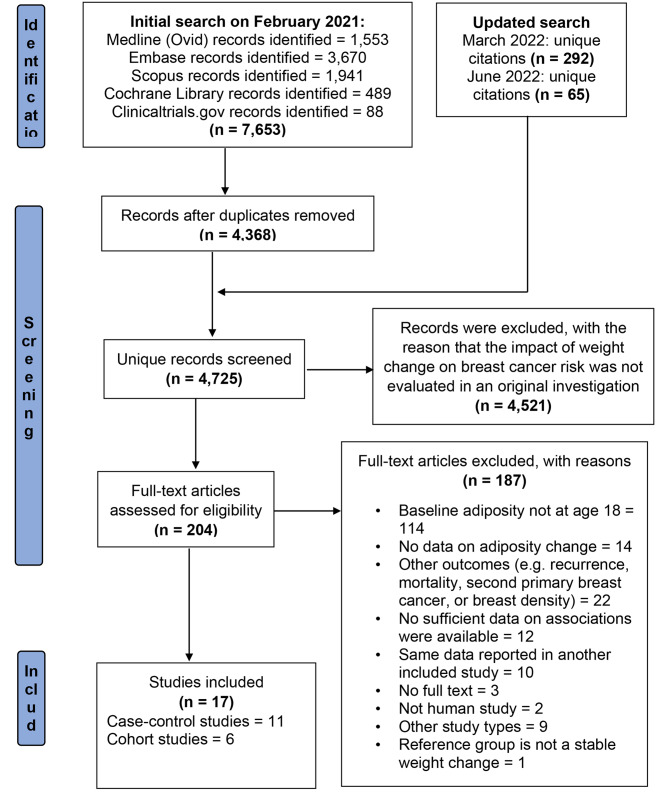
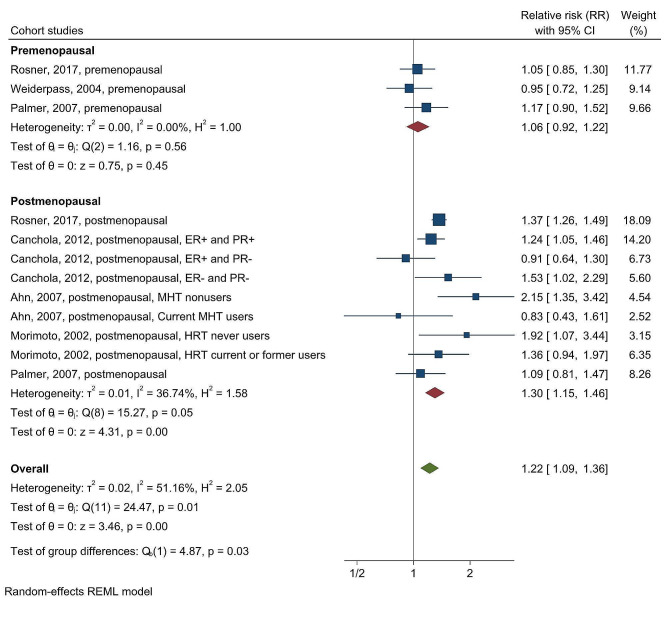
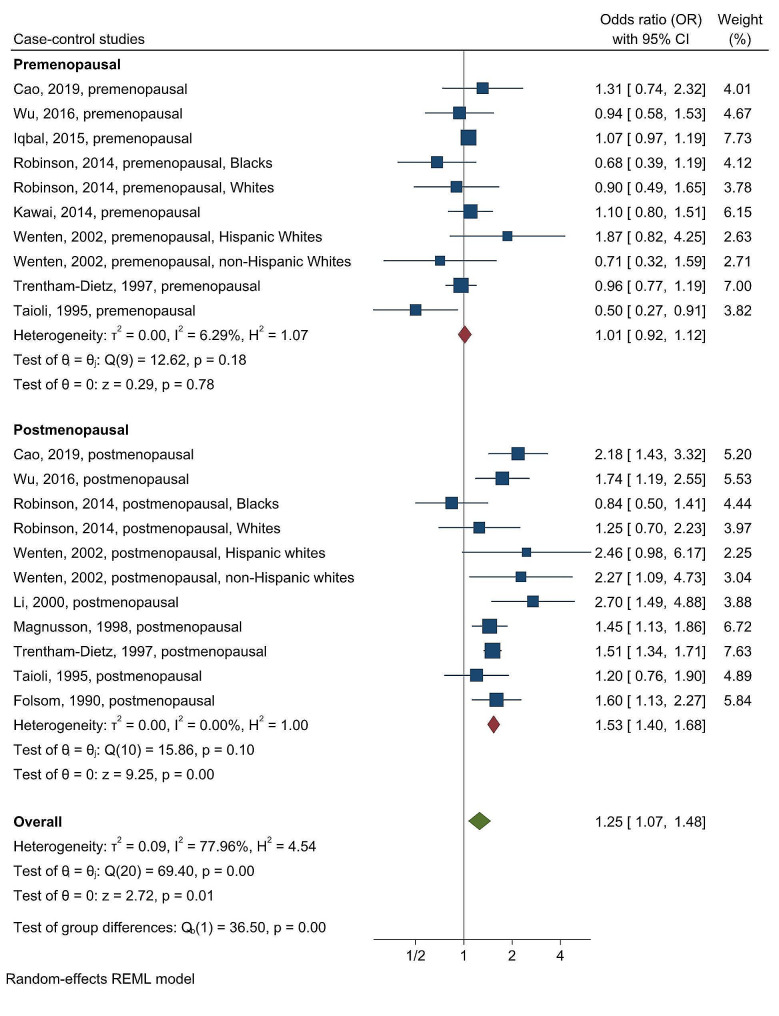
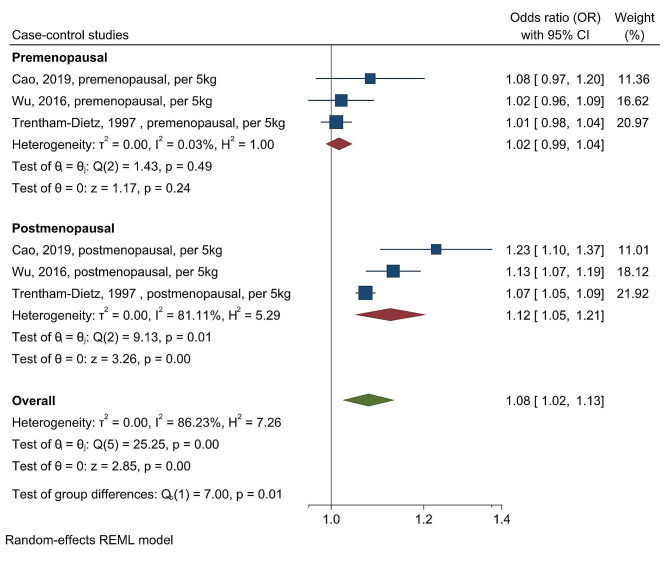
Early life factors are important risk factors for breast cancer. The association between weight gain after age 18 and breast cancer risk is inconsistent across previous epidemiologic studies. To evaluate this association, we conducted a meta-analysis according to PRISMA guidelines and the established inclusion criteria. We performed a comprehensive literature search using Medline (Ovid), Embase, Scopus, Cochrane Library, and ClinicalTrials.gov to identify relevant studies published before June 3, 2022. Two reviewers independently reviewed the articles for final inclusion. Seventeen out of 4,725 unique studies met the selection criteria. The quality of studies was assessed using the Newcastle-Ottawa Scale (NOS), and all were of moderate to high quality with NOS scores ranging from 5 to 8. We included 17 studies (11 case-control, 6 cohort) in final analysis. In case-control studies, weight gain after age 18 was associated with an increased risk of breast cancer (odds ratio [OR] = 1.25; 95% CI = 1.07-1.48), when comparing the highest versus the lowest categories of weight gain. Menopausal status was a source of heterogeneity, with weight gain after age 18 associated with an increased risk of breast cancer in postmenopausal women (OR = 1.53; 95% CI = 1.40-1.68), but not in premenopausal women (OR = 1.01; 95% CI = 0.92-1.12). Additionally, a 5 kg increase in weight was positively associated with postmenopausal breast cancer risk (OR = 1.12; 95%CI = 1.05-1.21) in case-control studies. Findings from cohort studies were identical, with a positive association between weight gain after age 18 and breast cancer incidence in postmenopausal women (relative risk [RR] = 1.30; 95% CI = 1.09-1.36), but not in premenopausal women (RR = 1.06; 95% CI = 0.92-1.22). Weight gain after age 18 is a risk factor for postmenopausal breast cancer, highlighting the importance of weight control from early adulthood to reduce the incidence of postmenopausal breast cancer.
早年生活因素是乳腺癌的重要危险因素。18 岁后体重增加与乳腺癌风险的关系在之前的流行病学研究中并不一致。为了评估这种关联,我们根据 PRISMA 指南和既定的纳入标准进行了荟萃分析。我们使用 Medline(Ovid)、Embase、Scopus、Cochrane Library 和 ClinicalTrials.gov 进行了全面的文献搜索,以确定截至 2022 年 6 月 3 日之前发表的相关研究。两位审查员独立审查了文章,以确定最终纳入标准。在 4725 项独特的研究中,有 17 项符合选择标准。使用纽卡斯尔-渥太华量表(NOS)评估研究质量,所有研究的质量均为中等到高度,NOS 评分范围为 5 到 8。我们最终分析纳入了 17 项研究(11 项病例对照,6 项队列)。在病例对照研究中,与体重增加最低组相比,18 岁后体重增加与乳腺癌风险增加相关(比值比 [OR] = 1.25;95%置信区间 [CI] = 1.07-1.48)。绝经状态是异质性的一个来源,18 岁后体重增加与绝经后妇女的乳腺癌风险增加相关(OR = 1.53;95%CI = 1.40-1.68),但与绝经前妇女无关(OR = 1.01;95%CI = 0.92-1.12)。此外,在病例对照研究中,体重增加 5 公斤与绝经后乳腺癌风险呈正相关(OR = 1.12;95%CI = 1.05-1.21)。队列研究的结果相同,18 岁后体重增加与绝经后妇女乳腺癌发病率之间存在正相关(相对风险 [RR] = 1.30;95%CI = 1.09-1.36),但与绝经前妇女无关(RR = 1.06;95%CI = 0.92-1.22)。18 岁后体重增加是绝经后乳腺癌的一个危险因素,这强调了从成年早期开始控制体重以降低绝经后乳腺癌发病率的重要性。