OCHIN Inc. Portland OR USA.
Department of Family Medicine Oregon Health & Science University Portland OR USA.
J Am Heart Assoc. 2024 Mar 19;13(6):e033151. doi: 10.1161/JAHA.123.033151. Epub 2024 Mar 8.
Studies analyzing blood pressure (BP) management using the hypertension control cascade have consistently shown disparities in hypertension awareness, treatment, and BP control between Latino patients and non-Latino White patients. We analyze this cascade using electronic health record data from a multistate network of community health centers.
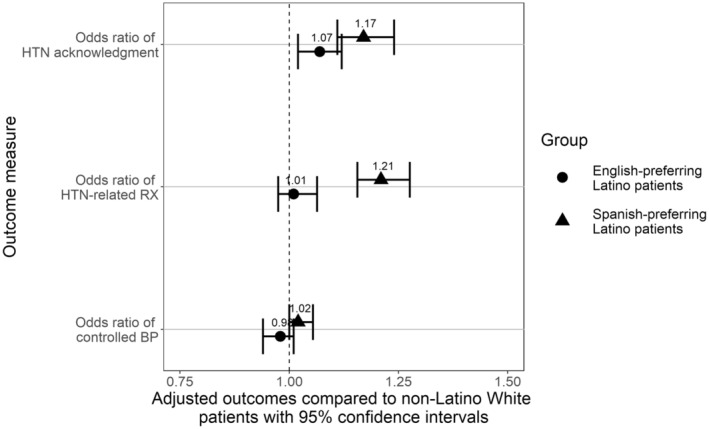
Data from 790 clinics in 23 US states from 2012 to 2020, including 1 270 174 patients, were analyzed to compare BP documentation in the electronic health record, clinician acknowledgment (diagnosis or treatment) of incident hypertension (BP ≥140/90), medication prescription, and BP control between non-Latino White patients, English-preferring Latino patients, and Spanish-preferring Latino patients, adjusted for patient-level covariates, and clustered on patients' primary clinics. Among the 429 182 patients with elevated BP (≥140/90) during ambulatory visits from 2012 to 2020, we found that clinician acknowledgment of hypertension was more likely in Spanish-preferring and English-preferring Latino patients versus non-Latino White patients (adjusted odds ratio [aOR], 1.17 [95% CI, 1.11-1.24]; aOR, 1.07 [95% CI, 1.02-1.12], respectively). In addition, Spanish-preferring Latino patients were more likely to receive a medication versus non-Latino White patients (aOR, 1.21 [95% CI, 1.16-1.28]). Among those receiving medication, Latino patients were as likely as non-Latino White patients to have their BP controlled (<140/90).
In a large retrospective study of community health center patients with incident hypertension, the expected disparities in hypertension management between Spanish-preferring Latino, English-preferring Latino, and non-Latino White patients were not identified. These findings add to the hypertension control cascade by examining robust electronic health record data from community health centers and may provide clues to reducing disparities in hypertension management.
使用高血压控制级联分析血压(BP)管理的研究一致表明,拉丁裔患者和非拉丁裔白种人患者之间在高血压知晓率、治疗和 BP 控制方面存在差异。我们使用来自多个社区卫生中心组成的州际网络的电子健康记录数据来分析这个级联。
对 2012 年至 2020 年来自 23 个州的 790 个诊所的数据进行了分析,这些数据包括 1270174 名患者,以比较电子健康记录中的 BP 记录、临床医生对新诊断的高血压(BP≥140/90)的确认(诊断或治疗)、药物处方和 BP 控制情况,比较对象为非拉丁裔白种人患者、英语偏好的拉丁裔患者和西班牙语偏好的拉丁裔患者,并根据患者的个体水平协变量进行调整,并对患者的主要诊所进行聚类。在 2012 年至 2020 年期间,在门诊就诊时发现血压升高(≥140/90)的 429182 名患者中,我们发现西班牙语偏好和英语偏好的拉丁裔患者的高血压诊断比非拉丁裔白种人患者更有可能(调整后的优势比[OR],1.17[95%CI,1.11-1.24];调整后的 OR,1.07[95%CI,1.02-1.12])。此外,与非拉丁裔白种人患者相比,西班牙语偏好的拉丁裔患者更有可能接受药物治疗(调整后的 OR,1.21[95%CI,1.16-1.28])。在接受药物治疗的患者中,拉丁裔患者与非拉丁裔白种人患者的血压控制率相当(<140/90)。
在一项对社区卫生中心新诊断高血压患者的大型回顾性研究中,并未发现西班牙语偏好的拉丁裔、英语偏好的拉丁裔和非拉丁裔白种人患者在高血压管理方面的预期差异。这些发现通过检查来自社区卫生中心的可靠电子健康记录数据,为高血压控制级联增添了新内容,并可能为减少高血压管理中的差异提供线索。