Kong Isabella Y, Giulino-Roth Lisa
Weill Cornell Medical College, New York, NY, United States.
Front Immunol. 2024 Feb 23;15:1342455. doi: 10.3389/fimmu.2024.1342455. eCollection 2024.
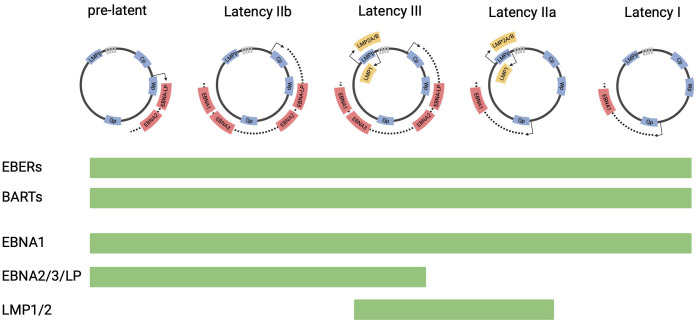
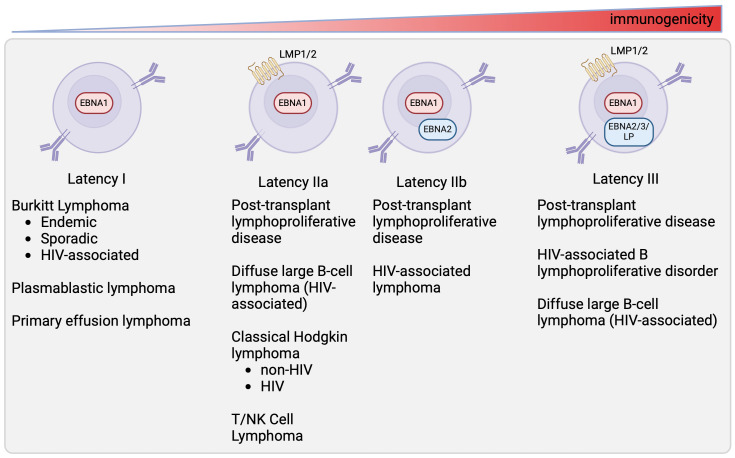
Epstein-Barr virus (EBV) contributes to the development of a significant subset of human lymphomas. As a herpes virus, EBV can transition between a lytic state which is required to establish infection and a latent state where a limited number of viral antigens are expressed which allows infected cells to escape immune surveillance. Three broad latency programs have been described which are defined by the expression of viral proteins RNA, with latency I being the most restrictive expressing only EBV nuclear antigen 1 (EBNA1) and EBV-encoded small RNAs (EBERs) and latency III expressing the full panel of latent viral genes including the latent membrane proteins 1 and 2 (LMP1/2), and EBNA 2, 3, and leader protein (LP) which induce a robust T-cell response. The therapeutic use of EBV-specific T-cells has advanced the treatment of EBV-associated lymphoma, however this approach is only effective against EBV-associated lymphomas that express the latency II or III program. Latency I tumors such as Burkitt lymphoma (BL) and a subset of diffuse large B-cell lymphomas (DLBCL) evade the host immune response to EBV and are resistant to EBV-specific T-cell therapies. Thus, strategies for inducing a switch from the latency I to the latency II or III program in EBV+ tumors are being investigated as mechanisms to sensitize tumors to T-cell mediated killing. Here, we review what is known about the establishment and regulation of latency in EBV infected B-cells, the role of EBV-specific T-cells in lymphoma, and strategies to convert latency I tumors to latency II/III.
爱泼斯坦-巴尔病毒(EBV)在相当一部分人类淋巴瘤的发生发展中起作用。作为一种疱疹病毒,EBV能够在建立感染所需的裂解状态和潜伏状态之间转变,在潜伏状态下仅表达有限数量的病毒抗原,使受感染细胞能够逃避免疫监视。已描述了三种广泛的潜伏程序,它们由病毒蛋白RNA的表达来定义,潜伏I是最受限制的,仅表达EBV核抗原1(EBNA1)和EBV编码的小RNA(EBERs),而潜伏III表达全套潜伏病毒基因,包括潜伏膜蛋白1和2(LMP1/2)以及EBNA 2、3和前导蛋白(LP),这些基因可诱导强烈的T细胞反应。EBV特异性T细胞的治疗应用推动了EBV相关淋巴瘤的治疗,然而这种方法仅对表达潜伏II或III程序的EBV相关淋巴瘤有效。潜伏I型肿瘤,如伯基特淋巴瘤(BL)和一部分弥漫性大B细胞淋巴瘤(DLBCL),可逃避宿主对EBV的免疫反应,并且对EBV特异性T细胞疗法具有抗性。因此,正在研究诱导EBV阳性肿瘤从潜伏I型转变为潜伏II或III型程序的策略,作为使肿瘤对T细胞介导的杀伤敏感的机制。在此,我们综述了关于EBV感染的B细胞中潜伏的建立和调控、EBV特异性T细胞在淋巴瘤中的作用以及将潜伏I型肿瘤转化为潜伏II/III型的策略的已知信息。