Jing Ruixia, Sun Xiubin, Cheng Jimin, Li Xue, Wang Zhen
Jinan Central Hospital, Shandong First Medical University & Shandong Academy of Medical Sciences, Jinan, China.
Department of Biostatistics, School of Public Health, Cheeloo Collage of Medicine, Shandong University, Jinan, China.
Front Endocrinol (Lausanne). 2024 Feb 23;15:1327325. doi: 10.3389/fendo.2024.1327325. eCollection 2024.
To investigate changes in the choroidal vasculature and their correlations with visual acuity in diabetic retinopathy (DR).
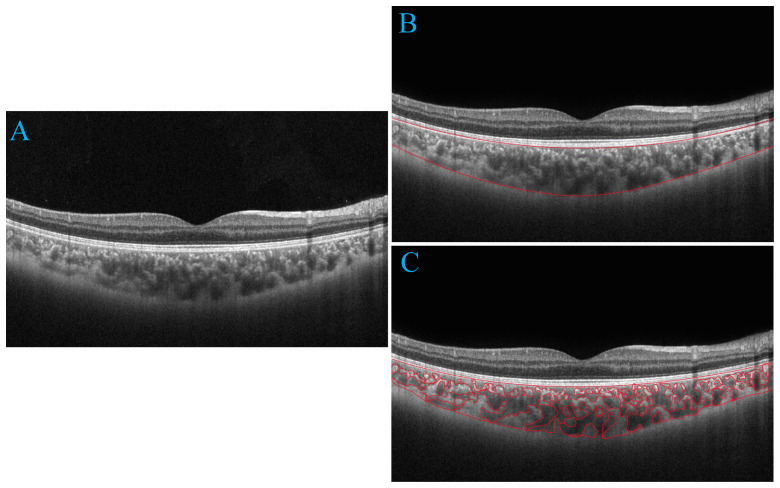
The cohort was composed of 225 eyes from 225 subjects, including 60 eyes from 60 subjects with healthy control, 55 eyes from 55 subjects without DR, 46 eyes from 46 subjects with nonproliferative diabetic retinopathy (NPDR), 21 eyes from 21 subjects with proliferative diabetic retinopathy (PDR), and 43 eyes from 43 subjects with clinically significant macular edema (CSME). Swept-source optical coherence tomography (SS-OCT) was used to image the eyes with a 12-mm radial line scan protocol. The parameters for 6-mm diameters of region centered on the macular fovea were analyzed. Initially, a custom deep learning algorithm based on a modified residual U-Net architecture was utilized for choroidal boundary segmentation. Subsequently, the SS-OCT image was binarized and the Niblack-based automatic local threshold algorithm was employed to calibrate subfoveal choroidal thickness (SFCT), luminal area (LA), and stromal area (SA) by determining the distance between the two boundaries. Finally, the ratio of LA and total choroidal area (SA + LA) was defined as the choroidal vascularity index (CVI). The choroidal parameters in five groups were compared, and correlations of the choroidal parameters with age, gender, duration of diabetes mellitus (DM), glycated hemoglobin (HbA1c), fasting blood sugar, SFCT and best-corrected visual acuity (BCVA) were analyzed.
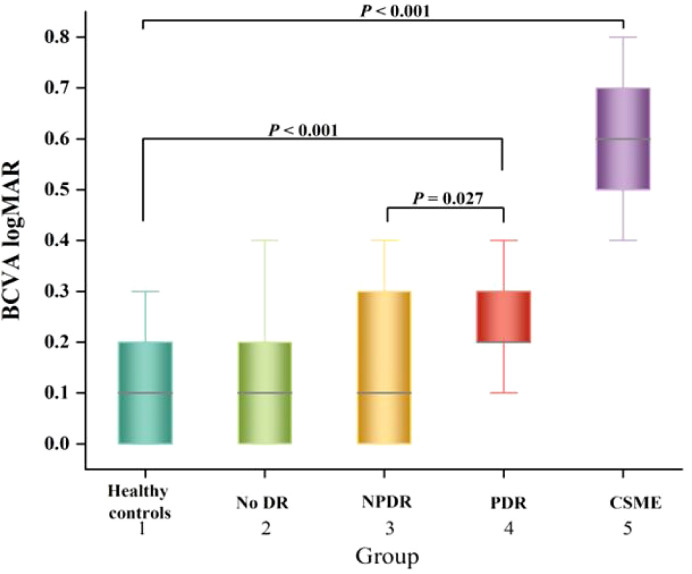
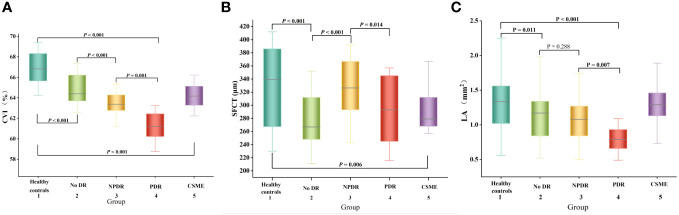
The CVI, SFCT, LA, and SA values of patients with DR were found to be significantly lower compared to both healthy patients and patients without DR ( < 0.05). The SFCT was significantly higher in NPDR group compared to the No DR group ( < 0.001). Additionally, the SFCT was lower in the PDR group compared to the NPDR group ( = 0.014). Furthermore, there was a gradual decrease in CVI with progression of diabetic retinopathy, reaching its lowest value in the PDR group. However, the CVI of the CSME group exhibited a marginally closer proximity to that of the NPDR group. The multivariate regression analysis revealed a positive correlation between CVI and the duration of DM as well as LA ( < 0.05). The results of both univariate and multivariate regression analyses demonstrated a significant positive correlation between CVI and BCVA ( = 0.003).
Choroidal vascular alterations, especially decreased CVI, occurred in patients with DR. The CVI decreased with duration of DM and was correlated with visual impairment, indicating that the CVI might be a reliable imaging biomarker to monitor the progression of DR.
研究糖尿病视网膜病变(DR)患者脉络膜血管的变化及其与视力的相关性。
该队列由225名受试者的225只眼睛组成,包括60名健康对照受试者的60只眼睛、55名无DR受试者的55只眼睛、46名非增殖性糖尿病视网膜病变(NPDR)受试者的46只眼睛、21名增殖性糖尿病视网膜病变(PDR)受试者的21只眼睛以及43名具有临床显著性黄斑水肿(CSME)受试者的43只眼睛。使用扫频光学相干断层扫描(SS-OCT)以12毫米径向线扫描方案对眼睛进行成像。分析以黄斑中心凹为中心的直径6毫米区域的参数。首先,利用基于改进残差U-Net架构的定制深度学习算法进行脉络膜边界分割。随后,将SS-OCT图像二值化,并采用基于尼布莱克的自动局部阈值算法,通过确定两个边界之间的距离来校准中心凹下脉络膜厚度(SFCT)、管腔面积(LA)和基质面积(SA)。最后,将LA与脉络膜总面积(SA+LA)的比值定义为脉络膜血管指数(CVI)。比较五组的脉络膜参数,并分析脉络膜参数与年龄、性别、糖尿病病程(DM)、糖化血红蛋白(HbA1c)、空腹血糖、SFCT和最佳矫正视力(BCVA)的相关性。
发现DR患者的CVI、SFCT、LA和SA值与健康患者和无DR患者相比均显著降低(P<0.05)。NPDR组的SFCT显著高于无DR组(P<0.001)。此外,PDR组的SFCT低于NPDR组(P=0.014)。此外,随着糖尿病视网膜病变的进展,CVI逐渐降低,在PDR组达到最低值。然而,CSME组的CVI与NPDR组的CVI略有接近。多因素回归分析显示CVI与DM病程以及LA呈正相关(P<0.05)。单因素和多因素回归分析结果均显示CVI与BCVA呈显著正相关(P=0.003)。
DR患者发生脉络膜血管改变,尤其是CVI降低。CVI随DM病程降低,并与视力损害相关,表明CVI可能是监测DR进展的可靠影像学生物标志物。