Liu Tingting, Lin Wei, Shi Genggeng, Wang Wenqi, Feng Meng, Xie Xiao, Liu Tong, Zhou Qingjun
Eye Hospital of Shandong First Medical University (Shandong Eye Hospital), Jinan, China.
State Key Laboratory Cultivation Base, Shandong Provincial Key Laboratory of Ophthalmology, Shandong Eye Institute, Qingdao, China.
Front Med (Lausanne). 2022 Mar 18;9:786708. doi: 10.3389/fmed.2022.786708. eCollection 2022.
To observe the changes in retinal and choroidal microstructures in patients with different stages of diabetic retinopathy (DR) and to evaluate the vascular perfusion of retina and choroid retinal thickness, retinal and choroidal vessel density by the swept-source optical coherence tomography angiography (SS-OCTA).
Subjects were divided into three groups: healthy control group (30 cases, 51 eyes), non-proliferative diabetic retinopathy (NPDR, 42 cases, 71 eyes) and proliferative diabetic retinopathy (PDR, 31 cases, 53 eyes). The area of the foveal avascular zone (FAZ), retinal and choroidal vascular perfusion, and the deep vascular complexes, including the intermediate capillary plexus (ICP) and deep capillary plexus (DCP) within the radius of 3, 6, 9, and 12 mm around the fovea were measured by SS-OCTA.
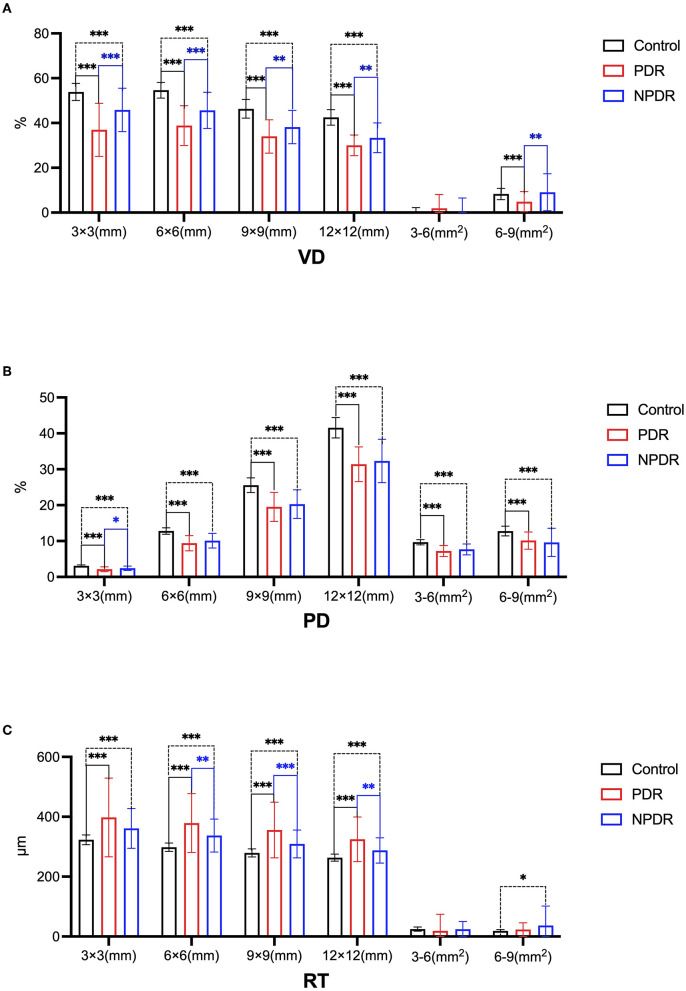
Compared with the healthy control group, DR patients presented significantly increased fovea avascular area, while vessel density (VD) in the ICP and DCP, vascular perfusion rate, and the retinal thickness were considerably decreased. There were significant differences in the retinal thickness, ICP, and DCP vessel densities between the control and NPDR groups, or control and PDR groups, or PDR and NPDR groups. The deep vascular perfusion rate also significantly differed between the control and PDR groups, but there was no significant difference between the PDR and NPDR groups. The choroidal perfusion exhibited significant differences across different areas and amongst the three groups. Furthermore, the choroidal thickness showed a significant difference between the PDR and NPDR groups.
Our results showed significant differences in the area of the avascular fovea and the VD of deep vascular complexes between DR patients and healthy control subjects. Moreover, there were significant differences in retinal VD, especially in the deep-retinalregions, choroidal perfusion, and the volume of large vessel choroid in DR patients with different degrees of disease severity. Notably, SS-OCTA provided in-depth information for detecting the potential VD damage in DR patients caused by a multitudeof factors.
观察不同阶段糖尿病视网膜病变(DR)患者视网膜和脉络膜微观结构的变化,并通过扫频光学相干断层扫描血管造影(SS-OCTA)评估视网膜和脉络膜的血管灌注、视网膜厚度以及视网膜和脉络膜血管密度。
将受试者分为三组:健康对照组(30例,51只眼)、非增殖性糖尿病视网膜病变组(NPDR,42例,71只眼)和增殖性糖尿病视网膜病变组(PDR,31例,53只眼)。通过SS-OCTA测量黄斑无血管区(FAZ)面积、视网膜和脉络膜血管灌注,以及黄斑周围3、6、9和12mm半径范围内的深层血管复合体,包括中间毛细血管丛(ICP)和深层毛细血管丛(DCP)。
与健康对照组相比,DR患者的黄斑无血管区面积显著增加,而ICP和DCP中的血管密度(VD)、血管灌注率和视网膜厚度显著降低。对照组与NPDR组、对照组与PDR组或PDR组与NPDR组之间在视网膜厚度、ICP和DCP血管密度方面存在显著差异。对照组与PDR组之间的深层血管灌注率也有显著差异,但PDR组与NPDR组之间无显著差异。脉络膜灌注在不同区域和三组之间存在显著差异。此外,PDR组和NPDR组之间的脉络膜厚度存在显著差异。
我们的结果显示,DR患者与健康对照者在无血管黄斑区面积和深层血管复合体的VD方面存在显著差异。此外,不同疾病严重程度的DR患者在视网膜VD,尤其是视网膜深层区域、脉络膜灌注和脉络膜大血管体积方面存在显著差异。值得注意的是,SS-OCTA为检测多种因素导致的DR患者潜在VD损伤提供了深入信息。