Son So-Hee, Kang Jin, Shin YuJin, Lee ChaeYoung, Sung Bong Hyun, Lee Ju Young, Lee Wonsik
Research Center for Bio-Based Chemistry, Korea Research Institute of Chemical Technology (KRICT), Ulsan, Republic of Korea.
Synthetic Biology Research Center, Korea Research Institute of Bioscience and Biotechnology (KRIBB), Daejeon, Republic of Korea.
J Ginseng Res. 2024 Mar;48(2):140-148. doi: 10.1016/j.jgr.2023.12.006. Epub 2024 Jan 3.
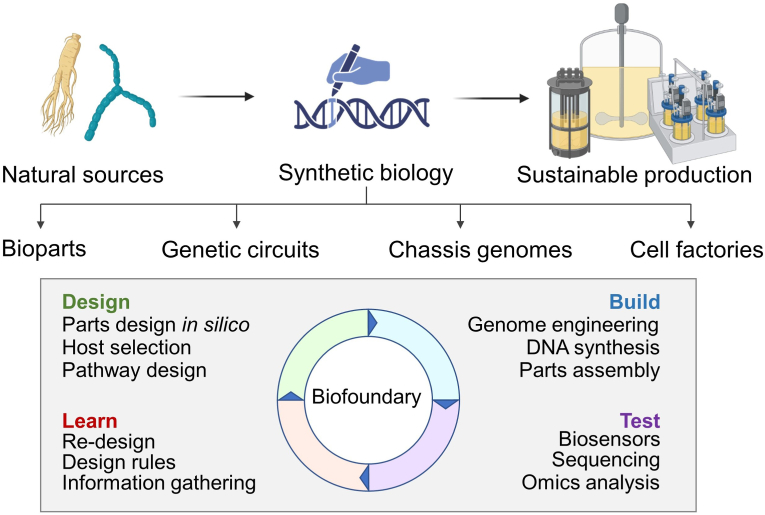
Synthetic biology approaches offer potential for large-scale and sustainable production of natural products with bioactive potency, including ginsenosides, providing a means to produce novel compounds with enhanced therapeutic properties. Ginseng, known for its non-toxic and potent qualities in traditional medicine, has been used for various medical needs. Ginseng has shown promise for its antioxidant and neuroprotective properties, and it has been used as a potential agent to boost immunity against various infections when used together with other drugs and vaccines. Given the increasing demand for ginsenosides and the challenges associated with traditional extraction methods, synthetic biology holds promise in the development of therapeutics. In this review, we discuss recent developments in microorganism producer engineering and ginsenoside production in microorganisms using synthetic biology approaches.
合成生物学方法为大规模可持续生产具有生物活性的天然产物(包括人参皂苷)提供了潜力,这为生产具有增强治疗特性的新型化合物提供了一种手段。人参在传统医学中以其无毒且功效显著而闻名,已被用于满足各种医疗需求。人参已显示出其抗氧化和神经保护特性的潜力,并且当与其他药物和疫苗一起使用时,它已被用作增强针对各种感染的免疫力的潜在药物。鉴于对人参皂苷的需求不断增加以及传统提取方法面临的挑战,合成生物学在治疗药物开发方面具有前景。在本综述中,我们讨论了利用合成生物学方法在微生物生产者工程和微生物中人参皂苷生产方面的最新进展。