Pepoyan Elya, Marotta Francesco, Manvelyan Anahit, Galstyan Artak, Stepanyan Lena, Grigoryan Hasmik, Grigoryan Liana, Mikayelyan Mikayel, Balayan Marine, Harutyunyan Natalya, Mirzabekyan Susanna, Tsaturyan Vardan, Torok Tamas, Pepoyan Astghik
Food Safety and Biotechnology Department, Scientific Research Institute of Food Science and Biotechnology, Armenian National Agrarian University, Yerevan, Armenia.
International Association for Human and Animals Health Improvement, Yerevan, Armenia.
Front Cell Infect Microbiol. 2024 Feb 23;14:1336752. doi: 10.3389/fcimb.2024.1336752. eCollection 2024.
Despite numerous investigations into the impact of drugs/probiotics on the gut microbiota composition in Familial Mediterranean Fever (FMF) patients, the question as to whether there exists a significant bacterial diversity(ies) independent of the placebo effect that can be reliably considered in clinical and nutritional trials remains unresolved.
This study represents the in augural analysis of the placebo's influence on the gut microbiota of both healthy individuals and FMF afflicted men, utilizing previously collected data from PhyloChip™ DNA microarray experiments. A total of 15 healthy and 15 FMF male volunteers, aged 18 to 50, participated in this partially randomized placebo trial, which is accessible through the GEO Series accession number GSE111835.
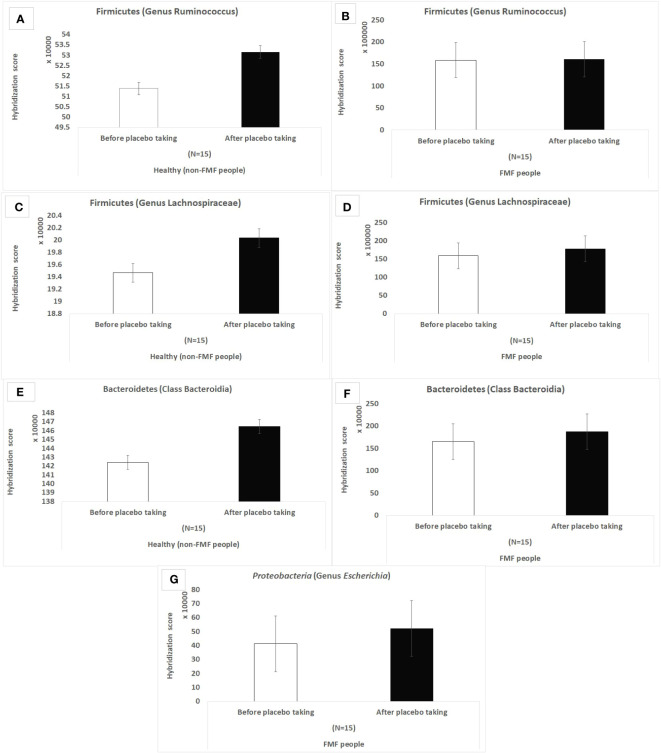
Key findings from current investigations include the anticipated divergence in gut bacteria resistance to placebo between healthy and FMF individuals, the minor impact of placebo on gut bacterial diversities in healthy individuals, with diversities identified as placebo-resistant among "healthy" gut bacteria, and the comprehensive influence of placebo on all bacterial phyla in the gut microbiome of FMF patients, extending to nearly all bacterial genera, except for the resilience of gut spp. to placebo in FMF patients. This study underscores the susceptibility of , , and genera to placebo. Consequently, this investigation holds significance for the proper design of placebo-controlled trials and establishes a foundation for further exploration of the gut-brain axis. Furthermore, it contributes valuable insights to discussions regarding proposals for probiotic therapies, particularly focusing on spp., spp., and spp.
尽管针对药物/益生菌对家族性地中海热(FMF)患者肠道微生物群组成的影响进行了大量研究,但在临床和营养试验中是否存在独立于安慰剂效应的显著细菌多样性,且能被可靠考虑这一问题仍未解决。
本研究利用先前从PhyloChip™ DNA微阵列实验收集的数据,首次分析了安慰剂对健康个体和FMF男性患者肠道微生物群的影响。共有15名年龄在18至50岁之间的健康男性志愿者和15名FMF男性志愿者参与了这项部分随机安慰剂试验,该试验可通过基因表达综合数据库(GEO)系列登录号GSE111835获取。
当前研究的主要发现包括:健康个体和FMF患者对安慰剂的肠道细菌抵抗力存在预期差异;安慰剂对健康个体肠道细菌多样性的影响较小,在“健康”肠道细菌中鉴定出对安慰剂有抗性的多样性;安慰剂对FMF患者肠道微生物群中所有细菌门都有全面影响,几乎扩展到所有细菌属,但FMF患者肠道中的某些菌属对安慰剂具有抗性。本研究强调了某些菌属对安慰剂的敏感性。因此,这项研究对安慰剂对照试验的合理设计具有重要意义,并为进一步探索肠-脑轴奠定了基础。此外,它为有关益生菌疗法建议的讨论提供了有价值的见解,特别是针对某些菌属。