Huang Handan, Yao Jingjing, Yang Nan, Yang Liuqing, Tao Lu, Yu Jinling, Gao Ying, Liu Zhihui
Department of Prosthodontics, Hospital of Stomatology, Jilin University, Changchun, China.
Front Nutr. 2022 Sep 7;9:999836. doi: 10.3389/fnut.2022.999836. eCollection 2022.
Evidence linking trace minerals and periodontitis is limited. To investigate the relationship between trace minerals (selenium, manganese, lead, cadmium, and mercury) and periodontitis, data from the National Health and Nutrition Examination Survey (NHANES) were analyzed after accounting for potential confounding factors. No known studies have explored the relationship between these five trace minerals and periodontitis.
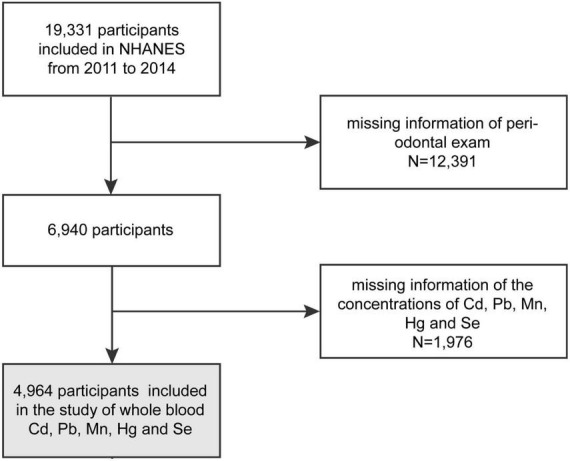
A total of 4,964 participants who had undergone a full-mouth periodontal examination and laboratory tests for five trace minerals were studied in a cross-sectional study. Clinical attachment loss (CAL) and periodontitis grading were used to measure periodontitis severity. Linear and logistic regression models were used to evaluate the association between trace minerals and periodontitis. Further subgroup analyses were performed.
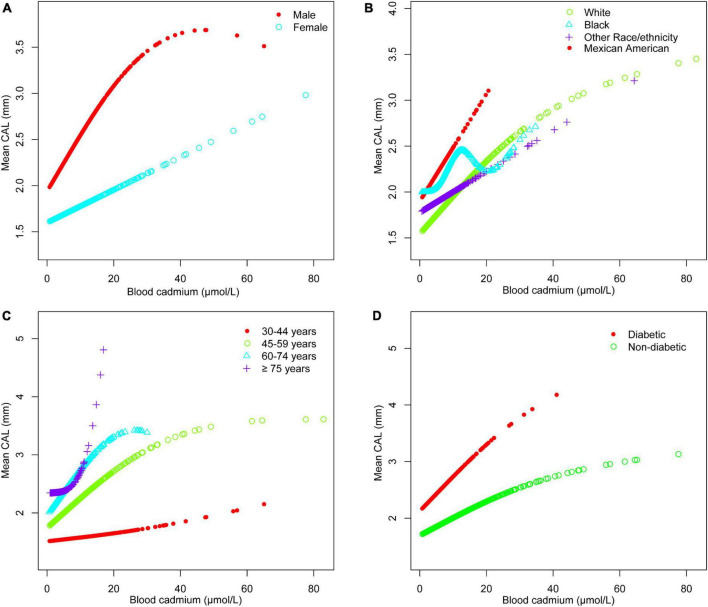
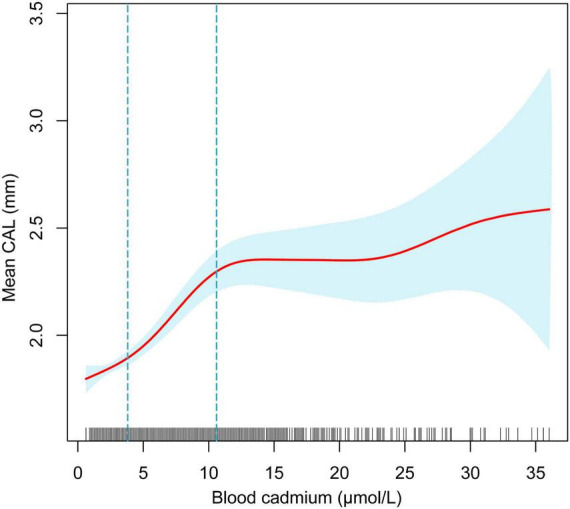
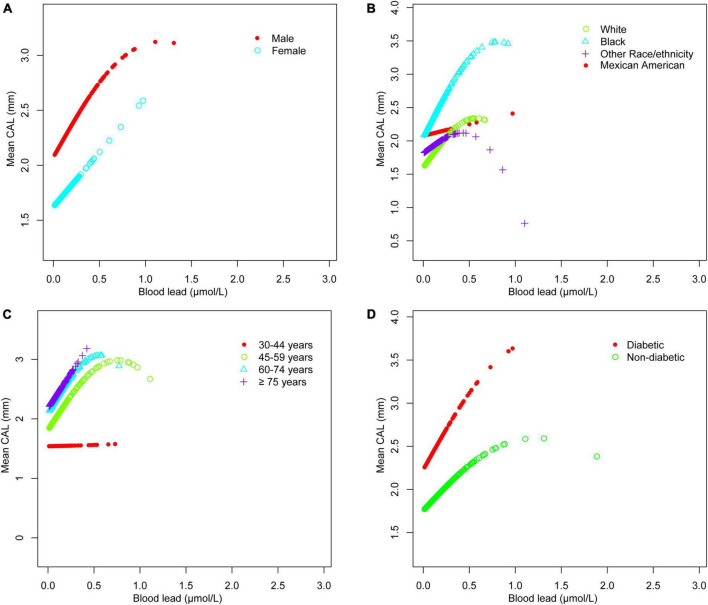
Blood lead and cadmium levels were positively associated with mean CAL, and blood selenium was negatively associated with mean CAL; however, blood mercury, blood manganese, and mean CAL were not significantly associated. The association between trace minerals and mean CAL was more significant in males, the elderly, and patients with diabetes. There was a threshold effect between blood cadmium levels and mean CAL. Among the Black population, the relationship between blood cadmium levels and mean CAL followed an inverted U-shaped curve. There was a saturation effect in the study of blood lead in people aged 45-59 years old.
Our study highlighted that blood selenium, lead, and cadmium levels were significantly associated with periodontitis in a nationally representative sample of United States adults.
将微量矿物质与牙周炎联系起来的证据有限。为了研究微量矿物质(硒、锰、铅、镉和汞)与牙周炎之间的关系,在考虑潜在混杂因素后,对来自美国国家健康与营养检查调查(NHANES)的数据进行了分析。尚无已知研究探讨这五种微量矿物质与牙周炎之间的关系。
在一项横断面研究中,对总共4964名接受了全口牙周检查和五种微量矿物质实验室检测的参与者进行了研究。使用临床附着丧失(CAL)和牙周炎分级来衡量牙周炎的严重程度。使用线性和逻辑回归模型来评估微量矿物质与牙周炎之间的关联。进行了进一步的亚组分析。
血铅和血镉水平与平均CAL呈正相关,血硒与平均CAL呈负相关;然而,血汞、血锰与平均CAL无显著关联。微量矿物质与平均CAL之间的关联在男性、老年人和糖尿病患者中更为显著。血镉水平与平均CAL之间存在阈值效应。在黑人人群中,血镉水平与平均CAL之间的关系呈倒U形曲线。在45 - 59岁人群的血铅研究中存在饱和效应。
我们的研究强调,在美国成年人具有全国代表性的样本中,血硒、铅和镉水平与牙周炎显著相关。