
根系解剖结构的变异有助于墨西哥本土玉米的局部适应的证据。
Evidence that variation in root anatomy contributes to local adaptation in Mexican native maize.
作者信息
McLaughlin Chloee M, Li Meng, Perryman Melanie, Heymans Adrien, Schneider Hannah, Lasky Jesse R, Sawers Ruairidh J H
机构信息
Intercollege Graduate Degree Program in Plant Biology The Pennsylvania State University University Park Pennsylvania USA.
Department of Plant Science The Pennsylvania State University University Park Pennsylvania USA.
出版信息
Evol Appl. 2024 Mar 10;17(3):e13673. doi: 10.1111/eva.13673. eCollection 2024 Mar.
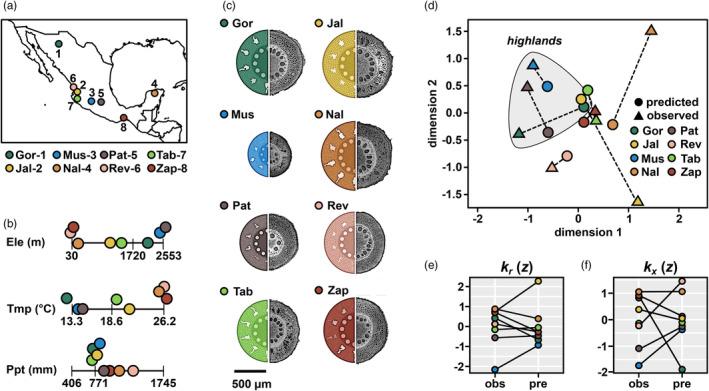
Mexican native maize ( ssp. ) is adapted to a wide range of climatic and edaphic conditions. Here, we focus specifically on the potential role of root anatomical variation in this adaptation. Given the investment required to characterize root anatomy, we present a machine-learning approach using environmental descriptors to project trait variation from a relatively small training panel onto a larger panel of genotyped and georeferenced Mexican maize accessions. The resulting models defined potential biologically relevant clines across a complex environment that we used subsequently for genotype-environment association. We found evidence of systematic variation in maize root anatomy across Mexico, notably a prevalence of trait combinations favoring a reduction in axial hydraulic conductance in varieties sourced from cooler, drier highland areas. We discuss our results in the context of previously described water-banking strategies and present candidate genes that are associated with both root anatomical and environmental variation. Our strategy is a refinement of standard environmental genome-wide association analysis that is applicable whenever a training set of georeferenced phenotypic data is available.
墨西哥本地玉米(亚种)能适应广泛的气候和土壤条件。在此,我们特别关注根系解剖结构变异在这种适应性中的潜在作用。鉴于表征根系解剖结构需要投入大量精力,我们提出一种机器学习方法,利用环境描述符将相对较小训练样本中的性状变异投射到更大的一组经过基因分型和地理定位的墨西哥玉米种质资源上。由此得到的模型定义了跨越复杂环境的潜在生物学相关梯度,我们随后将其用于基因型与环境关联分析。我们发现墨西哥各地玉米根系解剖结构存在系统性变异的证据,特别是在来自较凉爽、干燥高地地区的品种中,有利于轴向导水率降低的性状组合较为普遍。我们结合先前描述的水分储存策略来讨论我们的结果,并提出与根系解剖结构和环境变异都相关的候选基因。我们的策略是对标准环境全基因组关联分析的改进,只要有地理定位的表型数据训练集,该策略就适用。



 Zotero 插件