Coyle Daisy H, Davies Tazman, Taylor Fraser, Howes Kylie, Pettigrew Simone, Jones Alexandra
Faculty of Medicine, The George Institute for Global Health, University of New South Wales, Sydney, NSW, Australia.
Curr Dev Nutr. 2024 Feb 20;8(2):102058. doi: 10.1016/j.cdnut.2023.102058. eCollection 2024 Feb.
In recent years, various definitions of "added sugars" have emerged across jurisdictions. Although it is clear how these definitions differ, there is limited understanding of the policy implications associated with these variations.
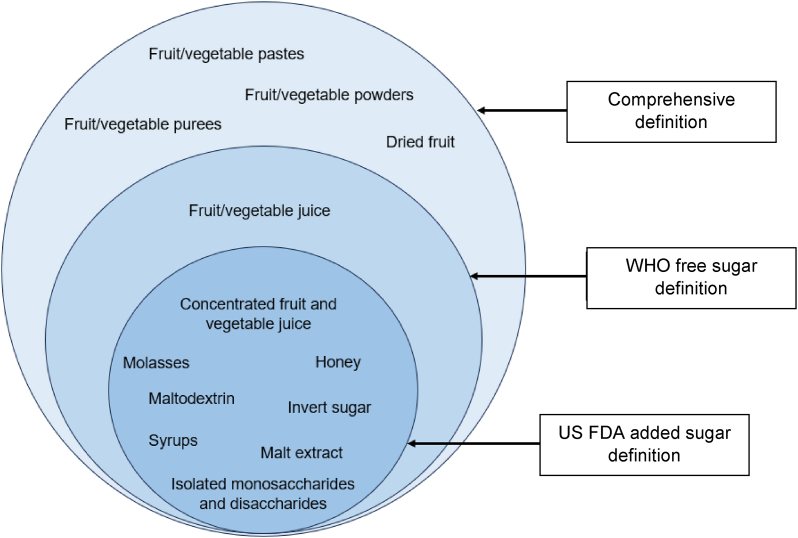
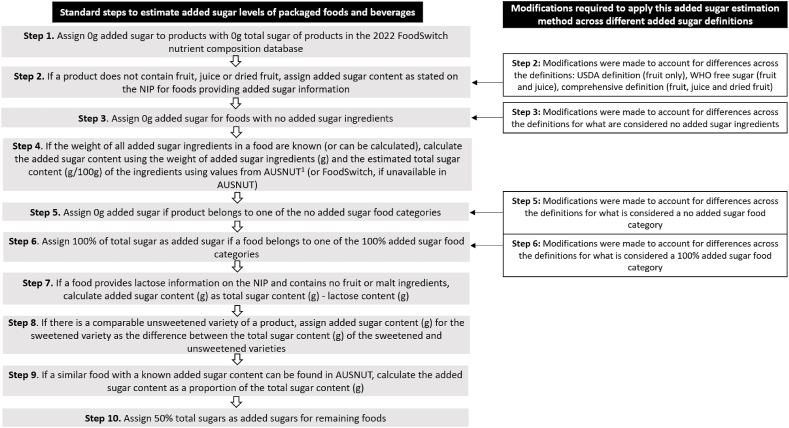
To test the potential policy implications of different definitions of "added sugars" on the Australian packaged food supply, we developed a method to estimate the content of "added sugars" in packaged foods and applied this to 3 different definitions of "added sugars": (i) United States Food and Drug Administration (US FDA) added sugar definition, (ii) the World Health Organization (WHO) free sugar definition, and (iii) a comprehensive definition that was developed from a review of the evidence on "added sugars."
Using a representative sample of 25,323 Australian packaged foods, the "added sugar" content and proportion of products that contain "added sugar" under the 3 definitions were estimated. In addition, a comparative analysis exploring the impact of the US FDA definition (least comprehensive) vs. the comprehensive definition was conducted to understand potential implications of adopting different regulatory definitions in Australia.
The US FDA definition identified the lowest number and proportion of products with any "added sugars" at 14,380 products (representing 56.8% of all products), followed by the WHO free sugar definition at 15,168 products (59.9%) and the comprehensive definition at 16,260 products (64.2%). The mean estimates for "added sugars" were 8.5 g/100 g, 8.7 g/100 g, and 9.6 g/100 g for the US FDA, WHO, and comprehensive definitions, respectively. Compared with the US FDA definition, the comprehensive definition captured an additional 7.4% of products, largely driven by nonalcoholic beverages, special foods and fruit, vegetables, nuts, and legumes.
Despite small variations in different "added sugars" definitions, their application has some significant policy implications. Findings highlight the importance of applying a comprehensive regulatory definition that adequately captures all sugars that have been linked to poor health.
近年来,不同司法管辖区出现了“添加糖”的各种定义。虽然很清楚这些定义的差异所在,但对于这些差异所带来的政策影响却了解有限。
为了测试“添加糖”不同定义对澳大利亚包装食品供应的潜在政策影响,我们开发了一种方法来估算包装食品中“添加糖”的含量,并将其应用于“添加糖”的3种不同定义:(i)美国食品药品监督管理局(US FDA)的添加糖定义,(ii)世界卫生组织(WHO)的游离糖定义,以及(iii)通过对“添加糖”证据审查而制定的综合定义。
利用25323种澳大利亚包装食品的代表性样本,估算了3种定义下“添加糖”的含量以及含有“添加糖”的产品比例。此外,进行了一项比较分析,探讨美国食品药品监督管理局定义(最不全面)与综合定义的影响,以了解在澳大利亚采用不同监管定义的潜在影响。
美国食品药品监督管理局的定义确定含有任何“添加糖”的产品数量和比例最低,为14380种产品(占所有产品的56.8%),其次是世界卫生组织的游离糖定义,为15168种产品(59.9%),综合定义为16260种产品(64.2%)。美国食品药品监督管理局、世界卫生组织和综合定义下“添加糖”的平均估计值分别为8.5克/100克、8.7克/100克和9.6克/100克。与美国食品药品监督管理局的定义相比,综合定义涵盖了另外7.4%的产品,主要由非酒精饮料、特殊食品以及水果、蔬菜、坚果和豆类推动。
尽管不同的“添加糖”定义存在细微差异,但其应用具有一些重大的政策影响。研究结果凸显了采用全面监管定义的重要性,该定义应能充分涵盖所有与健康不佳相关的糖类。