Iwaniak Paulina, Owe-Larsson Maja, Urbańska Ewa M
Department of Experimental and Clinical Pharmacology, Medical University of Lublin, 20-059 Lublin, Poland.
Department of Histology and Embryology, Center of Biostructure Research, Medical University of Warsaw, Chałubińskiego 5, 02-004 Warsaw, Poland.
Int J Mol Sci. 2024 Mar 2;25(5):2915. doi: 10.3390/ijms25052915.
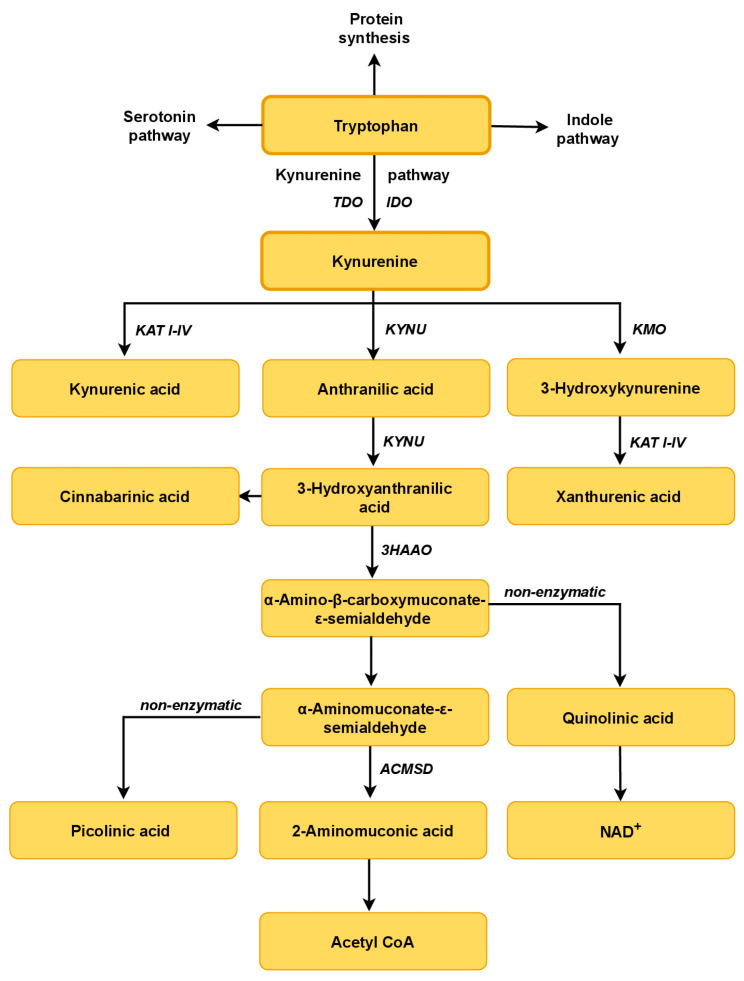
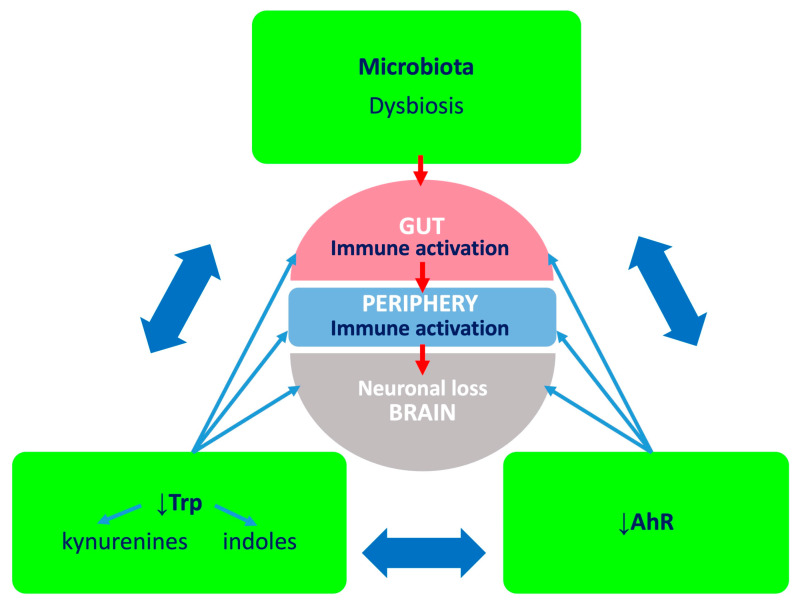
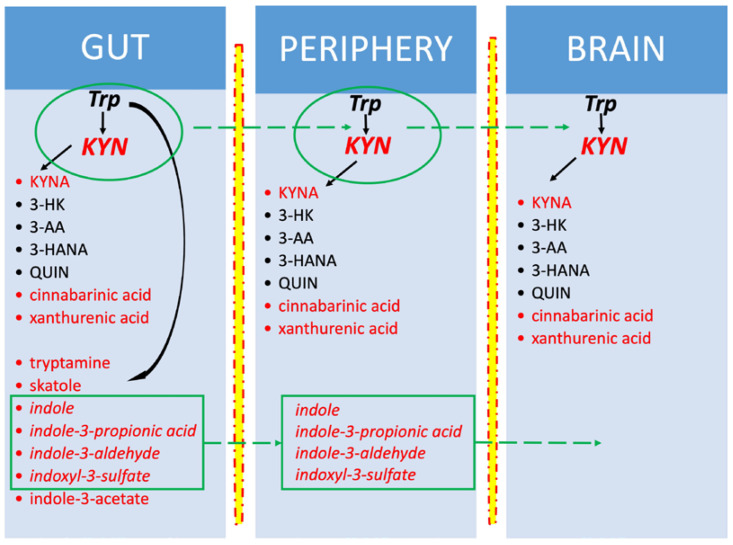
In the era of a steadily increasing lifespan, neurodegenerative diseases among the elderly present a significant therapeutic and socio-economic challenge. A properly balanced diet and microbiome diversity have been receiving increasing attention as targets for therapeutic interventions in neurodegeneration. Microbiota may affect cognitive function, neuronal survival and death, and gut dysbiosis was identified in Parkinson's disease (PD). Tryptophan (Trp), an essential amino acid, is degraded by microbiota and hosts numerous compounds with immune- and neuromodulating properties. This broad narrative review presents data supporting the concept that microbiota, the Trp-kynurenine (KYN) pathway and aryl hydrocarbon receptors (AhRs) form a triad involved in PD. A disturbed gut-brain axis allows the bidirectional spread of pro-inflammatory molecules and α-synuclein, which may contribute to the development/progression of the disease. We suggest that the peripheral levels of kynurenines and AhR ligands are strongly linked to the Trp metabolism in the gut and should be studied together with the composition of the microbiota. Such an approach can clearly delineate the sub-populations of PD patients manifesting with a disturbed microbiota-Trp-KYN-brain triad, who would benefit from modifications in the Trp metabolism. Analyses of the microbiome, Trp-KYN pathway metabolites and AhR signaling may shed light on the mechanisms of intestinal distress and identify new targets for the diagnosis and treatment in early-stage PD. Therapeutic interventions based on the combination of a well-defined food regimen, Trp and probiotics seem of potential benefit and require further experimental and clinical research.
在寿命稳步增长的时代,老年人的神经退行性疾病带来了重大的治疗和社会经济挑战。均衡的饮食和微生物群多样性作为神经退行性疾病治疗干预的靶点,受到了越来越多的关注。微生物群可能会影响认知功能、神经元的存活和死亡,并且在帕金森病(PD)中发现了肠道菌群失调。色氨酸(Trp)是一种必需氨基酸,可被微生物群降解,并产生许多具有免疫调节和神经调节特性的化合物。这篇广泛的叙述性综述展示了支持微生物群、色氨酸-犬尿氨酸(KYN)途径和芳烃受体(AhRs)形成参与帕金森病的三联体这一概念的数据。肠道-脑轴紊乱会使促炎分子和α-突触核蛋白双向传播,这可能有助于疾病的发生/发展。我们认为,犬尿氨酸和芳烃受体配体的外周水平与肠道中的色氨酸代谢密切相关,应该与微生物群的组成一起进行研究。这样的方法可以清楚地界定表现出微生物群-色氨酸-KYN-脑三联体紊乱的帕金森病患者亚群,他们将从色氨酸代谢的改变中受益。对微生物群、色氨酸-KYN途径代谢物和芳烃受体信号传导的分析可能会揭示肠道功能障碍的机制,并确定早期帕金森病诊断和治疗的新靶点。基于明确的饮食方案、色氨酸和益生菌组合的治疗干预似乎具有潜在益处,需要进一步的实验和临床研究。