Tejedor Sandra, Wågberg Maria, Correia Cláudia, Åvall Karin, Hölttä Mikko, Hultin Leif, Lerche Michael, Davies Nigel, Bergenhem Nils, Snijder Arjan, Marlow Tom, Dönnes Pierre, Fritsche-Danielson Regina, Synnergren Jane, Jennbacken Karin, Hansson Kenny
Research and Early Development, Cardiovascular, Renal and Metabolism (CVRM), BioPharmaceuticals R&D, AstraZeneca, 431 50 Gothenburg, Sweden.
Systems Biology Research Center, School of Bioscience, University of Skövde, 541 28 Skövde, Sweden.
Cells. 2024 Feb 27;13(5):414. doi: 10.3390/cells13050414.
Diabetic foot ulcers (DFU) pose a significant health risk in diabetic patients, with insufficient revascularization during wound healing being the primary cause. This study aimed to assess microvessel sprouting and wound healing capabilities using vascular endothelial growth factor (VEGF-A) and a modified fibroblast growth factor (FGF1).
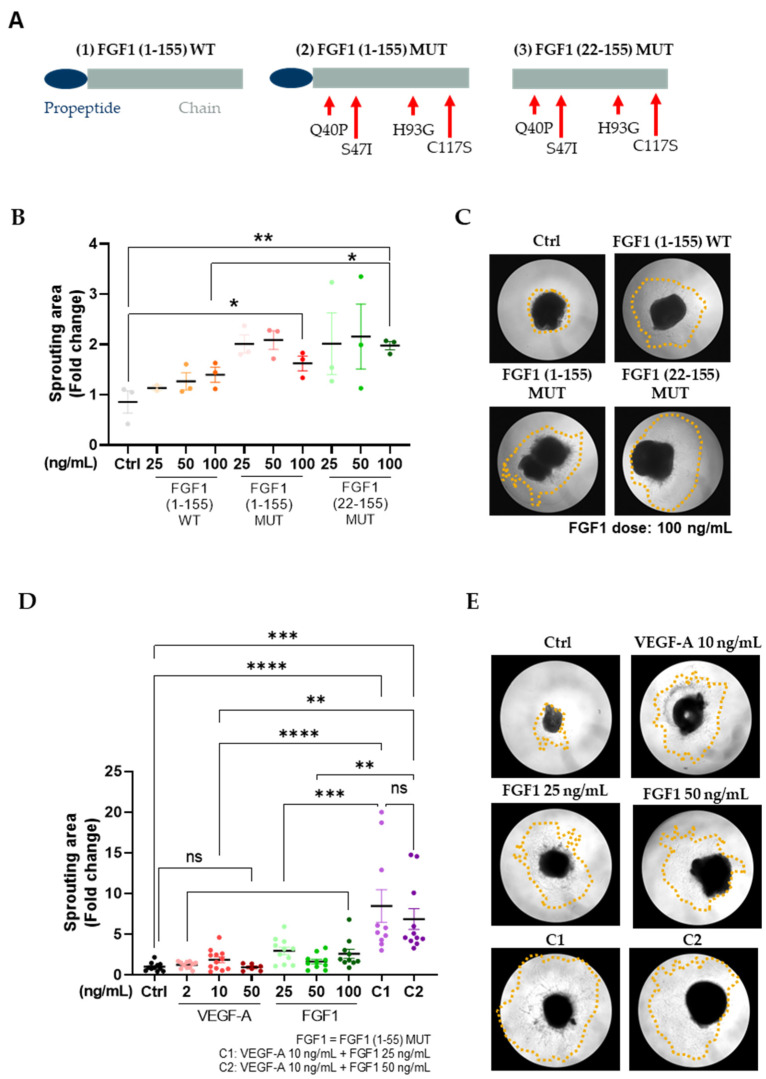
An ex vivo aortic ring rodent model and an in vivo wound healing model in diabetic mice were employed to evaluate the microvessel sprouting and wound healing capabilities of VEGF-A and a modified FGF1 both as monotherapies and in combination.
The combination of VEGF-A and FGF1 demonstrated increased vascular sprouting in the ex vivo mouse aortic ring model, and topical administration of a combination of VEGF-A and FGF1 mRNAs formulated in lipid nanoparticles (LNPs) in mouse skin wounds promoted faster wound closure and increased neovascularization seven days post-surgical wound creation. RNA-sequencing analysis of skin samples at day three post-wound creation revealed a strong transcriptional response of the wound healing process, with the combined treatment showing significant enrichment of genes linked to skin growth.
f-LNPs encapsulating VEGF-A and FGF1 mRNAs present a promising approach to improving the scarring process in DFU.
糖尿病足溃疡(DFU)给糖尿病患者带来重大健康风险,伤口愈合过程中血管再通不足是主要原因。本研究旨在使用血管内皮生长因子(VEGF-A)和改良的成纤维细胞生长因子(FGF1)评估微血管生成和伤口愈合能力。
采用离体主动脉环啮齿动物模型和糖尿病小鼠体内伤口愈合模型,评估VEGF-A和改良FGF1单独及联合应用时的微血管生成和伤口愈合能力。
在离体小鼠主动脉环模型中,VEGF-A和FGF1联合应用显示出血管生成增加,在小鼠皮肤伤口局部应用脂质纳米颗粒(LNP)配制的VEGF-A和FGF1 mRNA组合,在手术伤口形成7天后促进了更快的伤口闭合并增加了新生血管形成。伤口形成后第3天对皮肤样本进行RNA测序分析,显示伤口愈合过程有强烈的转录反应,联合治疗显示与皮肤生长相关的基因显著富集。
封装VEGF-A和FGF1 mRNA的f-LNP是改善DFU瘢痕形成过程的一种有前景的方法。