Department of Obstetrics and Gynecology, Women's Hospital, Zhejiang University School of Medicine, Hangzhou, Zhejiang, China.
Department of Pharmacy, Dongshan Hospital, Linyi, Shandong, China.
BMC Pregnancy Childbirth. 2024 Mar 12;24(1):193. doi: 10.1186/s12884-024-06375-5.
Single umbilical artery (SUA) is strongly associated with foetal structural abnormalities; however, the exact pattern of this association has not been described. We aimed to investigate the occurrence of malformations in singleton pregnancies with SUA in China and to study the association between the absent side of the umbilical artery and foetal malformations.
This was a retrospective study of singleton pregnancies for which routine first-trimester anatomical screening was performed at 11-13 gestational weeks and, if the pregnancy continued, a second-trimester scan was performed at 20-24 weeks. Data were extracted from records at the referral centre, the Obstetrics and Gynecology Hospital of Fudan University, between January 2011 and April 2019 (n = 47,894). Using logistic regression, the odds ratios (OR) with 95% confidence intervals (CIs) were calculated for malformations associated with SUA.
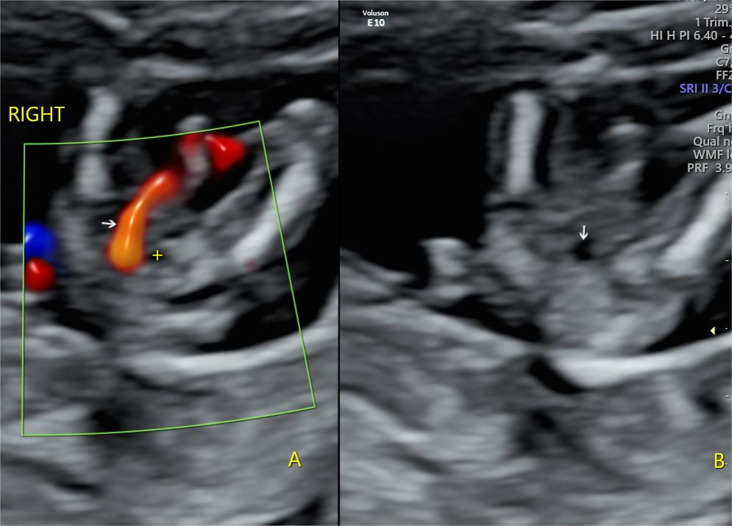
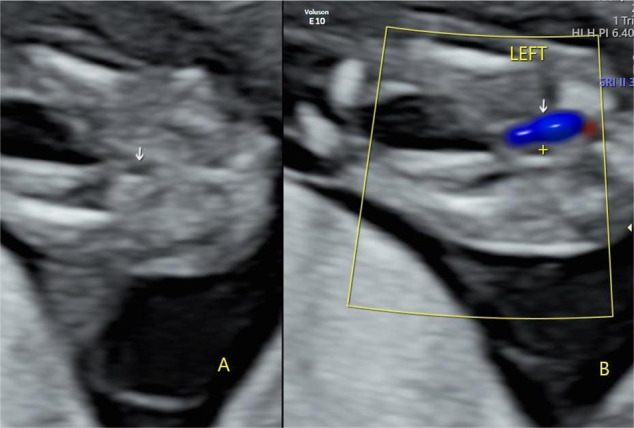
The incidence of SUA in our study was 2.0% (970/47,894). Of all foetuses with SUA, 387 (39.9%) had structural malformations. The malformation type varied, with cardiovascular complications being the most common. A robust association was observed between SUA and oesophageal stenosis or atresia (OR: 25.33), followed by cardiovascular (OR: 9.98-24.02), scoliosis (OR: 18.62), genitourinary (OR: 2.45-15.66), and brain malformations (OR: 4.73-9.12). The absence of the left umbilical artery (n = 445, 45.9%) was consistent with that of the right umbilical artery (n = 431, 44.4%). Furthermore, a significantly higher rate of an absent right than the left umbilical artery (p<0.01) was observed in SUA with foetal abnormalities than in SUA with no malformations.
Overall, we observed a higher risk of various specific malformations in foetuses with SUA, and a strong association between SUA and oesophageal stenosis or atresia. The absence of the right umbilical artery was most common in foetuses with SUA and structural malformations. This study provides a reference for ultrasonographers in conducting foetal structural screening for pregnant women with SUA.
单脐动脉(SUA)与胎儿结构异常密切相关;然而,这种关联的确切模式尚未描述。我们旨在研究中国 SUA 单胎妊娠中的畸形发生率,并研究脐动脉缺失侧与胎儿畸形之间的关系。
这是一项回顾性研究,纳入了在复旦大学妇产科医院进行常规 11-13 孕周初次超声筛查并继续妊娠的 20-24 孕周二次超声筛查的单胎妊娠。数据来自 2011 年 1 月至 2019 年 4 月期间的转诊中心记录(n=47894)。使用逻辑回归,计算了 SUA 相关畸形的优势比(OR)及其 95%置信区间(CI)。
本研究中 SUA 的发生率为 2.0%(970/47894)。所有 SUA 胎儿中,有 387 例(39.9%)存在结构畸形。畸形类型多样,心血管并发症最为常见。SUA 与食管狭窄或闭锁(OR:25.33)、心血管畸形(OR:9.98-24.02)、脊柱侧凸(OR:18.62)、泌尿生殖系统畸形(OR:2.45-15.66)和脑畸形(OR:4.73-9.12)显著相关。左侧脐动脉缺失(n=445,45.9%)与右侧脐动脉缺失(n=431,44.4%)一致。此外,在存在结构畸形的 SUA 胎儿中,右侧脐动脉缺失的发生率明显高于左侧(p<0.01)。
总的来说,我们观察到 SUA 胎儿存在各种特定畸形的风险较高,且 SUA 与食管狭窄或闭锁密切相关。在存在结构畸形的 SUA 胎儿中,最常见的是右侧脐动脉缺失。本研究为超声医师对 SUA 孕妇进行胎儿结构筛查提供了参考。