Institute of Nutrition and Food Technology, University of Chile, Santiago, Chile.
MRC Biostatistics Unit, University of Cambridge, Cambridge, UK.
Breast Cancer Res. 2024 Mar 12;26(1):45. doi: 10.1186/s13058-024-01793-x.
Breast density (BD) is a strong risk factor for breast cancer. Little is known about how BD develops during puberty. Understanding BD trajectories during puberty and its determinants could be crucial for promoting preventive actions against breast cancer (BC) at early ages. The objective of this research is to characterize % fibroglandular volume (%FGV), absolute fibroglandular volume (AFGV), and breast volume (BV) at different breast Tanner stages until 4-year post menarche in a Latino cohort and to assess determinants of high %FGV and AFGV during puberty and in a fully mature breast.
This is a longitudinal follow-up of 509 girls from low-middle socioeconomic status of the Southeast area of Santiago, recruited at a mean age of 3.5 years. The inclusion criteria were singleton birth born, birthweight between 2500 and 4500 g with no medical or mental disorder. A trained dietitian measured weight and height since 3.5 years old and sexual maturation from 8 years old (breast Tanner stages and age at menarche onset). Using standardized methods, BD was measured using dual-energy X-ray absorptiometry (DXA) in various developmental periods (breast Tanner stage B1 until 4 years after menarche onset).
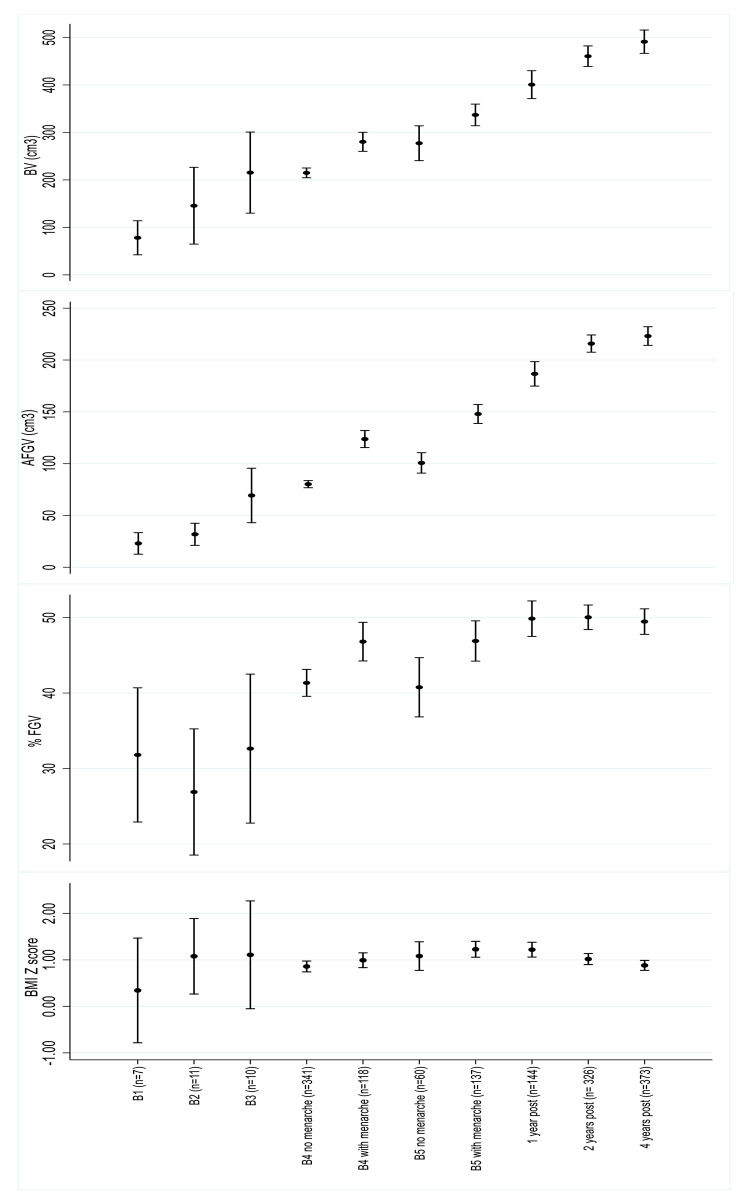
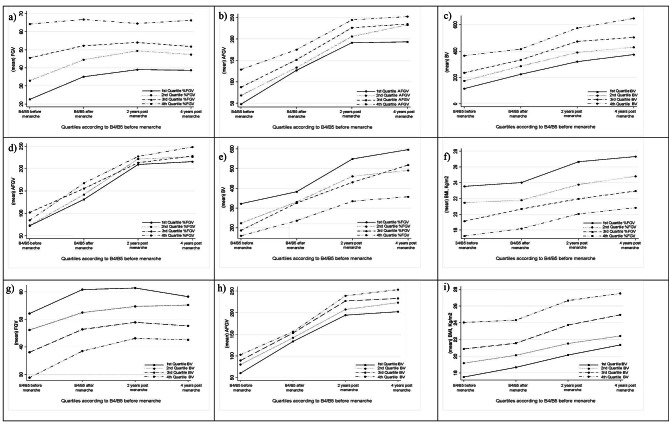
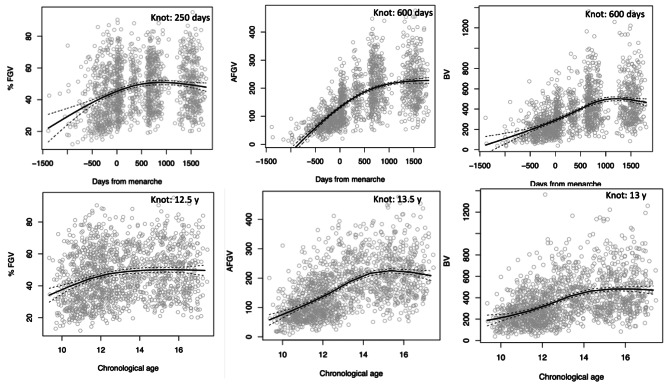
In the 509 girls, we collected 1,442 breast DXA scans; the mean age at Tanner B4 was 11.3 years. %FGV increased across breast Tanner stages and peaked 250 days after menarche. AFGV and BV peaked 2 years after menarche onset. Girls in the highest quartiles of %FGV, AFGV, and BV at Tanner B4 and B5 before menarche onset had the highest values thereafter until 4 years after menarche onset. The most important determinants of %FGV and AFGV variability were BMI z-score (R = 44%) and time since menarche (R = 42%), respectively.
We characterize the breast development during puberty, a critical window of susceptibility. Although the onset of menarche is a key milestone for breast development, we observed that girls in the highest quartiles of %FGV and AFGV tracked in that group afterwards. Following these participants in adulthood would be of interest to understand the changes in breast composition during this period and its potential link with BC risk.
乳腺密度(BD)是乳腺癌的一个重要危险因素。关于青春期期间 BD 如何发展的信息知之甚少。了解青春期 BD 轨迹及其决定因素对于在早期阶段采取预防乳腺癌(BC)的措施可能至关重要。本研究的目的是描述拉丁裔队列中不同乳腺 Tanner 阶段的%纤维腺体体积(%FGV)、绝对纤维腺体体积(AFGV)和乳腺体积(BV),并评估青春期和完全成熟乳腺中高%FGV 和 AFGV 的决定因素。
这是对圣地亚哥东南部中低收入阶层的 509 名女孩进行的一项纵向随访研究,她们在平均 3.5 岁时入组。入选标准为单胎出生、出生体重在 2500 至 4500 克之间、无医学或精神障碍。一名经过培训的营养师自 3.5 岁起测量体重和身高,自 8 岁起测量性成熟度(乳腺 Tanner 阶段和初潮年龄)。使用标准化方法,在不同发育阶段(乳腺 Tanner 阶段 B1 至初潮后 4 年)使用双能 X 射线吸收法(DXA)测量 BD。
在 509 名女孩中,我们共采集了 1442 次乳腺 DXA 扫描;乳腺 Tanner 4 期的平均年龄为 11.3 岁。%FGV 在乳腺 Tanner 各阶段增加,并在初潮后 250 天达到峰值。AFGV 和 BV 在初潮后 2 年达到峰值。在初潮前乳腺 Tanner 4 期和 5 期%FGV、AFGV 和 BV 四分位最高的女孩,此后直至初潮后 4 年,这些值均较高。%FGV 和 AFGV 变异性的最重要决定因素分别是 BMI z 评分(R=44%)和初潮后时间(R=42%)。
我们描述了青春期期间的乳腺发育情况,这是一个易感性的关键时期。尽管初潮是乳腺发育的一个关键里程碑,但我们观察到,在初潮前%FGV 和 AFGV 四分位最高的女孩随后仍在该组中。对这些参与者进行成年期随访将有助于了解这一时期乳腺成分的变化及其与 BC 风险的潜在联系。