College of Medicine and Biological Information Engineering, Northeastern University, Shenyang, China.
Department of General Surgery, Shengjing Hospital of China Medical University, 110004, Shenyang, P.R. China.
BMC Cancer. 2024 Mar 12;24(1):337. doi: 10.1186/s12885-024-12087-y.
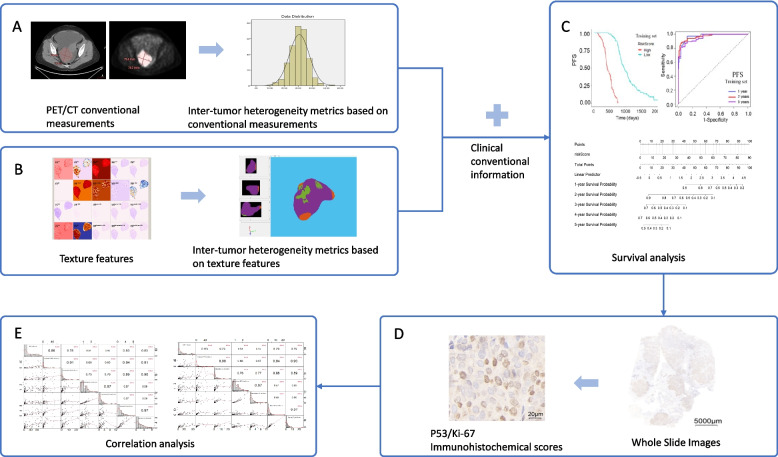
The presence of heterogeneity is a significant attribute within the context of ovarian cancer. This study aimed to assess the predictive accuracy of models utilizing quantitative F-FDG PET/CT derived inter-tumor heterogeneity metrics in determining progression-free survival (PFS) and overall survival (OS) in patients diagnosed with high-grade serous ovarian cancer (HGSOC). Additionally, the study investigated the potential correlation between model risk scores and the expression levels of p53 and Ki-67.
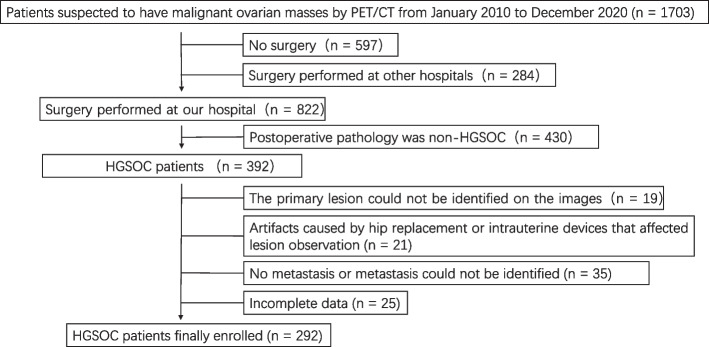
A total of 292 patients diagnosed with HGSOC were retrospectively enrolled at Shengjing Hospital of China Medical University (median age: 54 ± 9.4 years). Quantitative inter-tumor heterogeneity metrics were calculated based on conventional measurements and texture features of primary and metastatic lesions in F-FDG PET/CT. Conventional models, heterogeneity models, and integrated models were then constructed to predict PFS and OS. Spearman's correlation coefficient (ρ) was used to evaluate the correlation between immunohistochemical scores of p53 and Ki-67 and model risk scores.
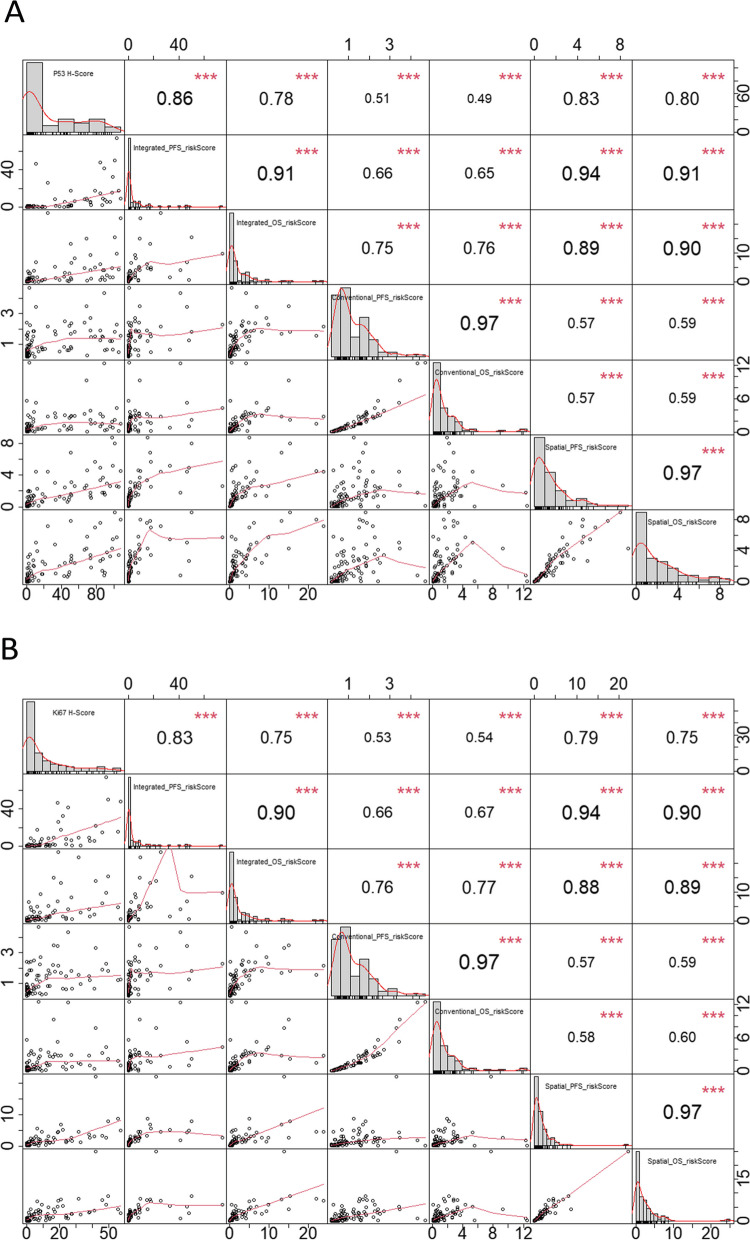
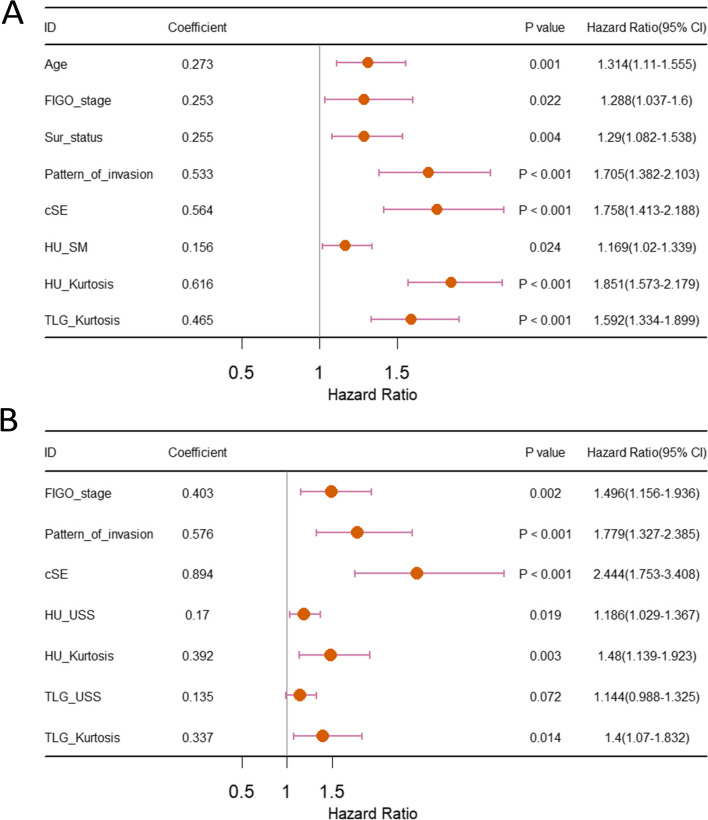
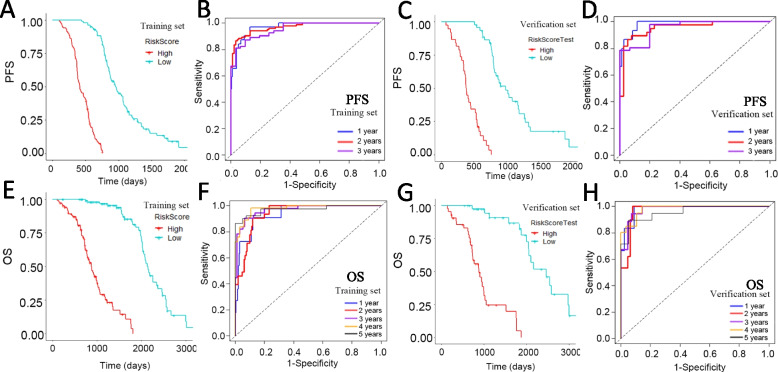
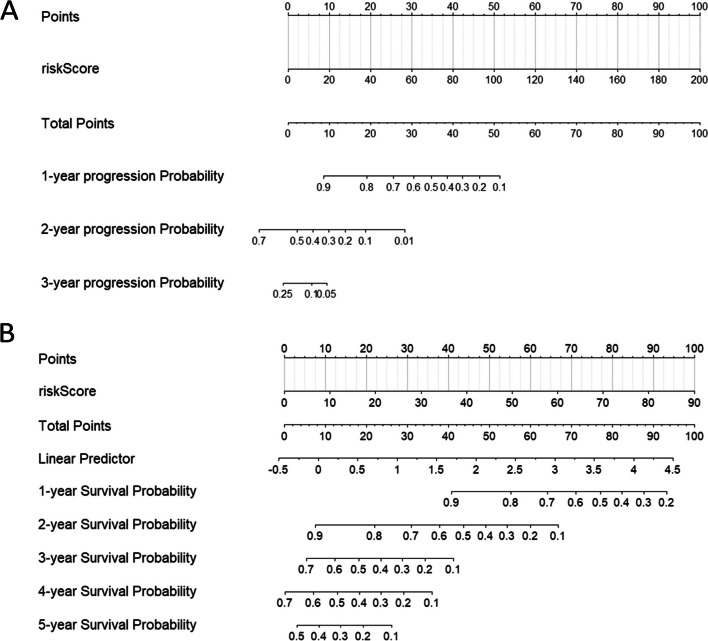
The C-indices of the integrated models were the highest for both PFS and OS models. The C-indices of the training set and testing set of the integrated PFS model were 0.898 (95% confidence interval [CI]: 0.881-0.914) and 0.891 (95% CI: 0.860-0.921), respectively. For the integrated OS model, the C-indices of the training set and testing set were 0.894 (95% CI: 0.871-0.917) and 0.905 (95% CI: 0.873-0.936), respectively. The integrated PFS model showed the strongest correlation with the expression levels of p53 (ρ = 0.859, p < 0.001) and Ki-67 (ρ = 0.829, p < 0.001).
The models based on F-FDG PET/CT quantitative inter-tumor heterogeneity metrics exhibited good performance for predicting the PFS and OS of patients with HGSOC. p53 and Ki-67 expression levels were strongly correlated with the risk scores of the integrated predictive models.
在卵巢癌中,异质性的存在是一个重要特征。本研究旨在评估利用定量 F-FDG PET/CT 衍生的肿瘤间异质性指标构建的模型在预测高级别浆液性卵巢癌(HGSOC)患者无进展生存期(PFS)和总生存期(OS)方面的预测准确性。此外,本研究还探讨了模型风险评分与 p53 和 Ki-67 表达水平之间的潜在相关性。
回顾性纳入中国医科大学附属盛京医院 292 例 HGSOC 患者(中位年龄:54±9.4 岁)。基于 F-FDG PET/CT 中的原发和转移病灶的常规测量和纹理特征,计算定量肿瘤间异质性指标。然后构建常规模型、异质性模型和综合模型,以预测 PFS 和 OS。采用 Spearman 相关系数(ρ)评估 p53 和 Ki-67 免疫组化评分与模型风险评分之间的相关性。
综合模型的 PFS 和 OS 模型的 C 指数均最高。综合 PFS 模型的训练集和测试集的 C 指数分别为 0.898(95%置信区间[CI]:0.881-0.914)和 0.891(95%CI:0.860-0.921)。对于综合 OS 模型,训练集和测试集的 C 指数分别为 0.894(95%CI:0.871-0.917)和 0.905(95%CI:0.873-0.936)。综合 PFS 模型与 p53(ρ=0.859,p<0.001)和 Ki-67(ρ=0.829,p<0.001)表达水平的相关性最强。
基于 F-FDG PET/CT 定量肿瘤间异质性指标构建的模型在预测 HGSOC 患者的 PFS 和 OS 方面具有良好的性能。p53 和 Ki-67 表达水平与综合预测模型的风险评分密切相关。