Laboratory for Building Energy Materials and Components, Swiss Federal Laboratories for Materials Science and Technology, Empa, Dübendorf, 8600, Switzerland.
Department of Chemistry, University of Fribourg, Fribourg, 1700, Switzerland.
Adv Sci (Weinh). 2024 Jun;11(24):e2307921. doi: 10.1002/advs.202307921. Epub 2024 Mar 13.
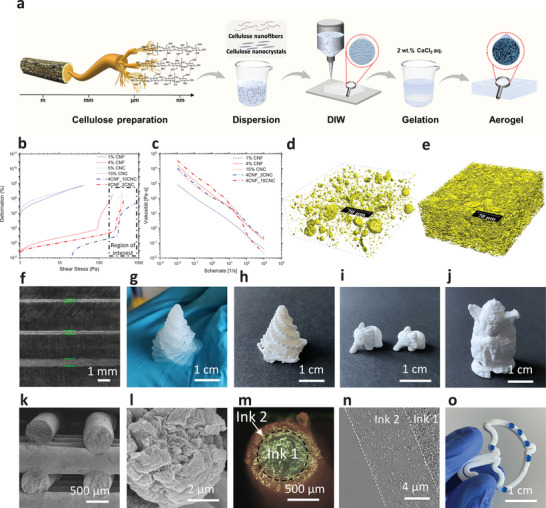
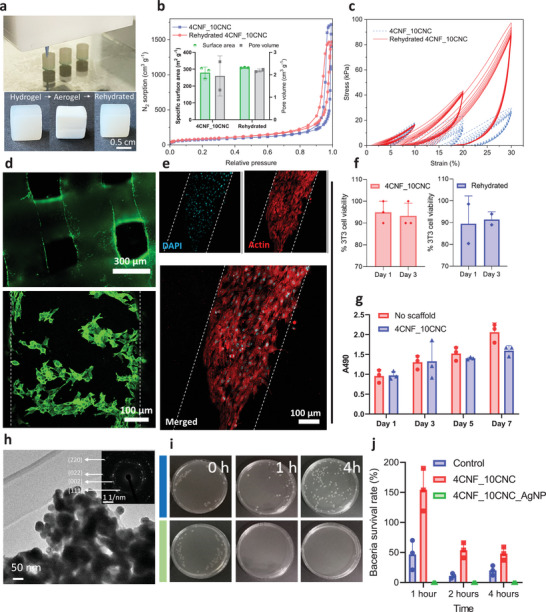
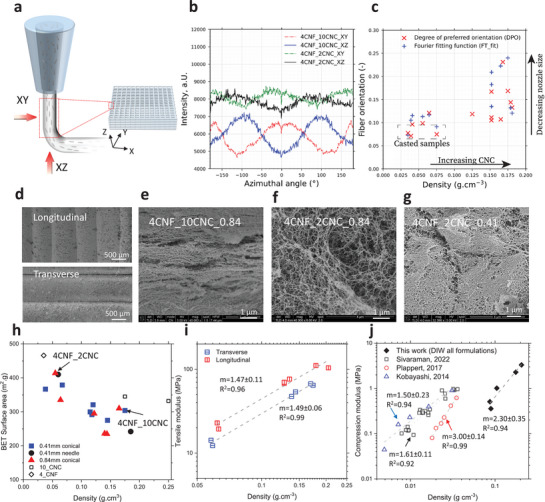
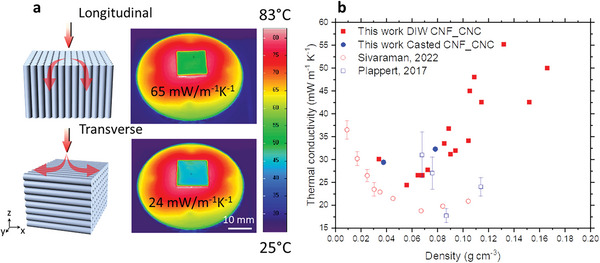
Additive manufacturing (AM) is widely recognized as a versatile tool for achieving complex geometries and customized functionalities in designed materials. However, the challenge lies in selecting an appropriate AM method that simultaneously realizes desired microstructures and macroscopic geometrical designs in a single sample. This study presents a direct ink writing method for 3D printing intricate, high-fidelity macroscopic cellulose aerogel forms. The resulting aerogels exhibit tunable anisotropic mechanical and thermal characteristics by incorporating fibers of different length scales into the hydrogel inks. The alignment of nanofibers significantly enhances mechanical strength and thermal resistance, leading to higher thermal conductivities in the longitudinal direction (65 mW m K) compared to the transverse direction (24 mW m K). Moreover, the rehydration of printed cellulose aerogels for biomedical applications preserves their high surface area (≈300 m g) while significantly improving mechanical properties in the transverse direction. These printed cellulose aerogels demonstrate excellent cellular viability (>90% for NIH/3T3 fibroblasts) and exhibit robust antibacterial activity through in situ-grown silver nanoparticles.
增材制造(AM)被广泛认为是一种通用工具,可以在设计材料中实现复杂的几何形状和定制功能。然而,挑战在于选择一种合适的 AM 方法,该方法可以在单个样品中同时实现所需的微观结构和宏观几何设计。本研究提出了一种用于 3D 打印复杂、高保真度宏观纤维素气凝胶的直接墨水书写方法。通过将不同长度尺度的纤维纳入水凝胶油墨中,所得到的气凝胶具有可调节的各向异性机械和热特性。纳米纤维的取向显著提高了机械强度和耐热性,导致纵向热导率(65 mW m K)高于横向热导率(24 mW m K)。此外,用于生物医学应用的打印纤维素气凝胶的再水合作用在显著提高横向机械性能的同时保持了其高比表面积(≈300 m g)。这些打印纤维素气凝胶表现出优异的细胞活力(NIH/3T3 成纤维细胞>90%),并通过原位生长的银纳米粒子表现出强大的抗菌活性。