Urology Department, Urology and Nephrology Center, Mansoura University, Mansoura, Egypt.
Urology Department, Horus University, New Damietta, Egypt.
World J Urol. 2024 Mar 13;42(1):151. doi: 10.1007/s00345-024-04874-w.
We aimed to define factors affecting the non-invasive overall treatment success (medical expulsive therapy (MET) ± shock wave lithotripsy (SWL)) for uncomplicated ureteral steinstrasse (SS) clearance.
We retrospectively evaluated consecutive patients who underwent SWL for renal stones between 2017 and 2021. Patients with uncomplicated SS were included. All patient's demographic and radiological data, e.g., age, gender, pre-SWL stenting, SS site, type, leading stone size in widest diameter (< 10 mm and ≥ 10 mm), ureteral wall thickness (UWT) in mm against the leading stone were collected. If SS was diagnosed, medical treatment was given for 4 weeks. In case of MET failure, either SWL for the leading stones + MET or direct URS was done. Non-invasive treatment success (SFR) was considered if complete clearance of SS occurred with no complications or the need for invasive intervention.
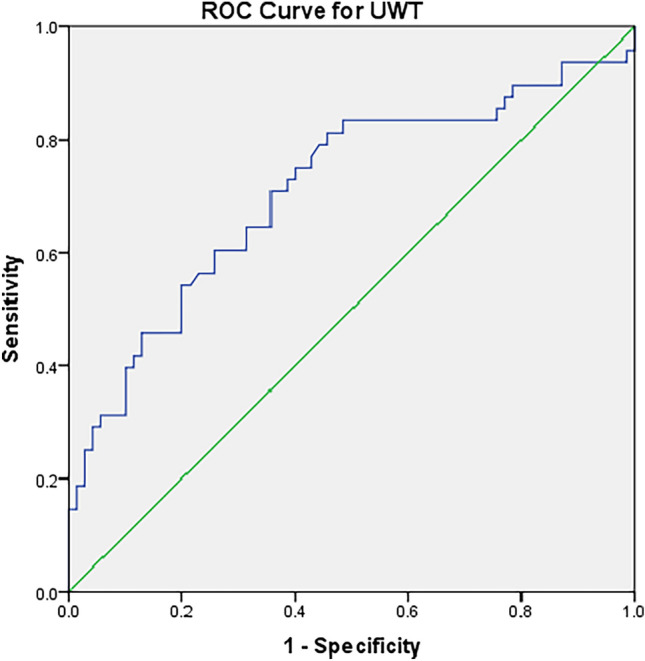
A total of 145 patients were included with mean age of 45.9 ± 12.4 years. SFR in case of MET only occurred in 27.9%. Complications happened in 26 patients (17.9%). Non-invasive treatment SFR was achieved in 78 patients (53.8%) totally where SS type I, leading stone size ≤ 10 mm type and decreased UWT around the leading stone increased treatment success.
Ureteral wall thickness is an important factor predicting SS management success. Besides the decreased UWT, non-invasive management should be offered for type I SS with leading stone ≤ 10 mm.
我们旨在确定影响无创整体治疗成功(药物排石治疗(MET)±冲击波碎石术(SWL))的因素,以清除单纯输尿管石街(SS)。
我们回顾性评估了 2017 年至 2021 年间接受 SWL 治疗肾结石的连续患者。纳入单纯 SS 患者。收集所有患者的人口统计学和影像学数据,如年龄、性别、SWL 术前支架置入、SS 部位、类型、主导结石最大直径(<10mm 和≥10mm)、输尿管壁厚度(mm)与主导结石相对应。如果诊断为 SS,则给予 4 周的药物治疗。如果 MET 失败,要么对主导结石进行 SWL+MET,要么直接进行输尿管镜检查。如果 SS 完全清除且无并发症或需要侵入性干预,则认为无创治疗成功(SFR)。
共纳入 145 例患者,平均年龄为 45.9±12.4 岁。仅 MET 的 SFR 为 27.9%。26 例患者出现并发症(17.9%)。总共有 78 例患者(53.8%)实现了无创治疗 SFR,其中 SS 类型 I、主导结石大小≤10mm 类型和降低的主导结石周围输尿管壁厚度增加了治疗成功率。
输尿管壁厚度是预测 SS 管理成功的重要因素。除了降低的 UWT 外,对于主导结石≤10mm 的 I 型 SS 应提供无创治疗。