Faculty of Biomedical Engineering, Technion Institute of Technology, Technion-IIT, Haifa, 32000, Israel.
Pázmány Péter Catholic University Faculty of Information Technology and Bionics, Budapest, Práter u. 50/A, 1083, Hungary.
Physiol Meas. 2024 Apr 8;45(4):045001. doi: 10.1088/1361-6579/ad33a2.
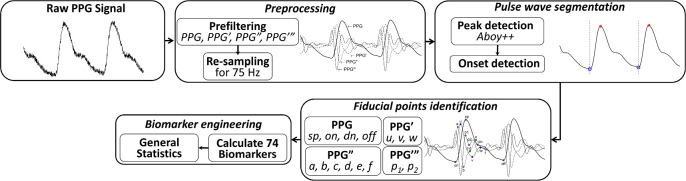
Photoplethysmography is a non-invasive optical technique that measures changes in blood volume within tissues. It is commonly and being increasingly used for a variety of research and clinical applications to assess vascular dynamics and physiological parameters. Yet, contrary to heart rate variability measures, a field which has seen the development of stable standards and advanced toolboxes and software, no such standards and limited open tools exist for continuous photoplethysmogram (PPG) analysis. Consequently, the primary objective of this research was to identify, standardize, implement and validate key digital PPG biomarkers.This work describes the creation of a standard Python toolbox, denoted, for long-term continuous PPG time-series analysis and demonstrates the detection and computation of a high number of fiducial points and digital biomarkers using a standard fingerbased transmission pulse oximeter.The improved PPG peak detector had an F1-score of 88.19% for the state-of-the-art benchmark when evaluated on 2054 adult polysomnography recordings totaling over 91 million reference beats. The algorithm outperformed the open-source original Matlab implementation by ∼5% when benchmarked on a subset of 100 randomly selected MESA recordings. More than 3000 fiducial points were manually annotated by two annotators in order to validate the fiducial points detector. The detector consistently demonstrated high performance, with a mean absolute error of less than 10 ms for all fiducial points.Based on these fiducial points,engineered a set of 74 PPG biomarkers. Studying PPG time-series variability usingcan enhance our understanding of the manifestations and etiology of diseases. This toolbox can also be used for biomarker engineering in training data-driven models.is available onhttps://physiozoo.com/.
光体积描记法是一种非侵入性的光学技术,用于测量组织内血液体积的变化。它通常用于各种研究和临床应用,以评估血管动力学和生理参数。然而,与心率变异性测量不同,后者已经开发出了稳定的标准和先进的工具箱和软件,连续光体积描记图(PPG)分析目前还没有这样的标准和有限的开放工具。因此,本研究的主要目标是确定、标准化、实现和验证关键的数字 PPG 生物标志物。本工作描述了一个标准的 Python 工具箱的创建,称为,用于长期连续的 PPG 时序列分析,并展示了使用标准的基于手指的传输脉搏血氧仪检测和计算大量的基准点和数字生物标志物。改进后的 PPG 峰值检测器在评估 2054 个成人多导睡眠记录时,对超过 9100 万参考节拍的最先进基准的 F1 得分为 88.19%。当在 100 个随机选择的 MESA 记录的子集上进行基准测试时,该算法的性能优于开源的原始 Matlab 实现,超过了 5%。超过 3000 个基准点由两名注释员手动注释,以验证基准点检测器。该检测器始终表现出较高的性能,所有基准点的平均绝对误差小于 10ms。基于这些基准点,我们设计了一套 74 个 PPG 生物标志物。使用研究 PPG 时序列的变异性可以增强我们对疾病表现和病因的理解。这个工具箱也可以用于训练数据驱动模型的生物标志物工程。该工具箱可在https://physiozoo.com/上获得。